Trees don’t move across the land. They move through time. They do not migrate across continents. Continents drift around them. They outlive empires and generations, quietly gathering the passing ages beneath their branches.
There is something remarkable about Australia’s flora: it is itself a meeting place of distant worlds. While many species are native to this ancient continent, others have journeyed here from across the globe and found a new home. Rooted to the same patch of earth, they have stood together through Sydney’s many reinventions—from a harbour outpost to a colonial town, from a commercial capital to a global city—as though two centuries had unfolded in a single time-lapse. Few places embody this long botanical conversation more eloquently than the Royal Botanic Garden Sydney.
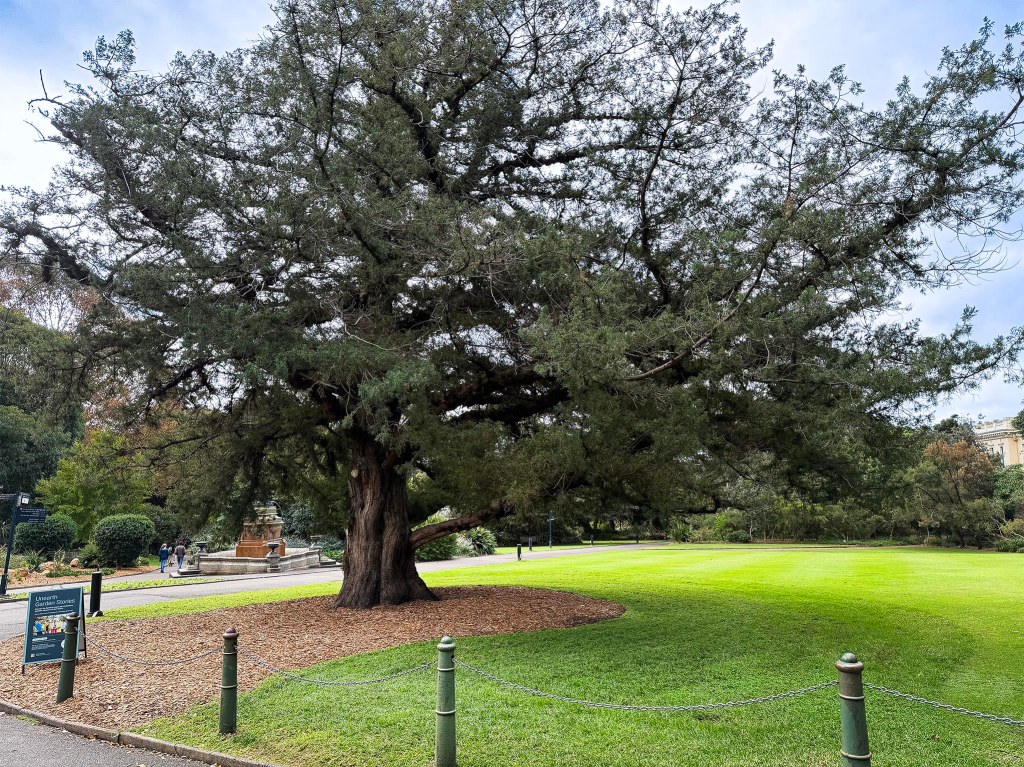
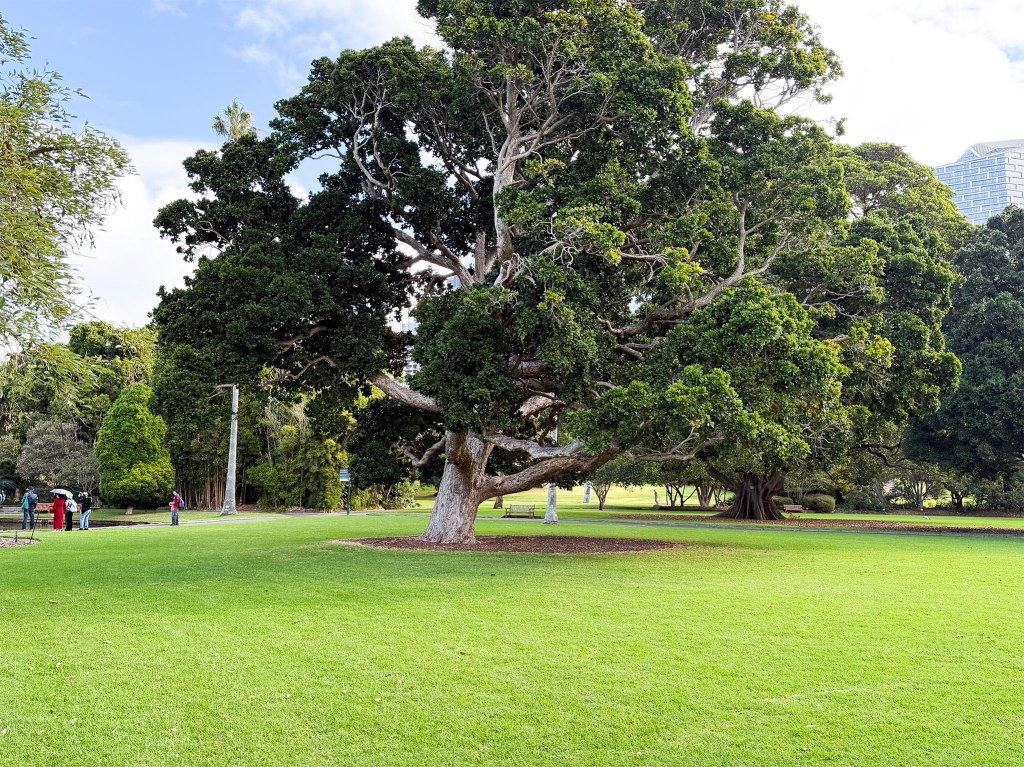
As we entered the Garden through the Woolloomooloo Gate, the first to greet us was a solitary old Montezuma Cypress (Taxodium mucronatum), a native of Mexico, standing behind a low chain barrier. Its gnarled branches stretched low across the lawn. Its broad canopy seemed to shelter centuries beneath its shade. The twisted trunk bore the patient craftsmanship of time, and the fresh grass at its feet spoke of perpetual renewal. Here, time was written not in books but in rings of wood.
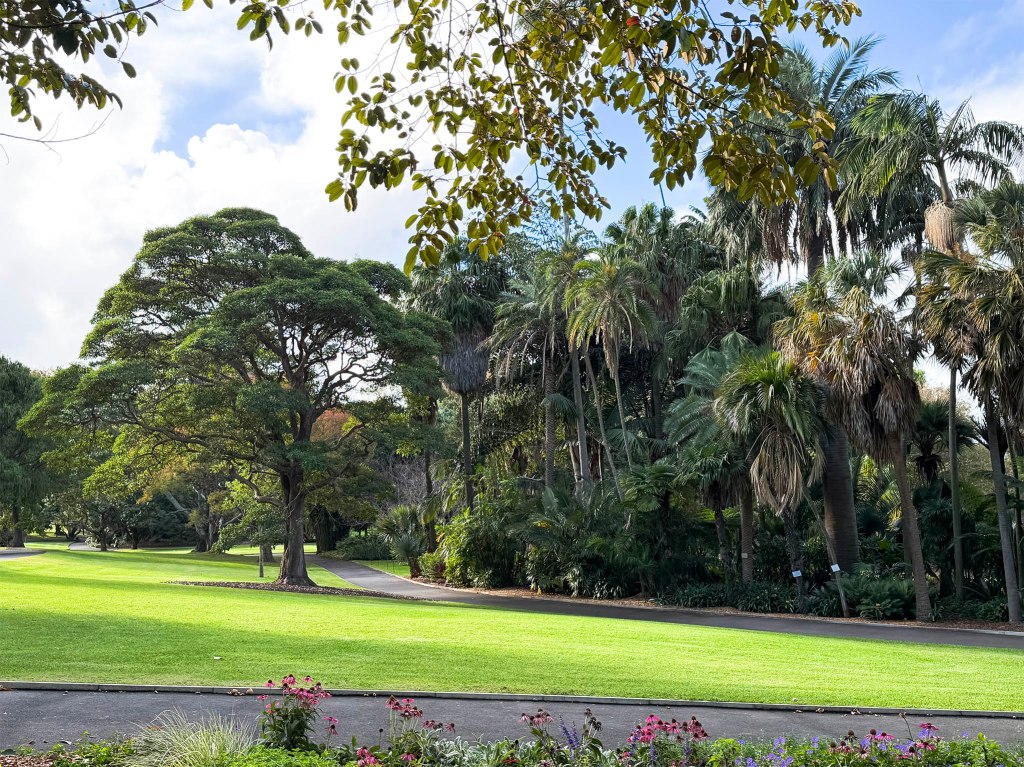
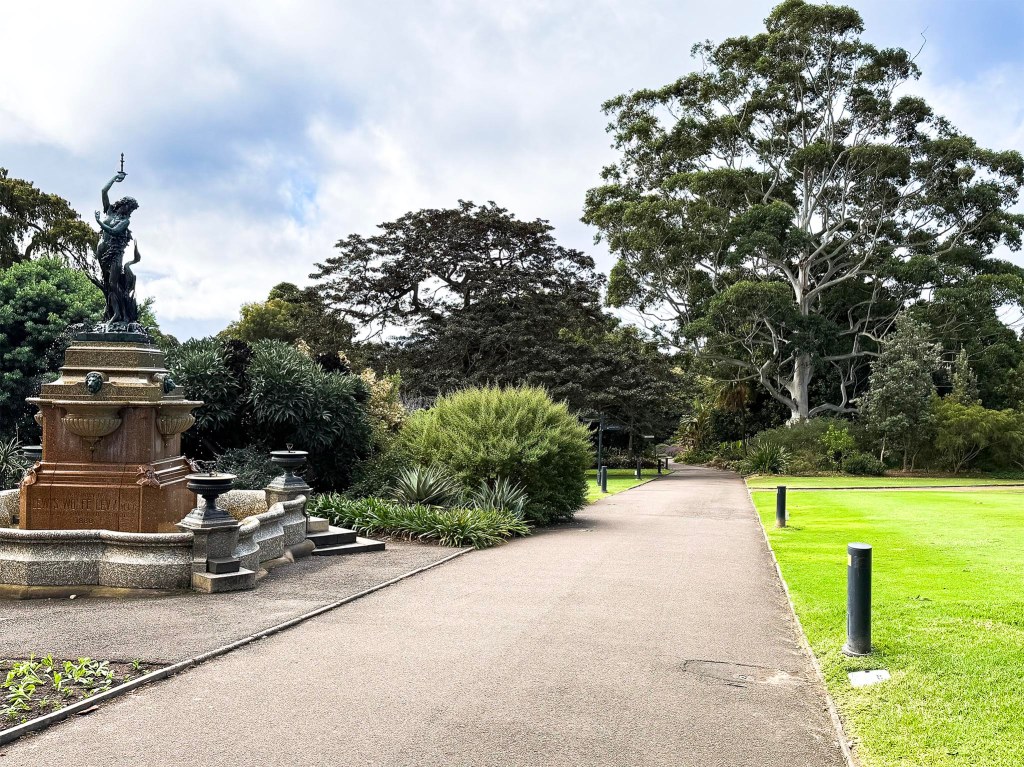
Beyond the Lewis Wolfe Levy Fountain, once an ornate public drinking fountain, the Garden seemed to exhale. Sweeping lawns unfurled in broad emerald waves, clipped with such precision that they appeared almost woven. Paths meandered towards destinations marked by discreet signposts. Immense trees of every habit and silhouette stood across the landscape like old masterpieces in an open-air gallery. Beneath the sprawling Moreton Bay figs (Ficus macrophylla), people lounged on the grass while children drifted across the lawns. Beyond their leafy canopy, Sydney’s sequined towers watched from a respectful distance.
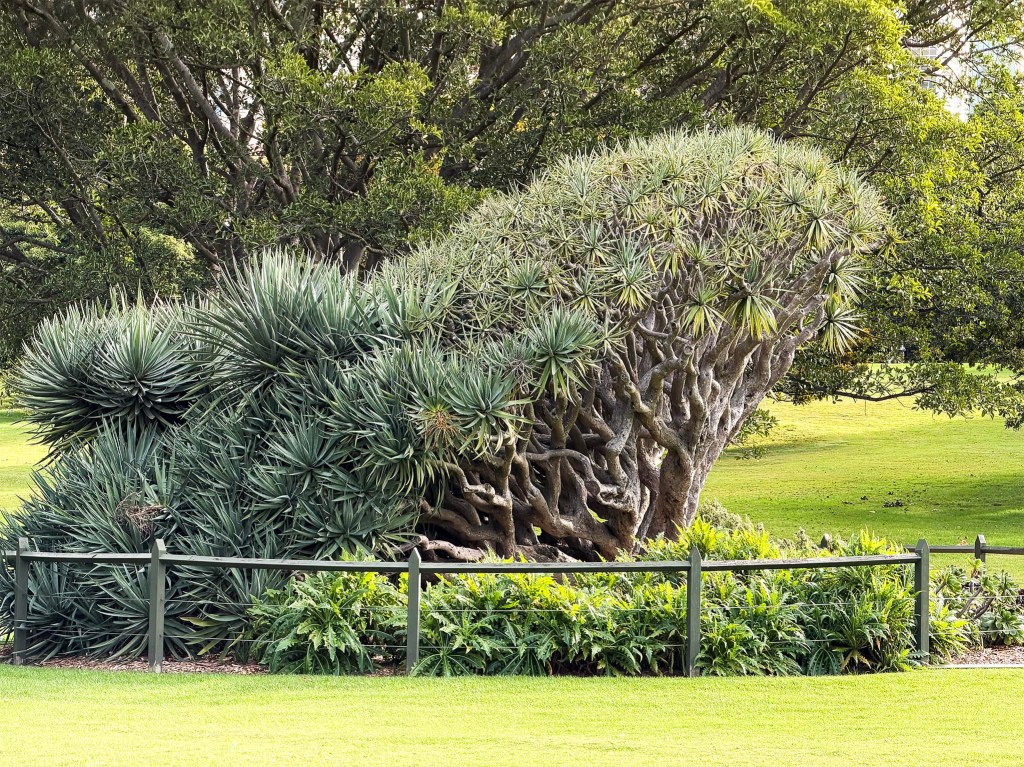
The Garden reveals itself through a succession of living collections. The Succulent Garden displays resilient species from Australia’s Outback alongside plants from the world’s other dry landscapes. Among these, one Dragon Tree (Dracaena draco) seemed determined to ignore ordinary botanical conventions. Its intertwined trunks rose like an intricate piece of living sculpture before spreading into a dense crown. It looked ancient enough to have wandered out of myth. Nearby, the Palm House and Palm Grove Centre sheltered one of Australia’s finest palm collections, many specimens dating back to the nineteenth century.
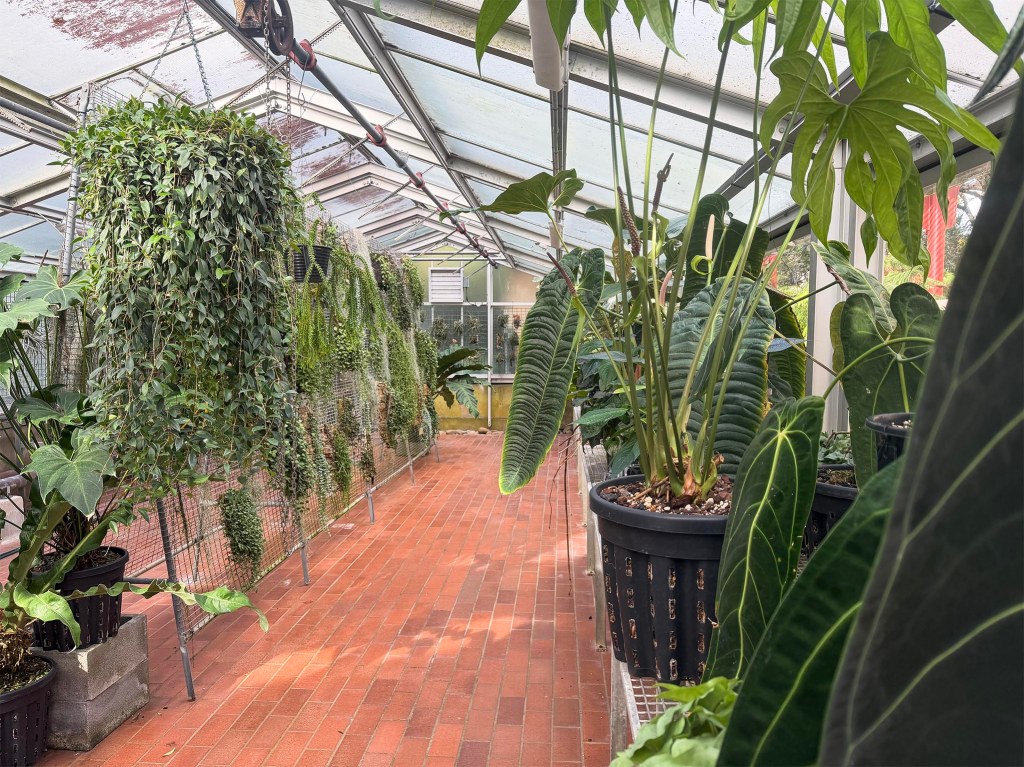
During our visit, the Garden’s exhibition pavilion, The Calyx, was hosting Alchemy of a Rainforest, an immersive exhibition exploring the hidden chemistry and subtle relationships of tropical forests under its soaring Living Green Wall and shimmering recycled canopy installation. A short distance away lay the Cadi Jam Ora Garden, where native plants tell the story of the Gadigal people, whose relationship with this land stretches back over 65,000 years, and whose encounter with the First Fleet began on this very ground.
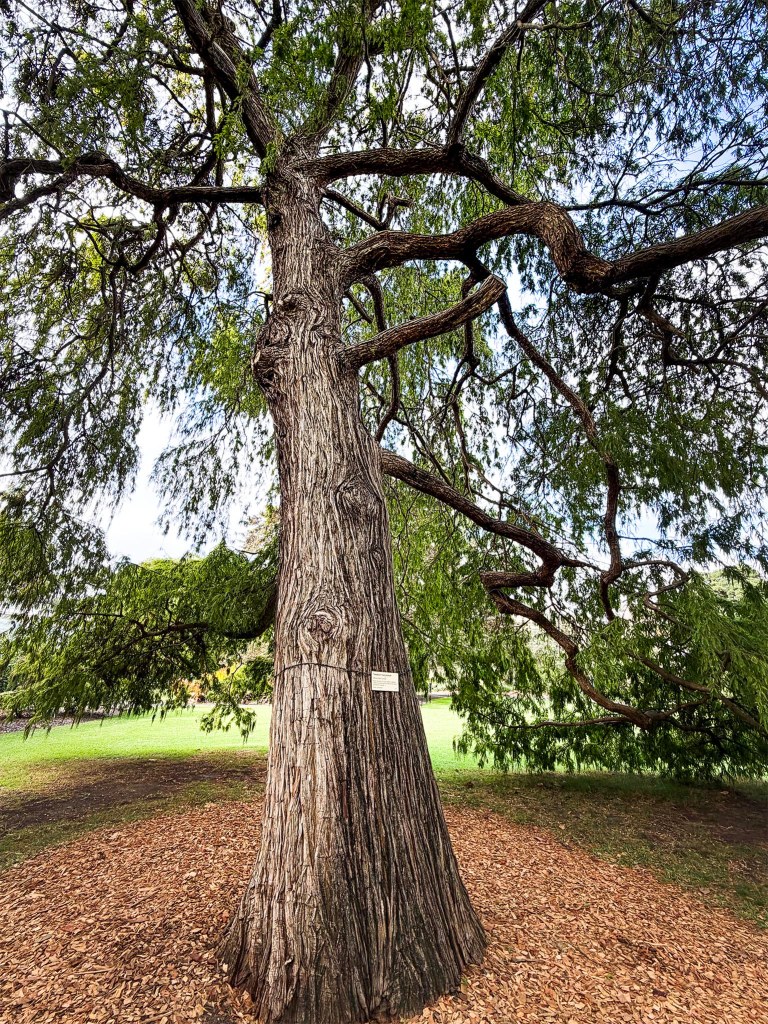
From there we wandered towards the Main Pond, pausing beneath the sprawling Moreton Bay figs, sweeping greens and tranquil water. A gently curving sandstone shore cradled still water where a great weeping willow trailed its branches. Palms stood watchful beyond, while drifting clouds settled upon the surface. Wooden benches along the edge seemed made for contemplation, and we gladly accepted the invitation. Between watching the pond, admiring its reflections, and staging a succession of deliberately moody family photographs, time went by almost unnoticed. Later, T would become mildly upset when she discovered that, in one particularly thoughtful portrait, I had managed to crop away the right legs of the very bench on which she sat contemplating the water.
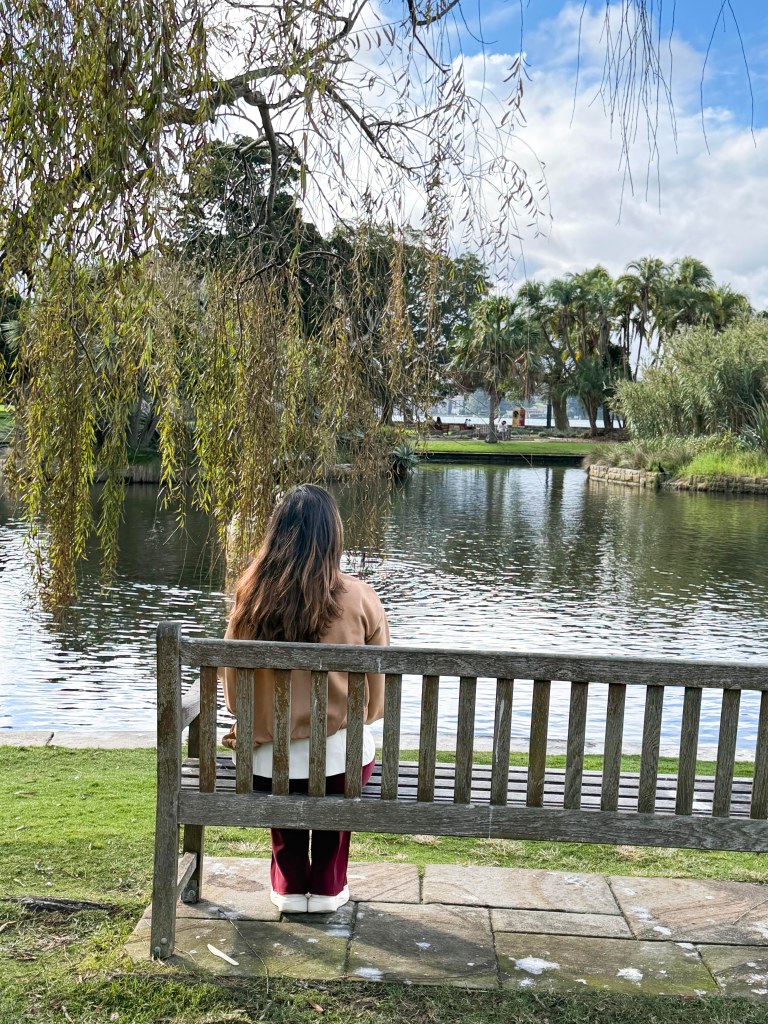
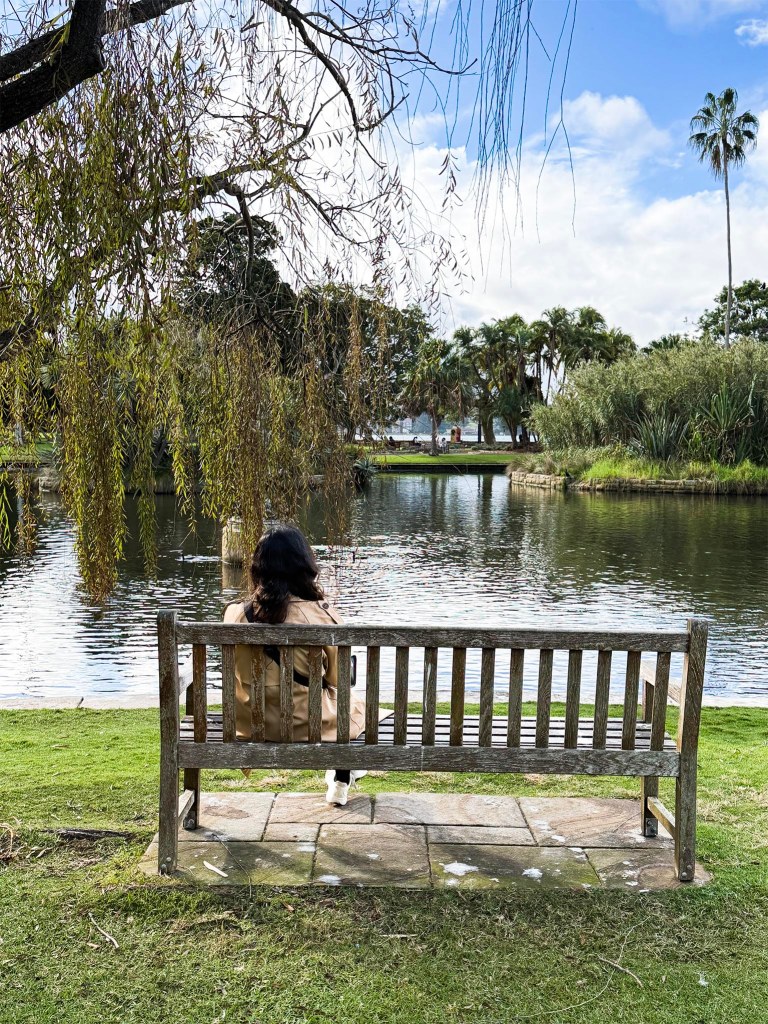
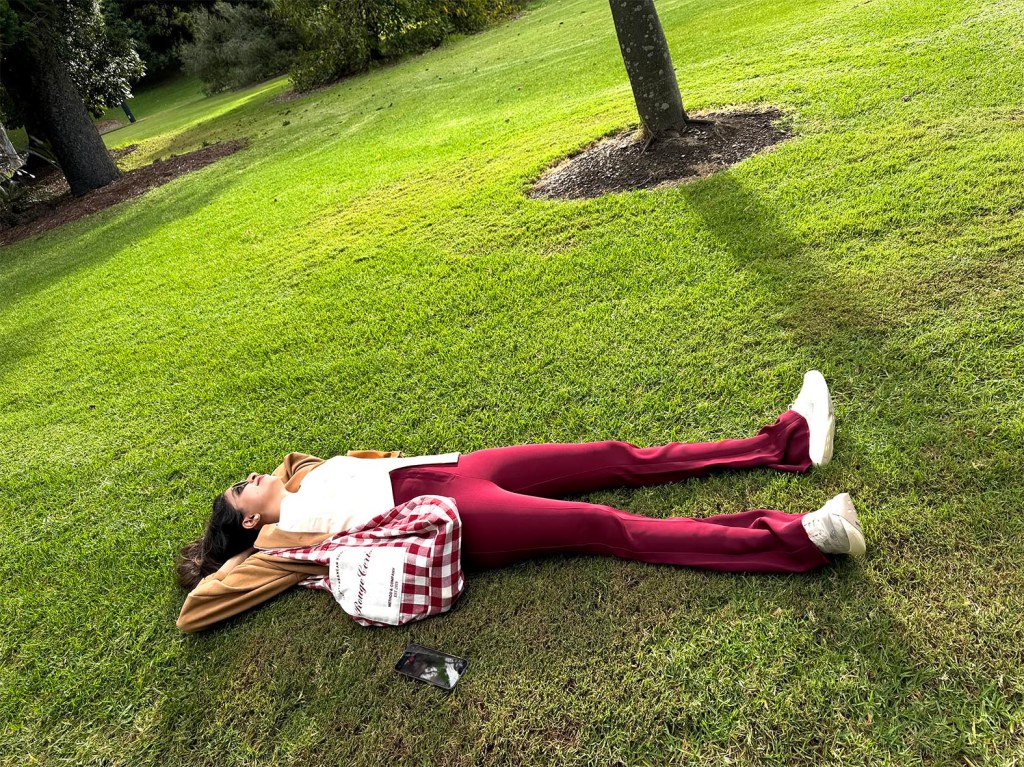
The afternoon, however, had one more disappointment in store for T. She had been looking forward to photographing herself on the famous Mrs Macquarie’s Chair, only to learn from a cheerful group of picnicking Sydneysiders that it was temporarily closed for restoration. The Chair, therefore, had to make do without her. She retired instead to a patch of sunlit lawn, where mock despair produced a photograph almost as memorable as the one she had imagined. Some memories, it seemed, would have to wait for another visit.
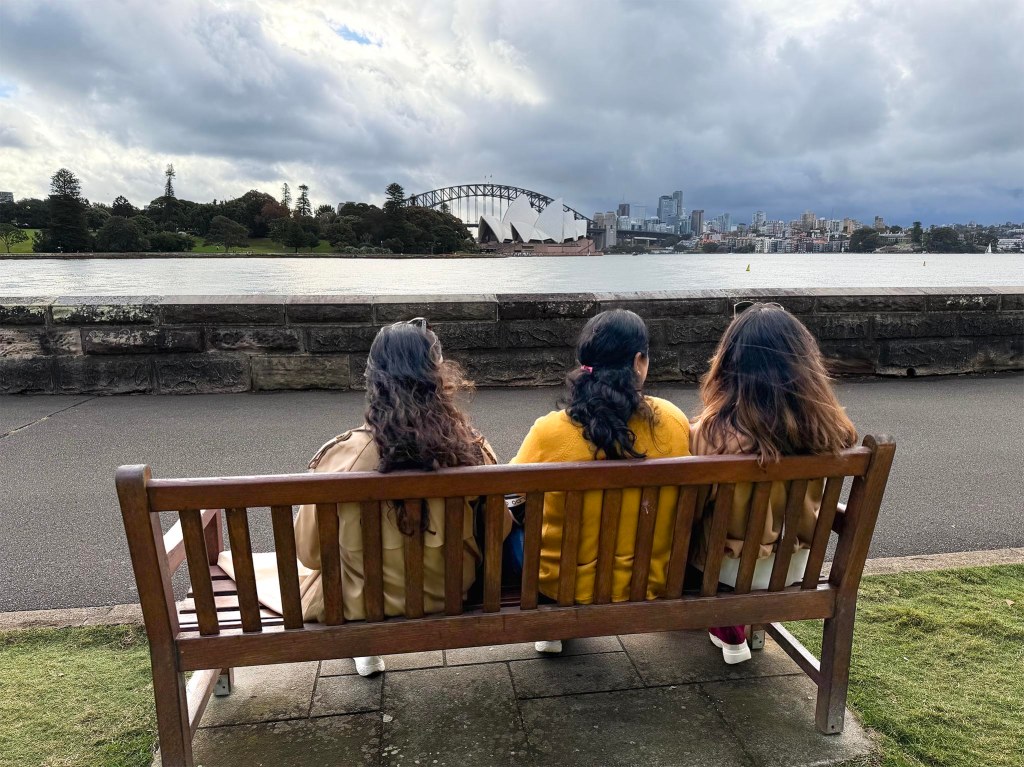
As we continued towards Harbour View Lawn, the weather remained gently agreeable. The sunshine was mellow, the breeze cool without becoming insistent. Throughout our walk, the Harbour Bridge and the Opera House had been teasing us, revealing themselves briefly between the trees before slipping once more behind curtains of foliage. But at Farm Cove they finally stepped fully onto the stage. Standing beside the tranquil crescent of water, the unmistakable curve of the Coathanger and the white sails of the Opera House settled into a single living panorama that no photograph could improve upon. As if in agreement, my Nikon’s battery quietly slipped into a coma.
Farm Cove is where some of Australia’s oldest colonial stories began. It was here, in 1788, that the infant settlement first attempted to establish itself. Along these shores the settlers cleared small plots and struggled to coax crops from an unfamiliar landscape, meeting only limited success. In time, the struggle to grow food yielded to the pursuit of growing knowledge. Those tentative beginnings led to the rise of the Royal Botanic Garden in 1816.
The harbour has altered remarkably little since those uncertain days. Everything around it has. The cityscape has climbed skywards, fortunes have risen and fallen, governments have come and gone. Yet the trees have belonged to every version of Sydney. They have watched the Gadigal people, the First Fleet, governors, botanists, labourers, immigrants and tourists arrive beneath their branches. They neither celebrate nor mourn the passing of ages. They continue to grow, outlasting each generation that passes beneath them, their stories there for those willing to listen.
The sheer breadth of Sydney meant that we had to measure our explorations with the proverbial coffee spoons. It was time to leave the Garden and head for the heart of the CBD.
Beyond the aura of its historic sandstone buildings and the glitter and bustle of the city centre, each of us arrived with a different agenda. The twins had a list of shops to visit, chief among them Mecca. R simply wanted to wander and window-shop. I had an unannounced appointment with Ted’s World of Imaging. My Nikon mirrorless and its 24–120 mm NIKKOR lens had a matter of their own to settle.
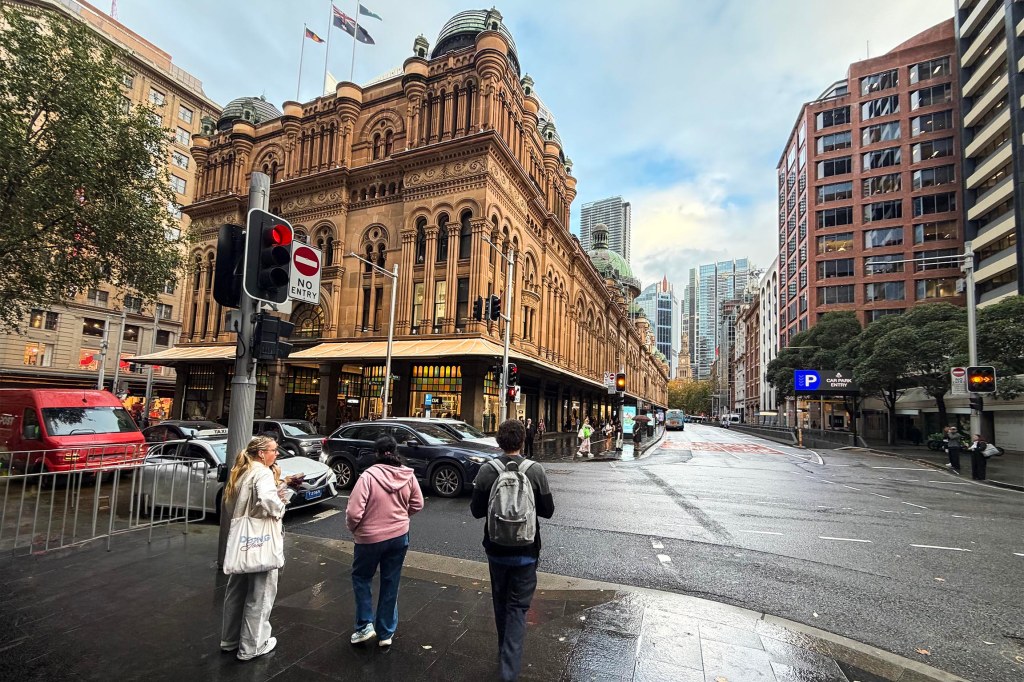
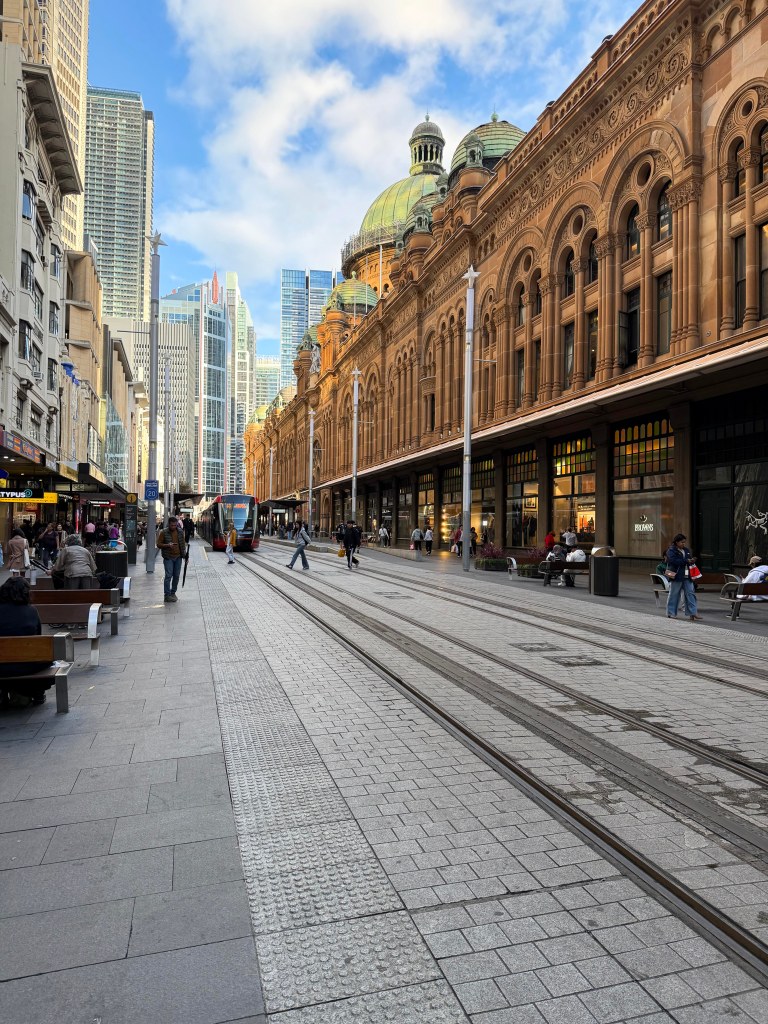
The stately sandstone Queen Victoria Building (QVB) stood before us with all the grandeur I had imagined, and all the stories I had yet to discover. It was difficult to believe that this architectural treasure had once come within a whisker of demolition. During Sydney’s post-war rush towards modernity, there were serious proposals to replace it with a civic square over an underground car park. Fortunately, heritage and better sense prevailed.
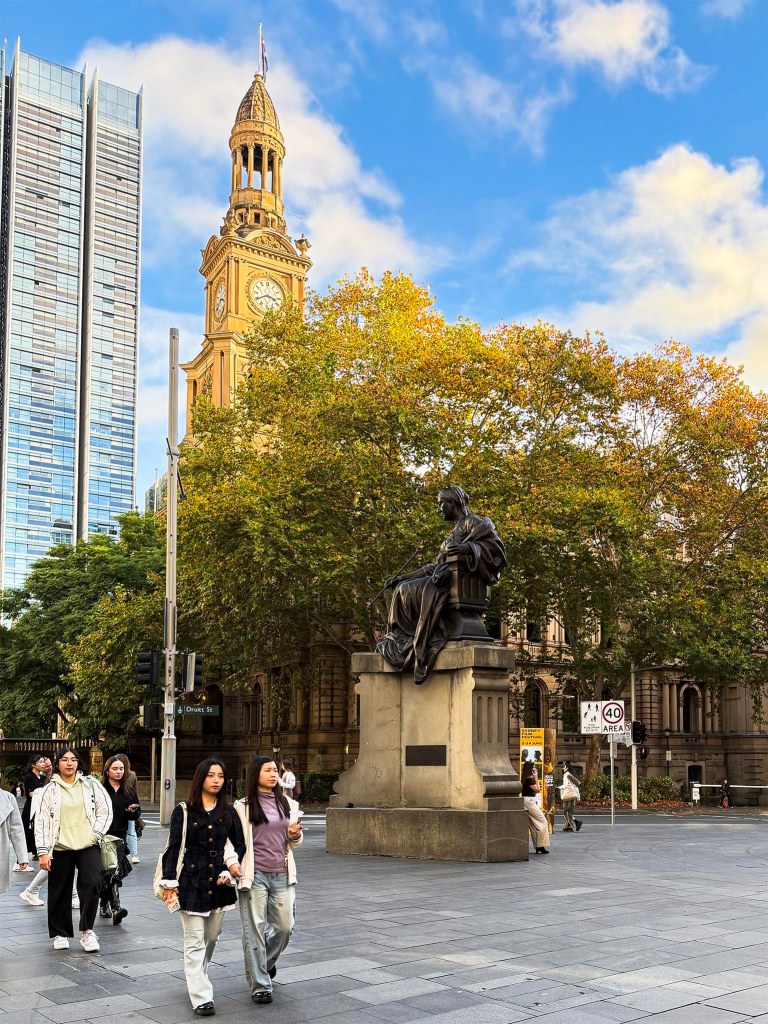
Outside the QVB sat Queen Victoria, serenely surveying the city that had named one of its finest buildings in her honour. Even she was something of an immigrant, having journeyed from Dublin to Sydney during the QVB’s restoration. She seemed a fitting guardian for a building that had itself narrowly escaped oblivion.
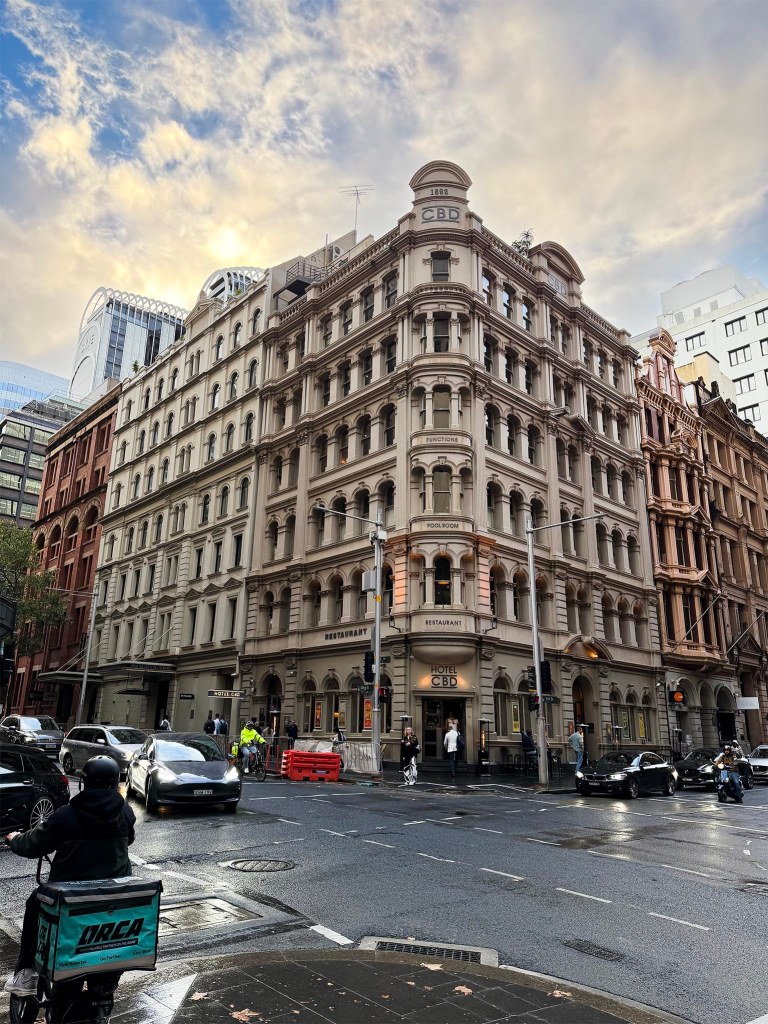
Content simply to wander, we drifted from George Street to York Street, from Market Street to Druitt Street, past grand shopfronts, cafés spilling onto the pavements, and inviting laneways. Somewhere along the walk, the 1892 Hotel CBD quietly asserted its presence beside soaring towers that mirrored the sky.
I was fascinated by Sydney’s deep-red light rail gliding up and down George Street. There was something almost unhurried about its movement, as though it belonged as naturally to the city’s nineteenth-century streets as to its twenty-first-century skyline.
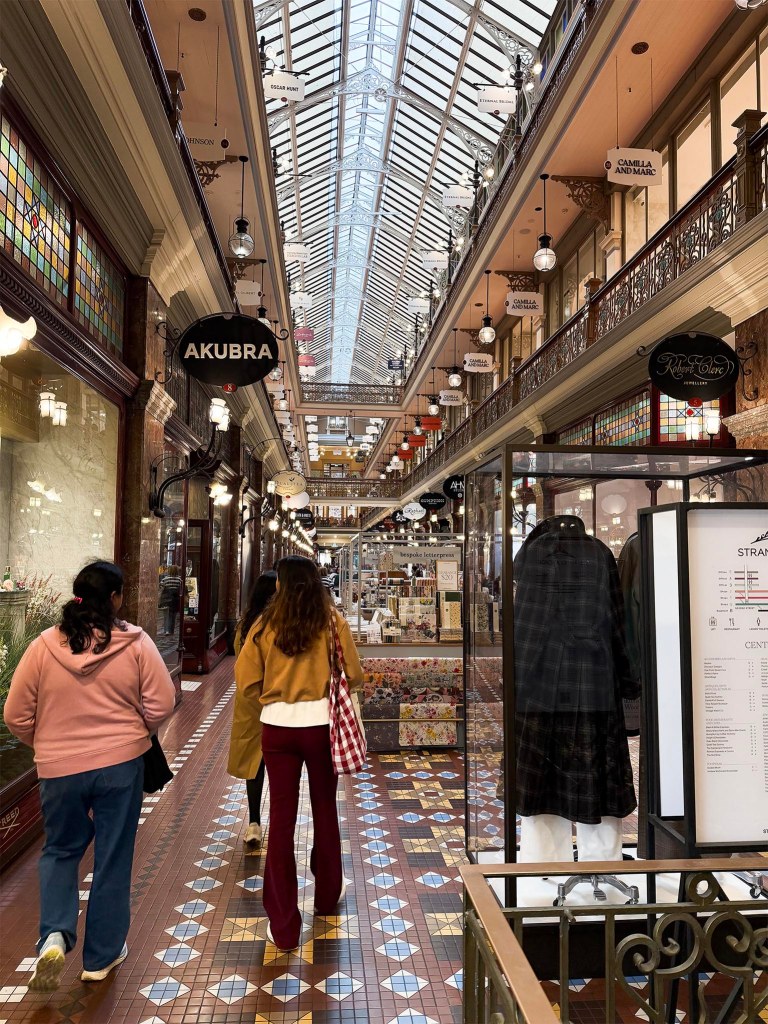
Inside the QVB, stained glass, mosaic floors and elegant arcades transformed shopping into an architectural experience. By then, evening had begun to settle over the city, leaving more than we could comfortably absorb in a single walk. We returned two days later to pick up the thread, though what follows draws upon both visits.
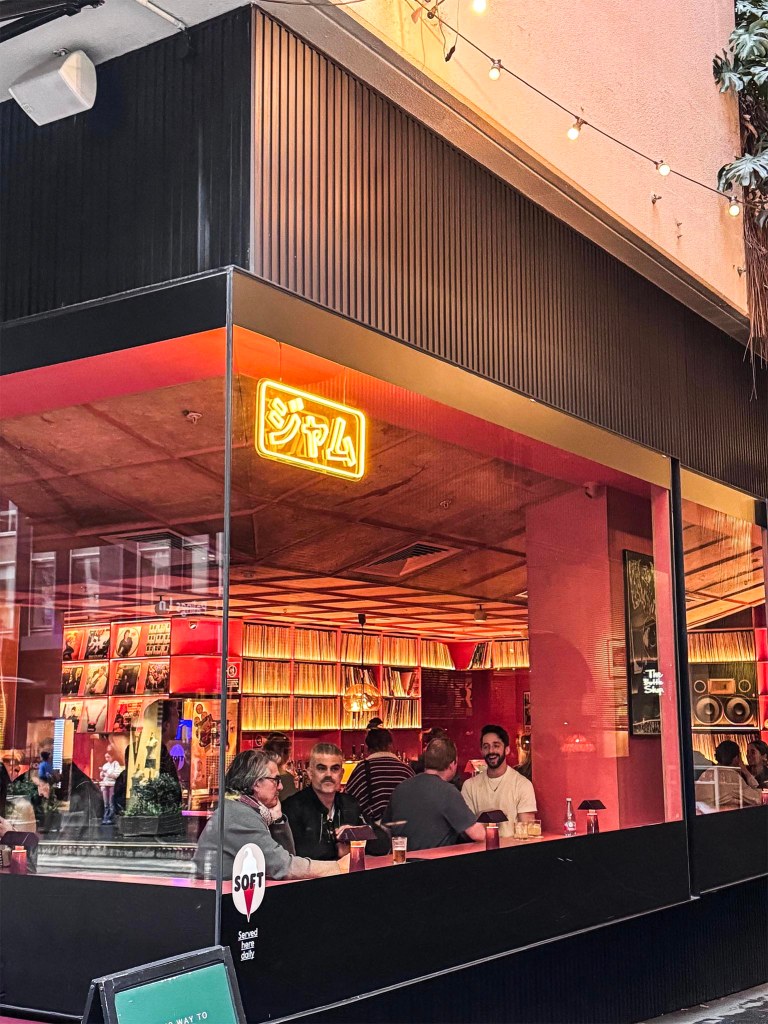
The twins and their mother disappeared into Mecca on George Street almost as though drawn there by instinct. For once, I was considered sufficiently trustworthy to enter a camera store unaccompanied.
Ted’s World of Imaging disappointed me once again. They had only the same aftermarket lens cap I had bought in the Gold Coast and promptly come to dislike. One of the staff, however, kindly pointed me towards Georges Cameras a few streets away.
There, two delightful ladies behind the counter not only produced the original Nikon lens cap and a much-needed battery, but also asked the question that every photographer secretly hopes to hear.
“Any lenses, sir?”
For a fleeting moment, my heart fluttered in its cage, perfectly in step with the credit cards in my wallet. It was a dangerous moment, for my conscience-keeper was somewhere else in the CBD. After a brief internal struggle, and narrowly avoiding a minor act of financial hara-kiri, I escaped with nothing more ambitious than a battery and a lens cap before retracing my steps to reclaim my companions from Mecca.
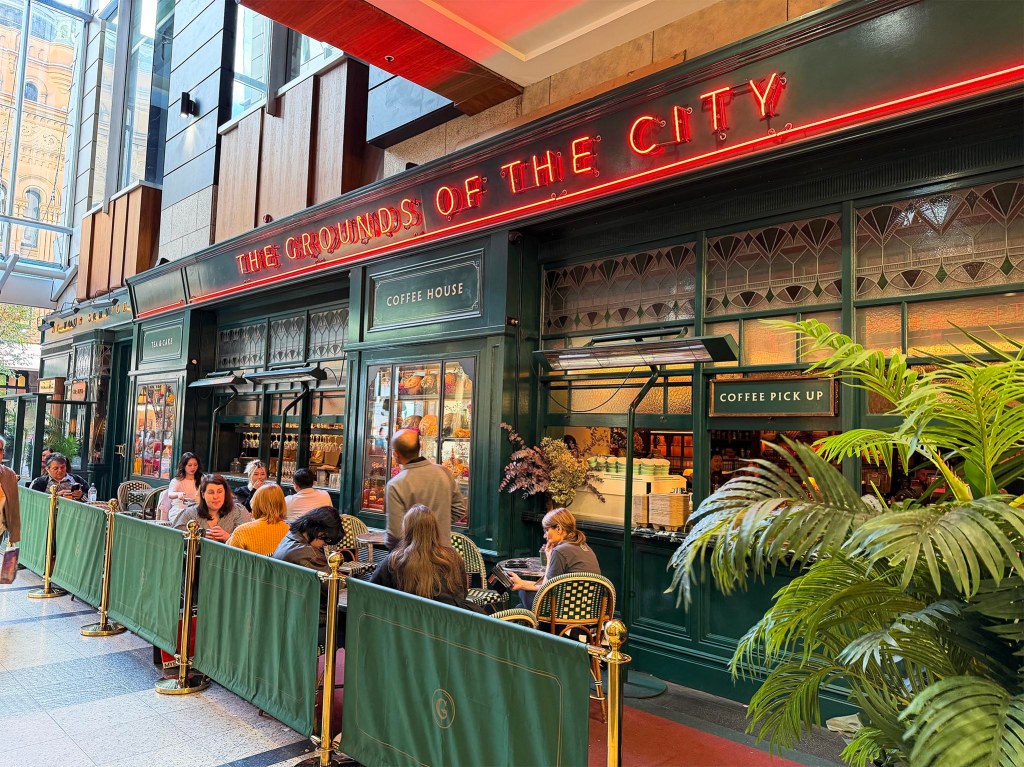
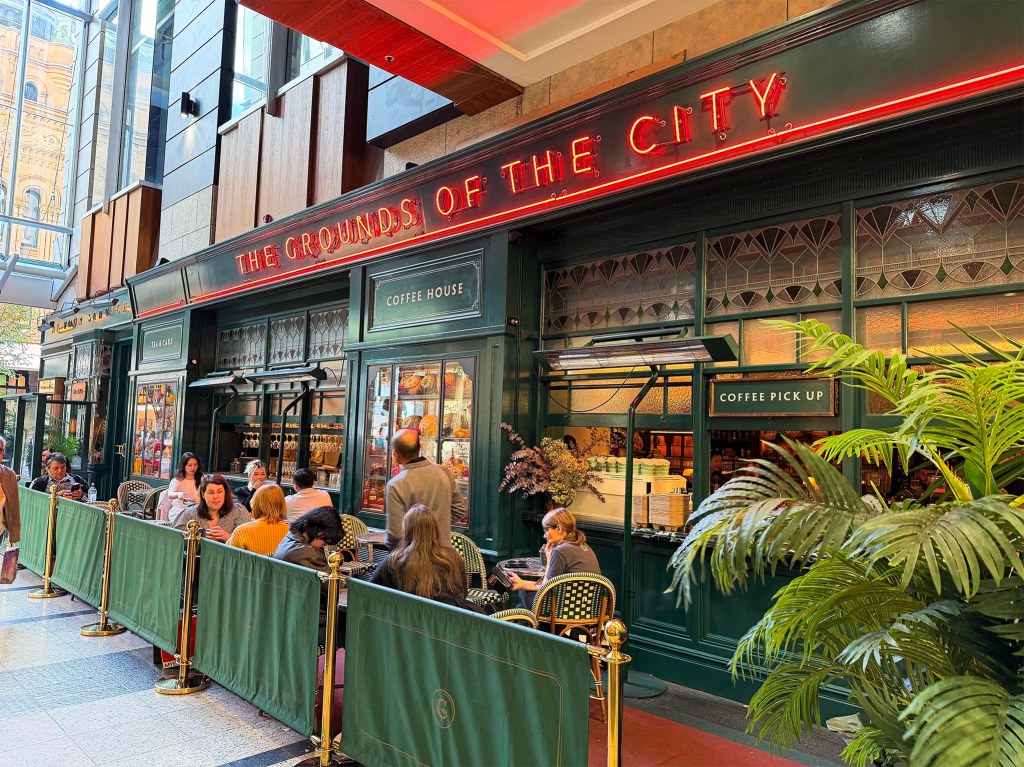
Perhaps that is what lingered with me most about Sydney’s CBD. It did not preserve its history behind velvet ropes or glass cases. Sandstone landmarks, Victorian arcades, mirrored towers, cafés, luxury boutiques and deep-red light rail all shared the same streets with an ease that suggested they had long ago agreed to coexist. The CBD had certainly learnt that a city need not erase its past to welcome its future.
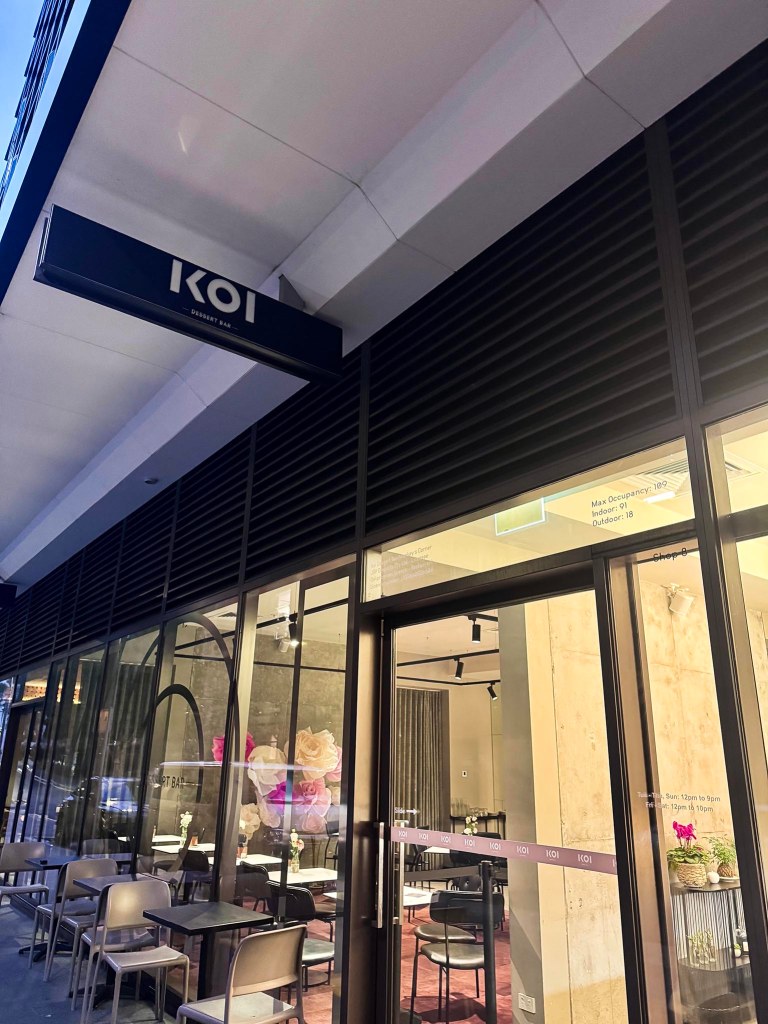
There remained one more destination on their Sydney pilgrimage—KOI Dessert Bar in Chippendale, founded by Reynold Poernomo, the three-time MasterChef Australia finalist whose extraordinary desserts had earned an almost legendary following. As twilight settled over the city, we left the CBD in search of sweetness.
We boarded one of Sydney’s elegant trams and rode south through George Street. Somewhere around Chinatown, we stepped off before it continued on its own business towards the suburbs. From there it was a walk of a little over a kilometre through Haymarket and into Chippendale.
The streets had grown noticeably busier by then, as office workers, shoppers and diners hurried towards their own destinations. About halfway to ours, that steady rhythm was abruptly broken. A dishevelled middle-aged man stood in the street, shouting angrily at no one we could see. Every few words he bent forward, hurling them into the evening air. We caught only fragments—“I’ll pull you all down!” … “I’ll get you all!”—while pedestrians instinctively gave him a wide berth. We did the same, wondering whether someone had already called for help.
Travellers see cities in fragments. Some are beautiful enough to remember for a lifetime; others remain unresolved, asking questions long after the journey has ended.
Contrary to our expectations, KOI Dessert Bar wore an unexpectedly quiet air. We had imagined queues, a lively buzz and perhaps a fleeting glimpse of Reynold Poernomo himself. Instead, the dining room was almost tranquil. The twins lingered at the display counter, chatting with the attendants, who explained that Reynold was away in Indonesia. A cousin made a brief appearance, but reflected glory, however agreeable, seldom rivals the original.
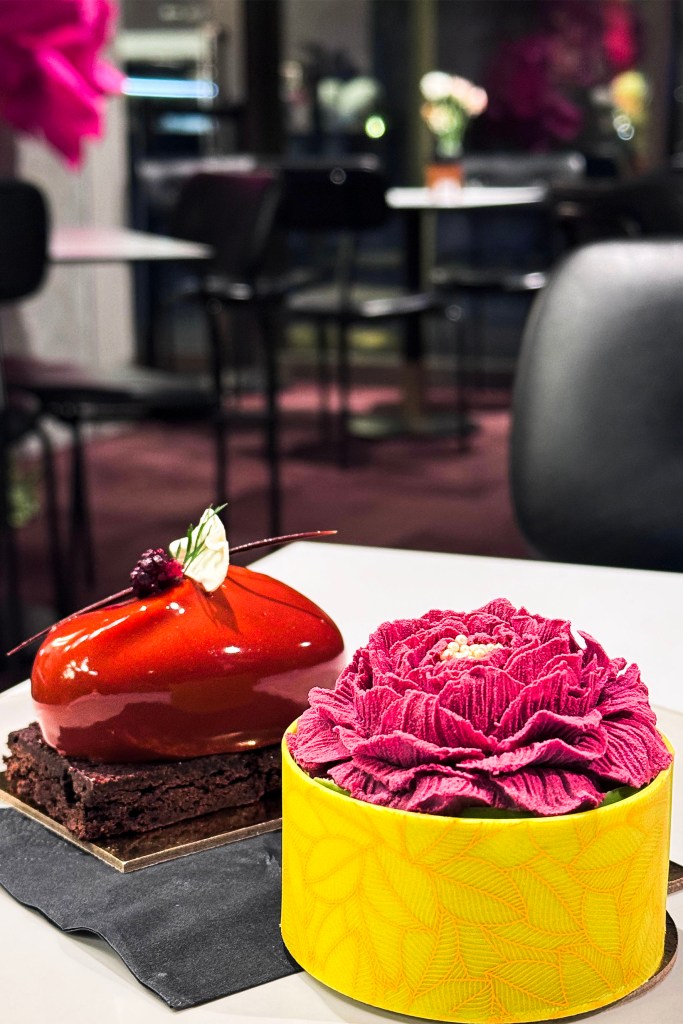
If the maître pâtissier was absent, his creations more than made up for it. Their names drew upon cuisines from around the world, combining flavours in ways far too intricate for me to remember, while each dessert looked like a miniature work of art. It seemed almost a pity to disturb them with a fork. Yet once we did, every layered flavour justified the artistry that had first drawn the eye.
We returned to Hurstville as night settled over Sydney. Tomorrow belonged to the Blue Mountains.


More delightfully eloquent descriptive prose, following a wonderful opening ode to trees. Congratulations on your restraint in the camera shop.
Thank you, Derrick, for your thoughtful reading and kind words of encouragement. Camera shops are always a test of my resolve—and the larger ones, like Georges Cameras, even more so!
A wonderful avenue of trees! An escapade into Sydney’s CBD! The conquering of a great temptation in a camera shop! All gloriously described and, like the dessert, wanting for more.
The Garden is a breathtaking sanctuary amid the bustle of the city. The temptations of the camera store and the patisserie were very real. Thank you for travelling along.
I’m really enjoying reading about your adventures. Such a beautiful city with so much history. Your camera shop story made me laugh!
Sydney has a way of revealing itself layer by layer. The beauty is immediate, but its history lingers after the journey ends. Thanks for stopping by.
Resisting the Temptation, but Succumbing to Nature!!
This episode, as ever, is studded with literary gems. Quoting them all would be the easiest task, for one could simply copy and paste the entire essay! Yet, if I were compelled to choose just three, these would unquestionably top my list.
1. “Trees don’t move across the land. They move through time. They do not migrate across continents. Continents drift around them. They outlive empires and generations, quietly gathering the passing ages beneath their branches.”
What a magnificent opening! It reads less like a description and more like an Ode to Trees. After reading those lines, one can never again look at an old tree merely as part of the landscape. It becomes a silent witness to history itself.
2. “The twisted trunk bore the patient craftsmanship of time, and the fresh grass at its feet spoke of perpetual renewal. Here, time was written not in books but in rings of wood.”
A lesson in botany? Perhaps. But far more than that—it is a lesson in philosophy. The tree becomes a living chronicle, quietly recording history in its rings while reminding us that renewal and ageing are companions rather than opposites.
3. “The cityscape has climbed skywards, fortunes have risen and fallen, governments have come and gone. Yet the trees have belonged to every version of Sydney…”
If the first quotation is an ode and the second a philosophy lesson, this third passage is nothing less than a chronicle of Sydney’s history. It is remarkable how a few trees become the narrative thread connecting the Gadigal people, the First Fleet, colonial Sydney, and the modern metropolis. History, in Mr Pandey’s hands, ceases to be a sequence of dates and becomes something that quietly grows beneath the shade of ancient branches.
The transition from the excursion through the bowers of the Royal Botanic Garden to the towers of Sydney’s CBD is seamless. Few writers could move so effortlessly from contemplative nature writing to the bustle of a modern city without the narrative ever feeling disjointed.
This chapter also carries Mr Pandey’s characteristic understated humour. His internal struggle at Georges Cameras, resisting the irresistible temptation to add a couple of Nikon lenses to his collection while his “conscience-keeper” was safely occupied elsewhere, is priceless! One can only imagine Mrs Pandey’s reaction had he succumbed to the temptation. His description of the episode as narrowly avoiding a “minor act of financial hara-kiri” is vintage Mr Pandey.
What I admire most about this chapter is its quiet message. Trees, gardens, heritage buildings, trams, camera shops, dessert bars—everything ultimately points to the same truth: a city flourishes not by abandoning its past, but by allowing history and modernity to walk side by side.
Looking forward eagerly to the Blue Mountains. Knowing Mr Pandey, I suspect the mountains will not merely be climbed—they will be contemplated.
Thank you for yet another wonderfully generous reading. I sometimes feel you discover meanings in these essays that I had only sensed instinctively while writing them.
I am especially pleased that the passages on the trees spoke to you. Standing beneath those ancient canopies, one cannot help feeling that they have outlived every incarnation of Sydney, quietly watching history unfold ring by ring.
Your remark about the transition from the Botanic Garden to the CBD is particularly heartening. In travel writing, such shifts can easily jar. Knowing that the journey felt seamless is a compliment I shall treasure.
And yes—the Nikon episode! The temptation was genuine, though fortunately wisdom prevailed over impulse, sparing me a small act of financial hara-kiri and, perhaps, an even sterner domestic reckoning!
What delighted me most, however, was your observation that the chapter ultimately became a conversation between history and modernity, nature and city. That quiet thread was always there; I am grateful that you found it.
Thank you once again for reading with such care and generosity. Your comments have become an eagerly awaited companion to these chapters.
The way you have blended history seamlessly with the narrative is fascinating. Enjoyed reading the article as much as looking at the pictures from the perspective of your camera angle.
There comes a point when the remembered place begins to add layers of meaning to the visible one. I am delighted that you liked the pictures as well as the piece.