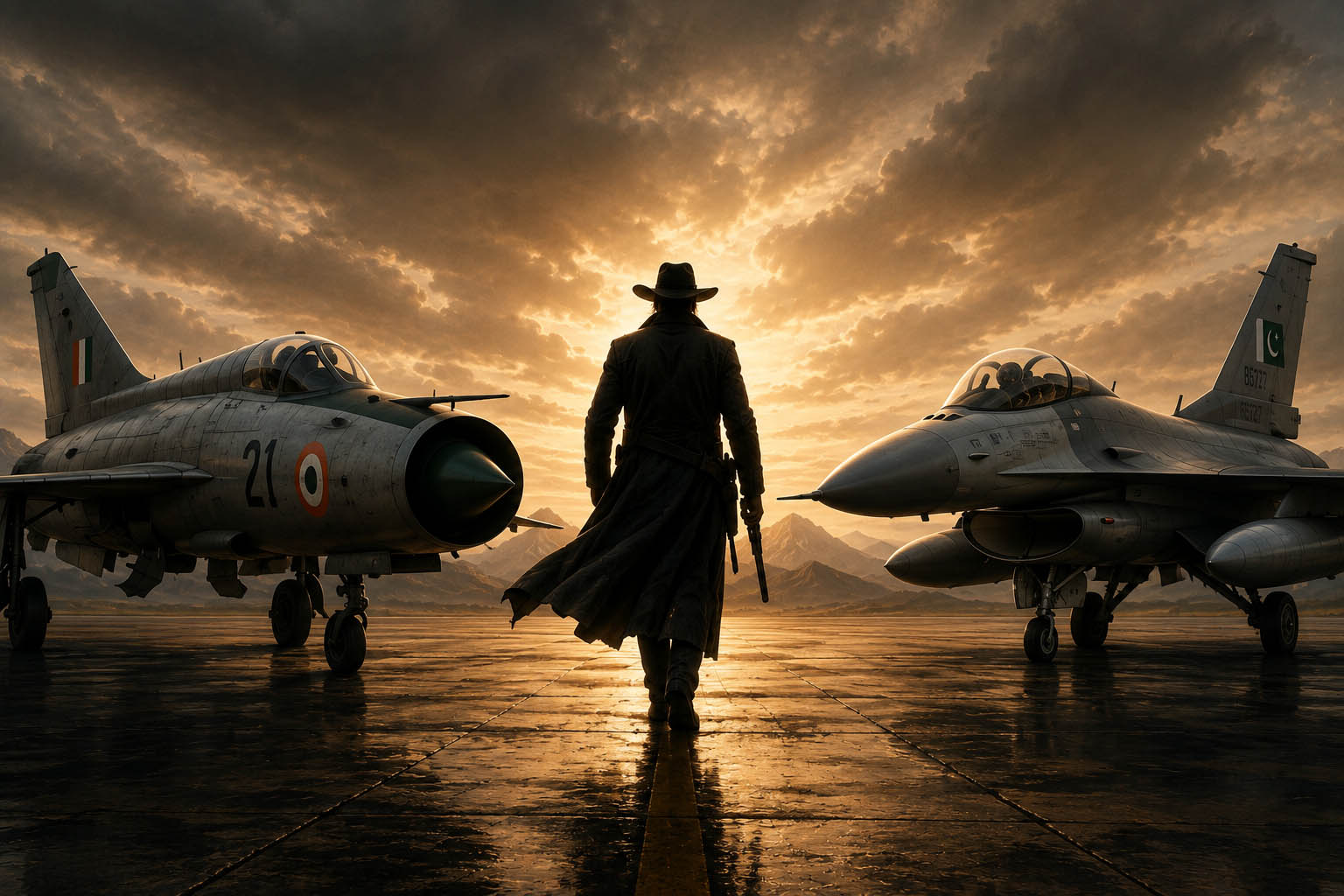
“The man in black fled across the desert, and the gunslinger followed.” ~Stephen King
In the darkness intervening the 25th and 26th of February 2019, the Indian Air Force executed what is now known as the Balakot Strike, variously celebrated or dismissed thereafter as a devastating strike on terrorists, a damp squib, an exercise in tree-slaughter, and assorted shades in between. The versions were promptly crafted to suit the respective interests of the stakeholders and spectators in the wider theatre of brinkmanship that is world politics. Facts had barely landed before competing versions of them were airborne.
Constituents of the potpourri were no less formidable: two nuclear-armed enemy states; one exceedingly ambitious power aspiring to tie much of the planet together with one belt and one road; and the two world powers that matter, or occasionally do not. Then came the screaming studios on both sides of the Line of Control, terrorist outfits entrenched in Pakistan and their fellow jihadists, political parties scenting opportunity, defence establishments guarding reputations, and, bringing up the rear, the industrious regiment of journalists, analysts and instant air marshals who had the engagement reconstructed, adjudicated and filed away before the wreckage had cooled.
But a strike is a strike is a strike, inflicted by an archenemy well beyond the frontier. Impelled to return the favour, Pakistan sent a formation of fighters towards Indian military installations the following day. F-16 Falcons were among them, challenged by Indian Sukhoi-30MKIs, Mirage 2000s and MiG-21 Bisons. The engagement might have ended with the Pakistani formation turning back. The Gunslinger, however, was not yet done. He pressed on, crossing the Line of Control in pursuit of a retreating Pakistani fighter.
What happened next remains the disputed heart of the story. India maintains that the Gunslinger fired an R-73 at a Pakistani F-16 before his own aircraft was hit; Pakistan denies losing any fighter. What is beyond dispute is that the Gunslinger continued the chase into Pakistani-controlled airspace, was shot down and ejected on the other side of the frontier. Whether another pilot was descending beneath another parachute at about the same time is another matter, and a considerably more interesting one.
What followed is less conjectural, because Pakistan obligingly supplied the first pieces of the puzzle itself. Its military spokesman announced that two Indian aircraft had been shot down and, more remarkably, that two Indian pilots had been captured. And this was no mere muddle over numbers: the two men were given distinctly different dispositions. One, Pakistan said, was in military custody; the other had been injured and taken to the Combined Military Hospital. Prime Minister Imran Khan too spoke publicly of two Indian pilots in Pakistani hands. India, meanwhile, acknowledged the loss of one MiG-21 Bison in the aerial engagement and one missing pilot, Wing Commander Abhinandan Varthaman. Before the day was out, Pakistan quietly revised its arithmetic: there was, after all, only one Indian pilot in its custody. The Gunslinger was accounted for. The second pilot had disappeared, not merely from custody, but from the official story.
There was another correction to come. Pakistan initially denied employing F-16s in the engagement. India, however, displayed fragments of an AIM-120 AMRAAM recovered on its side of the Line of Control, pointing strongly to their presence. No independently verifiable wreckage of the alleged F-16 ever emerged, but that proves rather less than might appear: had an aircraft fallen on the Pakistani side, the crash site, debris and access to both would naturally have remained under Pakistani control.
Which brings us back to the inconvenient arithmetic. Pakistan announced two captured Indian pilots; India had lost only one across the Line of Control. Who, then, was the injured second man reportedly taken to hospital? One account offered a remarkable answer: another airman had come down on the Pakistani side, been mistaken for an Indian and badly beaten before his identity became apparent. It fits Pakistan’s first announcements with almost embarrassing neatness, but lacks conclusive independent evidence. So the second pilot is best left without a name, nationality or certified fate. He remains what Pakistan’s own first account made him: the man in the hospital who ought not to have existed.
The Gunslinger returned to India two days later, his release helping cool the immediate crisis but doing little to settle the battle of narratives. Pakistan steadfastly denied losing an F-16; India just as steadfastly maintained that it had shot one down. The prospect was embarrassing enough: an F-16 allegedly brought down by a MiG-21, a fighter whose family tree reached back to Khrushchev and Kennedy. But appearances were deceptive. The Bison was old in lineage, not frozen in time; it had been repeatedly upgraded and was operating that morning as part of a much larger aerial network. The Gunslinger was riding an old buffalo, but somebody had fitted the beast with new eyes, new teeth and friends in the sky.
Newton, not Einstein as I once carelessly promoted him, tells us that every action invites an equal and opposite reaction. This particular action produced rather more than its allotted share. Pakistan had a military reputation to defend; India had a Gunslinger to celebrate; and farther afield stood the reputation of American combat aviation. Lockheed Martin was then courting India with the F-21, an F-16 derivative tailored for the Indian fighter competition. The suggestion that a MiG-21 Bison had just knocked an F-16 out of the sky was hardly the sort of field demonstration its salesmen would have ordered. Suddenly, there were reputations, contracts and national vanities circling the same patch of sky.
Then, on 4 April, came Lara Seligman in Foreign Policy with a headline admirably designed to end the argument: “Did India Shoot Down a Pakistani Jet? U.S. Count Says No.” Citing two unnamed senior US defence officials, the report said that American personnel had counted Pakistan’s F-16s and found them all present and accounted for. It was a formidable counter to the Indian claim, and was promptly treated in many quarters as something close to a Pentagon verdict. There was only one difficulty: the Pentagon had delivered no such verdict. Asked about the reported count, a US defence spokesman said the department was unaware of any investigation of the kind. The State Department did not publicly authenticate it either. Thus the famous American headcount remained exactly what it had originally been: a journalist’s report resting on unnamed officials, neither an announced Pentagon finding nor the last word on the matter.
None of this proves that an F-16 was shot down. Nor does the absence of publicly produced wreckage prove that one was not: had an aircraft fallen on the Pakistani side, the wreckage, crash site and access to both would naturally have remained under Pakistani control. History also counsels against assuming that every Pakistani military loss would have been acknowledged. At Kargil, Pakistan denied the involvement of its regular forces even as men of the Northern Light Infantry were dying across the Line of Control, acknowledging much of that history only years later.
And so, after the radar plots, missile fragments, denials, headcounts and counterclaims have been filed away, the one elephant that refuses to leave the room is not the Gunslinger but the second pilot who refuses to vanish into the footnotes.


Nicely articulated. Hope the political regime of India will entrust it’s faith it it’s traditional allies like Russia rather than sitting in the lap of uncle sam and giving in to the world’s biggest terror funder the Saudis.
The US hypocrisy about the many butchered pieces of Mr Jamal Khashoggi holds a key to their strategic interests. Thanks for approving –it matters a lot.
Written with a clarity that only an Uma could muster. I’m pretty aware of the depth of putrefaction festering in multitudinous political crevices, but having the Indian/Pakistan scenario portrayed so vividly and clearly was a real eye-opener. I once had a tiny bantam rooster that ruled the hen-house despite there being some huge roosters in the flock. He did it with cunning and skill – such as being able to run between the legs of the more powerful cockerels. The image of the Gunslinger is a good one.
I hate writing about politics but India is being pillaged by its rapacious politicians. Lusting for the lustrum throne, they will stop at nothing to install themselves in power. They will openly bribe, bluster, intimidate and indulge in worst crimes to milk the electorate, appease and pander to the radicalism of Muslim voters and sow cunning seeds of division among Hindus. They will even let the country disintegrate into pieces in their quest to bulge their personal fortunes which have been soaring to astronomical heights. As a matter of fact, the business of ruling a nation consisting largely of myopic and gullible plebs is so profitable that some families have remain glued to it for generations. Now whoever conceived and propagated the model called democracy never though of the rot it could lead to. The situation within is a festering cesspool and it’s has been drawing hordes of vultures from without, but then isn’t that the law of the Nature? Thus, With absolutely no light at the end of the tunnel, I felt compelled to wail at the wilderness, not that it’s going to help.
The image of the Gunslinger is real, taken at the point of his release by the enemy. It has taken over the country like a perfect storm —I have posterised it a bit with whatever warmth I have for him.
Being an ex-servicemen I first hand experience of many of the incidents you have narrated here. I hear that during China invasion our soldiers were so ill equipped half of them died or fell sick before reaching the border. Forget about snow boots, soldiers walked barefoot. While the world is moving at faster pace, when it comes to decision making for crucial issues of defence, the matter often drags for decades.
Your blog post, especially the conclusion aptly depicts the crisis faced by the armed forces.
The pathetic state of affairs speaks volumes of our leaders who are mostly leeches and vipers, which brings us to the zillion dollar question whether democracy is the appropriate instrument to run this country? The majority today will vote for bribes, doles and loan-waivers, a candidate from his own subset of castes, a leader endorsed in the Friday prayers, a note of Rupees 500 and a ride to the polling booth. The grossly incompetent leaders that get selected through this charade of democracy have been wreaking unbridled havoc on the country which is fast headed to an untimely demise.
I thought of you when this was going on, and wondered how it would affect you. Your analysis is brilliant, but very painful. Thank you for the clarity. Sometimes I am reminded of how fortunate I am to live where I do.
How very kind of you, Derrick! I was praying for the well-being of our Gunslinger at the moment. As the controversy is being kept alive by interested agents, I couldn’t resist giving voice to the dryness of facts. You and Jackie are indeed blessed to be in your heaven.
🙂
Thanks for sharing this insightful and passionate depiction of what is going on in your country Uma. There often seems nothing we can do but despair at the levels of corruption and self-interest that rule the world.
I guess much before the Great Central Black Hole would consume our planet, our own machinations will annihilate the humanity.
Sometimes it’s hard to hope for peace in the face of so much posturing, violence and self-interest. Thank you for this informative post!
Unprovoked terrorism and aggression are strategic ideologies of certain entities emanating from their existential dilemmas. Peace is an immensely endangered species.
I have read this at least 4 times Uma Shankarji. I have neither the eloquence nor the vocabulary to articulate my response to this wonderful outpouring of your thoughts and emotions. I quote Gulzar ” sirf ehsaas hain ye, rooh se mehsoos karo”…..I am confident you will understand the depth of my feelings, thank you so very much
I am touched by your kind words, Shubha Ji; the compliment will be cherished. These are testing times for country loving, middle class, non-privileged citizens like me.
Uma Shankar ji, chota mooh, badi baat nahi karna chahti, main Bharat se bahar rehti hoon, par dil chota na keejiye, aap ke jaise citizens hee to desh ki shann hain…..one can take a girl out of India, but never the love of India out of the girl. May is going to be a challenging month for both my countries as there are Federal Elections. I don’t mind if my party does not come to power in Ausralia because elections are held every 3 years, but I pray that my party comes to party in India….
Indian politicians have gone feral. You don’t need an astrologer to tell you how the future of the Indian state is afloat on half a wing, a prayer, and a Gunslinger. So, prayer is important here, and I too shall pray for your parties to win the elections in both the nations.
Morrison and Modi 🙂
Following that eventful night, there was so much drama. So many conflicting reports and mixed messages.
The saddest part is to see that politicians (not just in India) are using stories of soldiers for their political gains.
Salutes to the Gunslinger. Salutes to soldiers everywhere. Salutes to the blogger behind this wonderfully written piece.
I hope you are doing well and having a good 2019.
The dragon and the scorpion that India has for neighbours, and former baring its fangs at the drop of a hat and the latter sworn to sting us a thousand times through its terrorist outfits, constrain India to have a potent army. Posturing alone won’t win a skirmish with the enemy stuffed to the gills with hatred and deadly weaponry. As for political dividends of inevitable military responses, it will be naive to believe it’s going to matter with the significant proletariat divided on the lines of cast and religion.
I salute you too for showing love to my desolate pen.
This is painful to read. I don’t have all the information I need to fully understand, but I am determined to read and do so.
The international hypocrisy, bluster and conspiratorial chatter in the aftermath of India successfully warding off a Pak aerial misadventure is execrable. What has made it deeply painful is the methodical wrecking of our valiant armed forces by the crooked leaders of the country.
The corrupt win way too often. I know. I live near Chicago
That is, sadly, so true.
Brilliant article, Uma. ‘Follow the money’ – this statement never gets old. So sorry that your country has always been a desirable territory for the powerful governments of the world… Whatever happens in the future, I do hope that the government of India is skeptical about friendship with Russia. You guys are their access to the ocean, nothing more. Russia is ‘geographically impaired’, it is why they have always targeted the countries with the access to water – The Baltics, Finland, Manchuria, Ukraine. India is too big for making it a target, so the cunning helps. Prayers for your country.
India has had a turbulent past and it now lives in a dangerous neighborhood. However, much more sinister than the threats posed by the outward forces are the internal legions of termites. Thanks for those kind words and the prayer which we do need urgently.
Internal termites are getting help from outside.
A hotbed of hypocrisy!
Incidentally, just today I read that the ‘gunslinger’ is back with his squadron 🙂