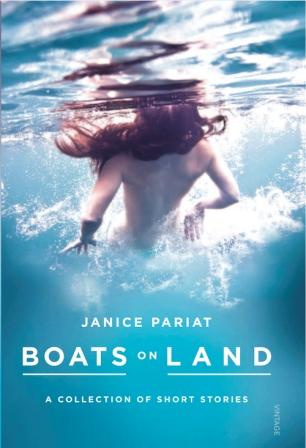
Boats on Land is a bewitching journey into the Khasi heartland, told through a string of stories spanning more than a century. They unfold amid the deep bond between a people and their landscape, in a culture shaped by forces both historical and occult. Colonial encounters, immigrant settlers and the frictions of a tightly knit community leave their marks upon this world, but so do older beliefs and presences. Gossip fermenting in jadoh stalls and mantras reverberating in waterfalls are as much a part of life as the undulating mountains and frost possessing the rooftops and gardens. Here the living share their terrain with the dead, the doctor is more of a shaman, the puri haunts the faint-hearted, and the niangkongwieng wails in the forest. In Pariat’s Khasi country, landscape, memory and folklore inhabit one another so completely that the boundary between the real and the imagined is seldom easy to discern.
A Waterfall of Horses, the first of the tales, draws the reader deep into this mysterious world. Set in the middle of the nineteenth century, it takes us to a time when the British ruled with their cannons, guns and horses. Fierce and formidable as the bilati men were, they found themselves confronted by another kind of power: the hitherto unwritten syllables, the trance of tales passed down through generations on dimly lit nights, the force of Ka ktien, “old as the first fire. Free to roam the mountains, circle the heath, and fall as rain.” From there, the stories move across generations, fusing folklore with history as they pass through the murderous parochialism of the 1980s and 1990s and into the present day.
The beauty of these stories lies in the ease with which they place the mysterious beside the ordinary, often speaking of both in the same breath. “The elder brother was taken by the drink. The younger by fairies.” Thus begins Dream of the Golden Mahseer, the story of two brothers, Mama Heh and Mama Kyn, who lived through the World Wars. As Mama Heh approaches death, he sees again the son he lost in a cold, wet Burmese war camp. At four in the morning, when the rooster crows, he smiles and murmurs, “He is here.” When Mama Kyn begins disappearing for days on end, the possibility that he has been ensnared by a water-fairy is entertained with much the same matter-of-factness. A broom is planted at his door, the only sentry thought capable of keeping such forces at bay. When he finally vanishes, the broom is found displaced. In Pariat’s world, the supernatural does not intrude upon reality; it already belongs there.
The imaginatively titled 19/87 marks a harsher fault line: the rift between the Khasi and the dkhars, the locals and the outsiders. Suleiman, whose father brought him to Shillong when he was barely two, has nowhere else to call home. Yet stones rain on his roof at night and the streets ring with cries of “Dkhar liah, mih na Shillong”: “You bastard outsider, get out of Shillong.” His father is dead, and he remembers no other place to which he might return. Against the curfews and violence, Pariat uses kites as a delicate symbol of both strife and the yearning for freedom. The senselessness of ethnic hatred finds its most haunting expression towards the close: “As he walked, scanning the road for a taxi he was sure he wouldn’t pass, rainwater gushed around his ankles. It was dark and murky, it could be blood for all he knew. Wounds ran deep in this hill-station town in the middle of nowhere.” Here, the wounds of belonging are no longer metaphorical; the question of who belongs to the land has become a matter of fear, exclusion and blood.
Pilgrimage turns from forced exclusion to the quieter estrangement of leaving home. A young woman who has drifted away to Delhi returns to Shillong, hoping to refresh her roots and recover something of her adolescent past. Remembering her Assamese boyfriend, she searches desperately for his house, only to find that it seems to have been swallowed by the altered landscape. The owner of a kwai kiosk offers her a simple piece of wisdom: “And that’s what pilgrimages are for, really. To think about the places and people you leave behind.” Homecoming, Pariat suggests, cannot restore the past; sometimes it merely reveals how far we have travelled from it.
Many of the stories in Boats on Land unfold through young characters for whom childhood and homeland remain repositories of mystery, memory and nature’s bounty. They may be restless or rebellious, drawn towards other lives and other places, yet the world they inherit continues to exert its pull. Pariat allows its dreams, apparitions and supernatural presences to enter their lives without demanding either belief or disbelief from the reader. That these stories seldom strain credulity, despite their generous traffic between the earthly and the otherworldly, is one of her considerable achievements. Even at their most mysterious, they remain anchored in recognisable human longings: for love, freedom, belonging and some accommodation with loss.
Few collections I have encountered evoke the Khasi world with the richness and musicality of Boats on Land. Dreams, beliefs, rituals, omens and folklore are as much a part of its canvas as the rains, rivers, valleys and mountains. They seep into the spirit of the place and follow those who leave for the dreary abstractness of the metropolis, tugging at them long afterwards. The crises of relationships, identity and death are played out against a terrain that is both physical and metaphysical. Nor is this an idyll untouched by history. Colonialism, ethnic strife, possession and dispossession shape the emotions of the Khasi, the British and the dkhars alike. Pariat’s achievement lies in bringing these forces together without reducing the Khasi world either to picturesque folklore or to a history of conflict.
Pariat’s prose is remarkably light and intrinsically lyrical, carrying even the quieter passages without allowing them to lapse into the mundane. The line between prose and poetry is as thin as the margin between fable and fact, creating an unusual harmony between content and style. Yet the lyricism rarely draws attention away from the stories themselves. Her language remains lucid and unforced, capable of moving from the everyday to the uncanny without announcing the crossing. It is this ease, perhaps, that allows the folklore, history and lived experience of the Khasi world to inhabit the same narrative space so naturally.
Boats on Land leaves behind more than the memory of individual stories. Its hills, rains and waterfalls, its ghosts and whispered tales, its violence and longings, gradually gather into a world that seems at once particular to the Khasi people and recognisable beyond them. Pariat does not merely set her stories in this landscape; she allows the land, its history and its lore to enter the lives of those who inhabit it. Long after the journey is over, wisps of that strange and beautiful country live with the reader.
Boats on Land
Author: Janice Pariat
Publisher: Random House India
Pages: 283


Hey Uma! Busy days now? Do not see much of you! This review – as good as ever – reminded me of my batchmate at IIM – Mawshandong Baskhem Blah – of the Khasi tribe. A more misnamed person I haven’t seen – Blah was as silent as they came 🙂 From what I understood from him it is one of the few communities that have a matrilineal inheritance policy.
Hi Suresh! I was hiding in boats on land! Don’t you miss the book. It will take you several degrees closer to your friend in retrospect.
This is a great review once again Uma. And I absolutely agree with the last point. Literature often is just so much more than a scientific treatise on any subject! It has that power indeed.
Thanks Amit. Literature has the power of breathing life into the effigies science may create.
wow! thats such a perfect thing to say…loved it!!
Seems quite interesting and a culture that I am not much aware of.
Interesting it is, Rachna.
Bewitching voyage, bewitching stories, bewitching review! A great opportunity to learn about our own people from the north. Mr Pandey, you are peerless!!!
I am indebted by the patronage, Mr Chandra.
It looks like a book that takes the readers on a voyage to a relatively unknown territory of India. I have added it to my list. It looks very interesting.
It is a collection beautiful, “revealatory” stories, Amit.
Sounds like some really intriguing short stories put together. As always, a high quality review. Makes even a non-book addict like me to take up a book and read. 😀 Thank you, Pandey ji.
Akshay, you should exploit your temporary confinement to the hilt by reading books. Boats on Land is a mesmerizing collection of short stories. Do read them.
We do not know much about the North-East — be it literature, culture, customs or even people—do we? I have an English translation of folktales from the Northeast and am Amar Chitra Katha on Folk Tales from Arunachal Pradesh. That sums up my literary exposure to this region. Thanks for another wonderful review, Umashankar; this book seems to be a must read. Just one question though: does the intriguing book cover reflect its contents?
Sudhagee, you simply cannot afford to miss this book. Thanks for liking the review. The cover is a photograph titled ‘Phantasmic Cycle’ by Neil Craver. It is a beautiful image and a unique choice for the book. It is probably symbolic of the intimacy certain humans experience with the elements of nature. It is a book with rather serene contents and you might want to proceed to the photographer’s website for further forays into his breathtaking collection.
Very well narrated 🙂 Keep it up !!
Thank you.
Seems like an interesting read. Anyway we are not much aware of the people in NE and this can be an eye opener.
‘Eye opener’ is the perfect phrase, Jas. It is a must read.
Umashankar, Interesting review!
Many stories have emerged from the mighty banks of Brahmaputra. I know Mamoni Baideo (Indira Goswami) personally. I met her when she was teaching in the Department of Modern Indian Languages at the University of Delhi, I met her through my sister-in-law who was also a Prof in DU those days. Have you read her autobiography ‘ Ada lekha Dastavej…(An unfinished autobiography)…? Do read it. Even her short stories are just too good….
I have not read this book. I want to read it now…Thanks for sharing..
Glad you found the review interesting; it is an amazing book. I will surely pick Indira Goswami soon. Many thanks to you.
Wow! I bet these stories opened out a whole new world. It does sound very enlightening. And seriously, I didn’t know anybody could do such great work reviewing a collection of short stories.
They did open my eyes to a surprising new world. “Revelatory” is what Jeet Thayil called them and I couldn’t have agreed more. Thank you for your continued support.
Looks like another interesting read. I never heard about the Khasi tribe. I am suprised as to how each books potrays different backgrounds,
Teaches us different histories, cultures…will keep this on my list..thank u for the review..
Now you have heard more than just their name, haven’t you! You are correct: books are like windows to far off worlds. Don’t miss this one. Ask the gentleman carrying the bag of books for you to include this one in the lot. Many thanks for those words.
That’s what I thought too..had I read the review last week, rather had you written it last week, it would have been just perfect. I already placed the order in flipkart. Will try to place now. Thank you so so much 🙂
Cheers! Flipkart is great. Do they deliver in the US too?
Its a treat to read your reviews….havent heard of this book or the author. Since I like short stories, this one piques my interest.
Thank you, Alka. These stories are light, lyrical, deep, profound, mysterious and yet so very real. And you may want to read them again and again!
Good one .. (can i get away by just saying this ) he he he 🙂
I have not heard of Khasi tribe.. so would be a good read and also Learn something new for sure .. and since you mentioned its set of short stories , that makes it good as sometimes long stories become boring ..
I am glad I have goaded you enough to pick up the anthology which I am sure you are going to enjoy. And hey, you are supposed to dole out just the right adjectives! Thank you so much for your continues support, Bikram!
Thats another interesting book, umashankar. You are becoming a touchstone for all bloggers to test how voracious readers they are. And all of us are beginning to feel uncomfortably like dim witted trolls .
Those are very kind words, TF and I presume it is a compliment! It is interesting how you have turned my own words on me! 🙂
I bought the book last night. I didn’t check the option to deliver in U.S. I bet they must be charging a lot for shipping. I shipped them directly to the person in India who is bringing them 🙂
Wow! Do tell me how you find the stories!
Every time you provide me with a recommendation for a compelling and wonderful book. I really love the way you scan the several layers of the book and give us a glimpse of the author’s mind and his style. Your reviews are wonderful celebrations of the book’s genius. It shows how much have enjoyed reading the book. This one sure does seem the kind of book I would love to read. I already have a wonderful list of books to read thanks to your reviews. This one goes right into that list.
Raj, The Boats on Land is indeed a compelling and wonderful book. I am happy you have decided to read it and allow me to assure you it will delight you thoroughly. As a reviewer, I strive to understand and represent the book’s core to the reader. Many thanks to you.
Sure sounds like an interesting book, and I look forward to reading it. North East is an exotic place inhabited by really fascinating people. It’s a pity that the rest of the country knows so little about them (as averred by one of your readers). Being from there, I am frequently quizzed about many facets of life in the North East and I find that people display curiosity and ignorance in equal measure. Janice Pariat’s book will hopefully create greater awareness about the region and also kindle fresh interest and curiosity among the rest of the Indians to learn more about its people and diverse culture. Congrats for a wonderful review. You have definitely played your part in bringing NE closer to rest of India.
Sir, I was waiting for your precious views here, especially since the book is such a brilliant mix of facts and folklore from the very region you hail from. I am sure Janice Pariat’s book will prove to be a milestone of literary writing because of its unique content. I do not see myself in a role more than that of a messenger’s. A million thanks to you.