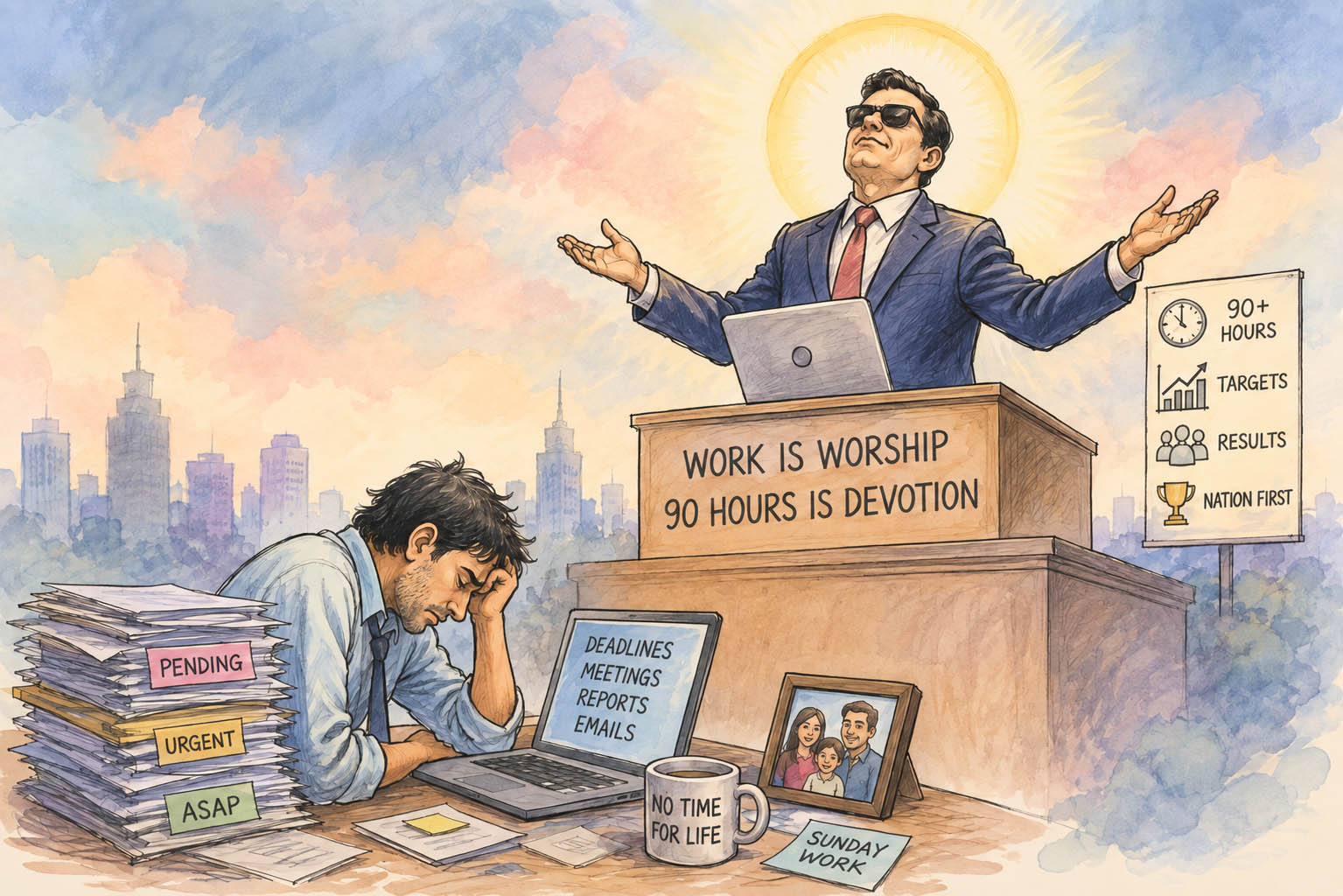
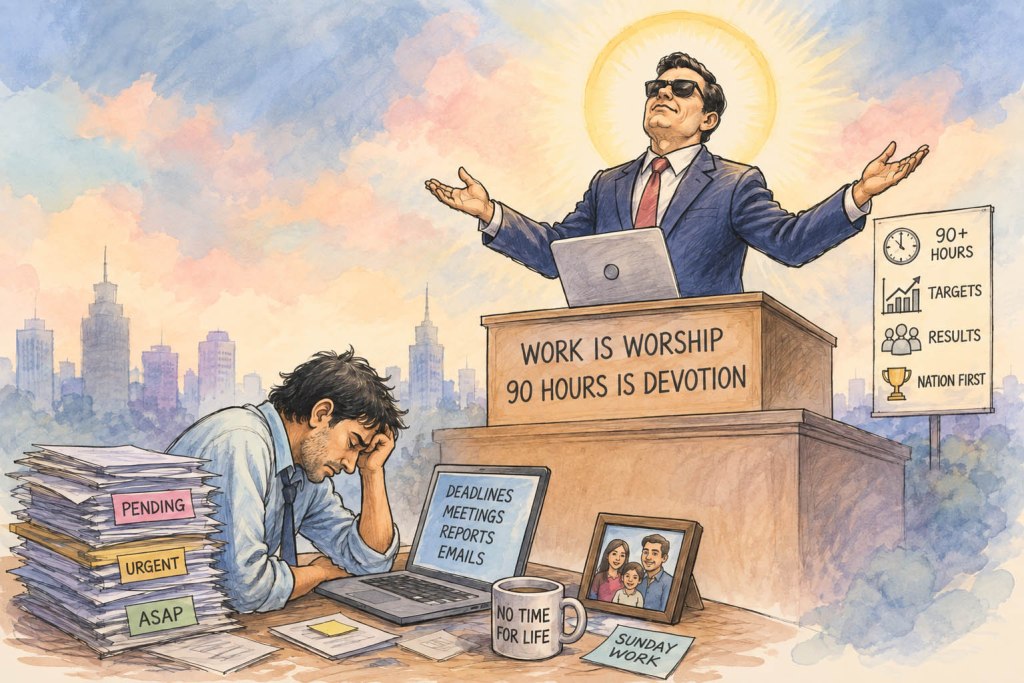
“What do you do sitting at home? How long can you stare at your wife? How long can the wives stare at their husbands? Come on, get to the office and start working.” —A recent Loud & Thoughtless statement advocating a 90-hour workweek and working Sundays
Early on this Sunday afternoon, as I sat gazing at my homemaker in the cosy confines of our living room, I couldn’t help but think of Joseph Heller and his masterpiece on the absurdities of bureaucracy, Catch-22. With an acute awareness of my own culpability for numerous sins, my thoughts turned to Catch-90—the impossible bind that countless corporate workers find themselves trapped in today.
There is another catch, then: Catch-90 specifies that concern for one’s mental and physical health, or a desire to stare at your wife instead of putting in a 90-hour workweek, is considered a betrayal of the organisation and an unwillingness to contribute to nation-building. However, if you agree to work 90 hours or more, you prove your commitment to the cause, but only until you collapse from exhaustion and your family disintegrates due to neglect. At that point, you become useless and inefficient, betray the organisation, and are deemed unwilling to build the nation.
Workers can speak up about the absurdity of working such hours, but the moment they do, they prove themselves unfit for patriotic duty and become eligible for elimination. And if they quit, they will be traitors to the national cause. If they put in 90 hours or more a week, they will be heroes committing hara-kiri in slow motion. They are, therefore, nothing more than fireflies, destined to burn in the corporate flame.
The brilliance of Catch-90 is that it ensnares the employees in a feedback loop:
If you work 90 hours or more, you’ll burn out and fail the corporation and hence the nation.
If you work less than 90 hours, you’re clearly lazy and undeserving of your position.
And if you dare to mutter even the faintest protest that life outside work matters, you’re just someone who stares at your spouse too much.
This profound leadership oracle deserves its own place in the pantheon of corporate absurdities. It’s the kind of rhetorical flourish that leaves employees speechless, unsure whether to laugh, cry, or double-check their marriage certificates.
I may be a worked-up moron craving basic sanity, and surely there is another side to the story that deserves a closer look. Is it not a perfect system? Your life outside work is merely a forgettable postscript. Personal relationships are distractions from corporate productivity. Why would anyone spend time with loved ones when delicious spreadsheets await, endless meetings beckon, and the ecstasy of answering official emails late into the night is not to be forgone?
And then comes the revelation: life outside work is an unnecessary invention. Home is merely the place where you wait for the next working day, and the people in it must learn not to compete with deadlines. Because the laptop never tires of you, and the inbox is forever eager for your return. Why seek happiness in the company of someone you love when unfinished spreadsheets offer a far more enduring relationship? Evenings may be spent on conference calls instead of being wasted at home, Sundays on pending reports, and anniversaries on the greater demands of the quarterly target. As you wake up to this reality, the distinction between living and working disappears altogether. You have finally arrived at corporate nirvana.
The Corporate Messiah’s conviction about a 90-hour workweek might first be tested against a simpler measure: what he earns for every minute of his time compared with what trickles down to those expected to toil for him. The gulf between those who lead and those who labour is enormous, and it is not measured merely in salaries, privileges or corporate hierarchies. There is also the rather inconvenient fact that people have lives beyond the workplace. To dismiss family life as a frivolous pastime while elevating work into a supreme calling is to reveal a profound disconnect between those who command from the top and those whose lives must accommodate their commands.


Uma, have I missed something? Have you been absent? Did WordPress forget to notify me? Or have you joined the 90 hours a week that are grinding the world into sand.
We do not appear to be on the best of terms: WordPress and I. The metaphorical mill is never too far away, my friend!
A scarily dystopian world so well evoked, Uma
The dystopia is already playing out in the burgeoning corporate jungle.
So I gather
Hoping this is complete fiction and not based on a true story…sounds like hell but written well, Uma.
Hoping this is pure fiction and not based on a true story…sounds like hell but written well, Uma.
Unfortunately, it’s based on a true event. Thank you for appreciating.
Ninety-hour work weeks are a crazy idea! (And I don’t use that word lightly.) I thought it was bad in the US, where putting in long hours is all too often equated with success in the corporate world, but even here no one is expected to work quite that much. And the younger generations are actively pursuing jobs that allow for a better work/life balance. I hope that saner minds prevail where you live, my friend!
Wherever they are doing it, it is not sustainable. The burnout and disintegration are real and often irreversible.
My life is far removed from any corporate life, but even from here I can see that it is not sustainable.
Time to watch Catch – 22 again.
It’s myopic to say the least. It will lead to fatigue and disintegration that may well be irreversible.
Hi Uma, it’s good to see a new post from you, even if it is a vision of hell! I’m so glad that here in the UK, most of us aren’t expected to work these kind of hours – and I think the younger generations are even less likely to do so – but I know we’re lucky in that regard. When I come to the end of my life I won’t be thinking about meetings I’ve had or spreadsheets I’ve done, but unfortunately some people have less choice in the matter.
Thank you, Andrea. It’s a weird subject for a comeback post, but then there it is. I am sure these corporate honchos are deficient in long term vision.
It is a somber day and I am looking for pieces to read. I decided to poke at your menu and find something I had not read yet—landing on ‘Sam Was Sad’. (not able to comment there:) )
“Ask Macbeth.” haha. You never waste words.
I find myself wondering 12 years down the road, what has become of Sam.
Lunch time. I think maybe–an omelet.
Thank you, my friend. Like you, I too wonder what has become of Sam.
What has become of me.
He’s still in there
90 hours? That is insane!!!
A well conceived article, coming from the bottom of a person’s heart, known to nurture his team. As a person intimately knowing the working style of Mr Pandey, I can say this with certainty.
Though I know the author of the diktat of the 90-hour work week, even the uninitiated into the corporate work culture or corporate absurdity would vouch for sure that the great words were spoken by a male only. My choice of ‘male’ where I could have used ‘man’ is deliberate, for there is nothing manly in this mindless utterance. Perhaps, if the preacher also follows what he tells others, his spouse would be fortunate for not having to stare back at the likes of a misanthrope—what else would you say about a person advocating a 90-hour work week.
Looking at this against the backdrop of the obscene pay disparity between the top and the median pay in many of the corporates where such inhuman working conditions are more a norm than the exception, would make one cringe.
It’s been a while since I wrote that, and I had to ask myself what had so thoroughly seized my thoughts as to draw me out of hibernation and set my pen in motion.
You have added some invaluable observations with those blistering strokes of humour, further exposing the dark underbelly of the corporate world.
Who would monitor how many hours the top honchos work? With the obscene bonus, ESOP, and other non-financial perks they enjoy, they should in fact borrow additional hours from the next day to justify the very fat pay check they get every month. They should be in perpetual debt as regards working hours!!
Will any lesser mortal dare to say that the 90 hour work week of his/her boss includes 50 hours of fine dining at the company’s expense and mid-afternoon siesta in the cosy corner offices?
Ah, yes! And that is just the tip of a rather stinking iceberg.
Loved the para on revelations 🙂
I am reading this over a year after yr post was written but the content has no expiry date. It is forever relevant. I also remember these proclamations, including a similar one by Shri NRN a little earlier.
But equally, we make too much of these proclamations many of which are designed to earn some media miles, nothing more.
Thank you for stopping by.
We may indeed be making too much of these proclamations. The trouble is, I suspect those making them often genuinely believe in the premise. And when people in positions of power believe such things, they also tend to put them into practice, thereby reinforcing an already exploitative work culture. Media miles may be part of it, but the consequences can be quite real.
While I don’t disagree, I also believe that if as human beings we compromise our right to disagree with something we don’t like for fear of the consequences, then we are sitting ducks.