(Further to The Spirits of Melbourne)
In the months spent planning and replanning our Australian adventure, there was a period when I was determined to explore beyond the cities under my own steam. The determination was serious enough for me to obtain an International Driving Permit.
Securing the permit itself was easy. The challenge arose when I discovered that the address on the IDP ought to match the one in my passport. For someone whose banking career had involved being periodically flung across the Indian map, this was no small undertaking. The addresses adorning my various identity documents displayed admirable geographical diversity and could easily have qualified for a government exhibition on the theme of Unity in Diversity.
After a mixture of pleading, paperwork, and one bold stroke of luck, the two addresses were finally persuaded to agree with one another.
As the departure date approached, however, the tour itself began shrinking. Days disappeared. Distances were compressed. Melbourne suffered more than most from these surgical revisions. Once a full day had been allocated to the unmissable Great Ocean Road, the committee concluded that joining an organised tour would be the wiser course. Nearly six hundred kilometres were to be covered, much of it through winding coastal roads and rolling country.
The official reasoning was impeccable. The person driving would be concentrating on the road and miss much of the scenery. The matter was therefore settled.
The “Deluxe Minibus” collected us from our temporary abode on Collins Street in Melbourne. The driver-cum-guide was an amiable young Australian of Chinese descent who introduced himself as Daniel.
We were the first passengers aboard. There were two seats beside the driver. R promptly dispatched the two most excitable members of the expedition to the frontline, while she and V occupied the first passenger row behind us. They would serve as the calm observers, and, if necessary, the diplomatic corps.
While collecting a few more tourists around the city, Daniel pulled over on the left side of an intersection. The road he intended to take required a right turn.
He glanced at me and smiled. “Do you know why I’ve parked on the left, and left the right lane clear when I need to turn right?”
I had no clue.
“Because of the trams. Melbourne rule.”
This nugget of local intelligence struck an immediate chord. Sensing an eager audience, Daniel proceeded to share further secrets of Australian motoring, each accompanied by detailed accounts of the astronomical penalties awaiting those who failed to observe them. By the time he finished, I had begun to suspect that Australian traffic authorities regarded fines not merely as a deterrent but as a significant branch of national industry.
We left the city and joined the Princes Freeway heading west. The road markings immediately caught my attention. Every lane, turn, merge, and exit appeared to have been planned with almost architectural precision. Overhead electronic signs displayed speed limits inside glowing red circles suspended above each lane. Beyond the suburbs, the signs mostly read 80, occasionally dipping lower before rising again.
Daniel declared that Australian speed limits were unnecessarily conservative.
T asked whether we might see kangaroos.
“Oh, you’ll see roos,” said Daniel. “Dead or alive.”
She informed him that she would greatly prefer her first kangaroo to be alive.
Daniel confessed that he had once hit a particularly large kangaroo while driving at night.
“What happens then?” she asked.
“You’re supposed to move it off the road.”
“And did you?”
He nodded gravely.
“It took a while.”
The silence that followed suggested that none of us wished to discuss the logistics further.
Beyond the suburbs, Melbourne gradually loosened its grip upon the landscape. The freeway stretched westward through country that seemed built on a generous scale. Scattered gum trees stood across the plains like old custodians of the land, their pale trunks glowing in the morning light. Between them lay broad expanses of pasture rolling gently towards horizons that never appeared to arrive. The road felt less like a route and more like a communion with space.
Kilometres slipped beneath the wheels while a magnificent sky staged an uninterrupted performance overhead. Great scalloped clouds drifted across vast stretches of blue, their edges illuminated by shafts of sunlight. Rain showers appeared without warning, only to vanish moments later. Silver skies became golden. Golden skies turned silver again.
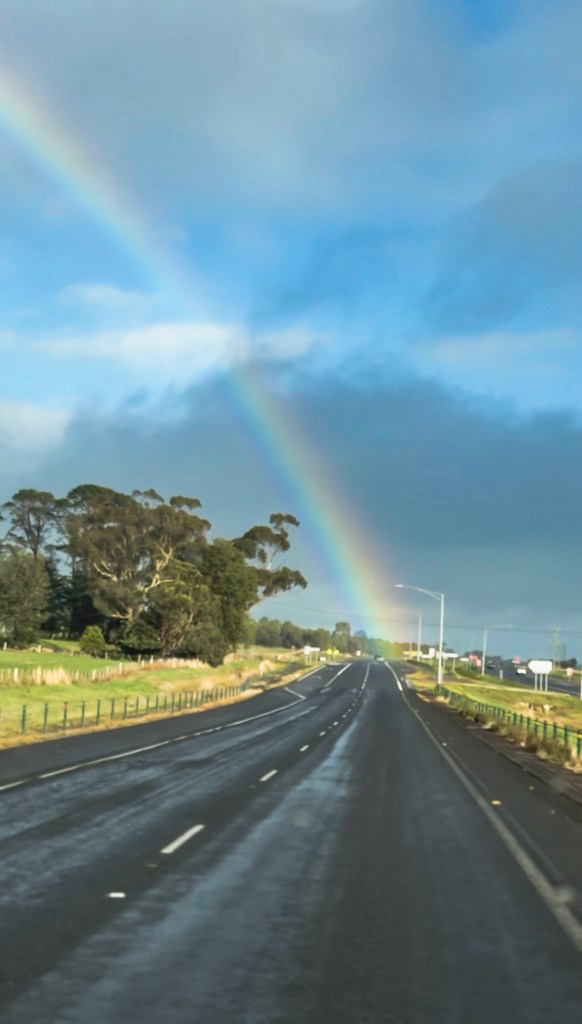
Then, near Highton, a rainbow emerged.
It rose from the freeway and swept upward across half the sky with such startling brilliance that we momentarily forgot whether we were photographers or spectators. Cameras and phones hovered uncertainly in our hands while the rainbow burned above the landscape with impossible clarity. We both agreed that neither of us had ever seen one quite like it.
As it happened, nature was merely warming up.
Beyond Warncoort, passing showers drifted across the countryside with cheerful unpredictability. Again and again, vivid rainbows materialised above paddocks and grazing land, lingering for a few minutes before dissolving into sunlight. Each seemed as luminous as the last. It was as though Australia had decided to present us with our lifetime allocation of rainbows in a single morning.
Our first pit stop arrived near Colac Memorial Square.
While we stretched our legs, Daniel requested that T AirDrop her collection of rainbow photographs to his phone.
“I need evidence,” he explained. “Otherwise, nobody believes me when I advertise the tour.”
Bella Hope Coffee provided precisely the sort of restorative fuel demanded by travellers who had already experienced several meteorological seasons before morning tea.
Having driven through rain-washed countryside and a succession of improbable rainbows, we were eventually halted by a temporary traffic signal guarding a sharp bend in the road. Beside it stood a solitary road worker in a fluorescent vest and white hard hat. Surrounded by gum trees and damp forest air, he appeared perfectly content with his assignment.
The signal remained stubbornly red. The road worker examined what looked like a blade of grass in his hand, then devoted his attention to a fragment of bark above one boot. Several minutes passed.
Daniel remarked that the fellow was probably earning five times more per hour than he was for demonstrating boredom at such a professional level. By the time the light finally turned green, T had become convinced that the operator was deriving personal satisfaction from our predicament.
As we rolled into Port Campbell, Melbourne was three and a half hours behind us. The Great Ocean Road now lay ahead, but rather than joining the westbound pilgrimage from the city, we had chosen to travel the route in reverse, beginning at its distant western reaches and tracing the coastline back towards Melbourne. The arrangement would keep us one step ahead of the crowds converging on the famous lookouts along the coast.
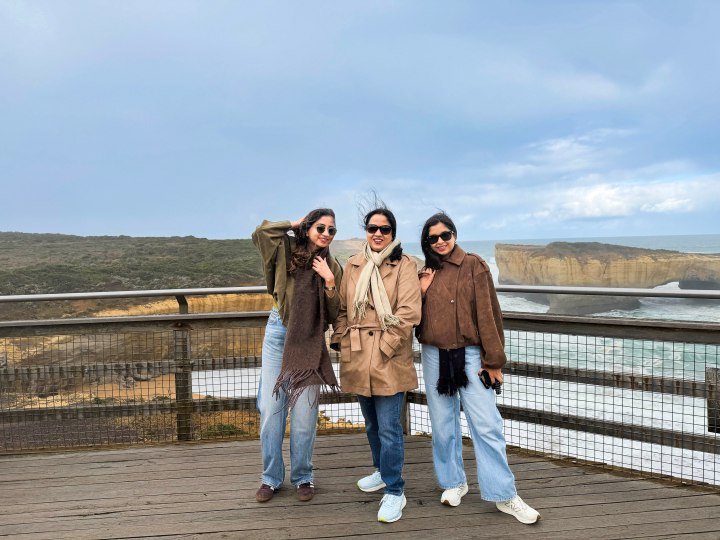
At last, we arrived at the first shrine of the day. We spilled out of the minibus at the parking lot and followed a path cut through dense, wind-sculpted shrubs. The small coastal tea-trees had a gnarled, swept-back shape. They were swaying merrily in unison with the wind and thin drifting rain.
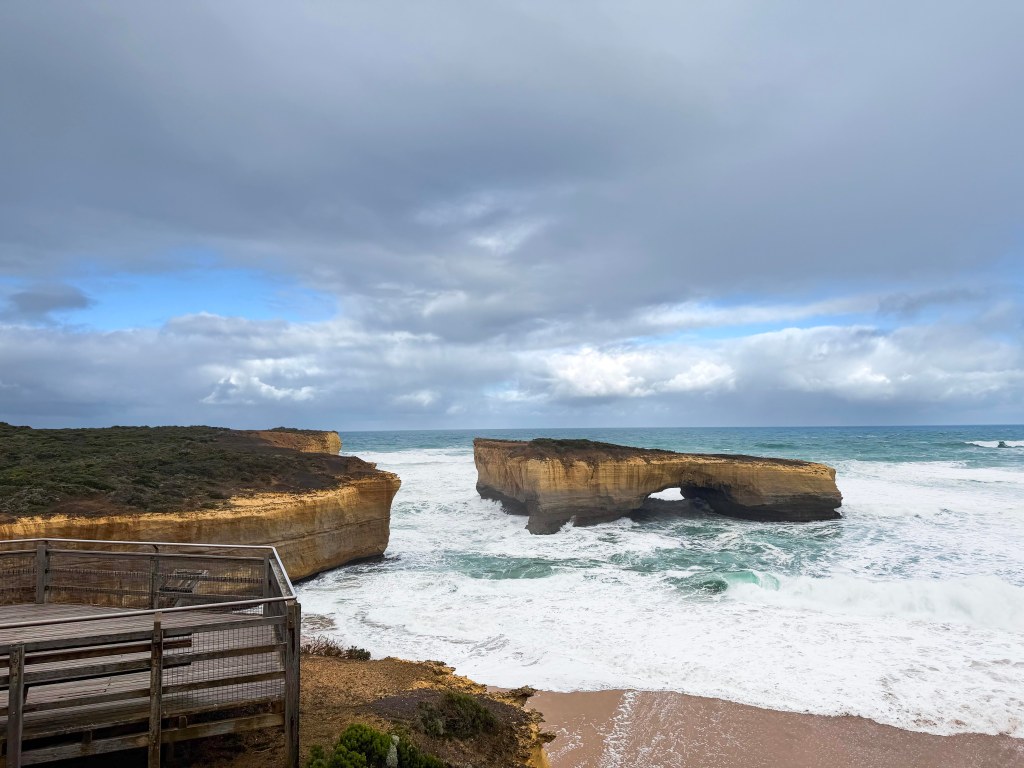
At the end of the walkway, the landscape suddenly opened onto the London Arch. Separated from the mainland and encircled by the Southern Ocean, it stood in solitary defiance of a sea that seemed determined to erase it. Dark clouds drifted overhead while restless waves surged and boiled below, wrapping the base of the arch in flashes of white. The scene possessed a raw, elemental power that no photograph had managed to capture.
Magnificent yet strangely vulnerable, the arch appeared less a permanent monument than a temporary truce between land and sea, as though the latter were patiently negotiating the terms of its surrender, one wave at a time. Its former name, London Bridge, hinted at a different shape. Until a few decades ago, a second span connected it to the mainland, but its collapse served as a reminder that along this coast the ocean is not merely scenery but an architect working to very long deadlines. Standing above the cliffs, with the wind in our faces and the distant thunder of the surf rising from below, one could not help but feel very small indeed.
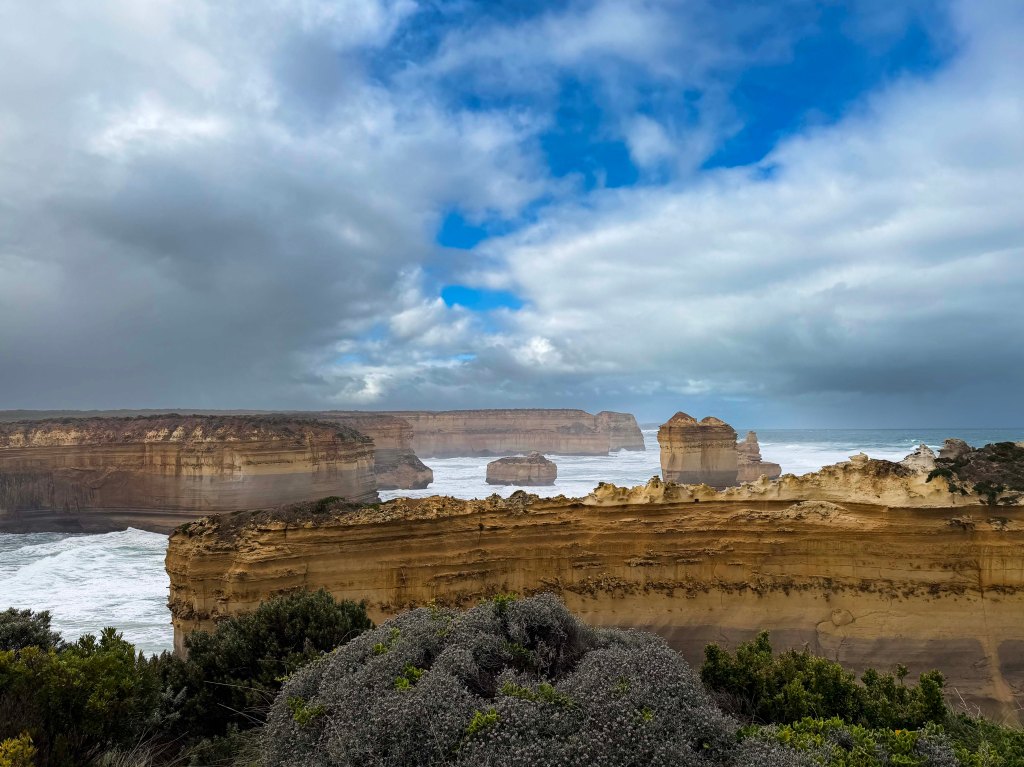
We lingered for as long as the weather would tolerate us, breathing in the salt-laden air, enduring the occasional wisps of rain, and taking photographs in every conceivable combination of groups, couples, and individuals. It was here that the electronic viewfinder of my otherwise faithful Nikon chose to stage a brief act of rebellion. The rear LCD remained perfectly functional, but the viewfinder refused to cooperate.
The malfunction became apparent when we handed the camera to a fellow traveller armed with a Fujifilm for a family group photograph. Like most photographers, he instinctively raised the Nikon to his eye, only to discover that it had unexpectedly abandoned that mode of operation. Those of us brought up on viewfinders tend to compose first and consult screens later.
In return, he entrusted me with his Fujifilm and requested a portrait against the backdrop of the coastline. By now the rain had grown more determined and I was keen to complete the operation swiftly. Unfortunately, the controls of this alien species proved far more mysterious than I had anticipated. Buttons appeared where no buttons ought to be, and dials seemed to perform functions known only to their designers.
I eventually succeeded in taking a few photographs. Whether I succeeded in taking good photographs remains a matter of considerable doubt. Judging by the look on his face when he reviewed them, the verdict had already been delivered, and it was not in my favour.
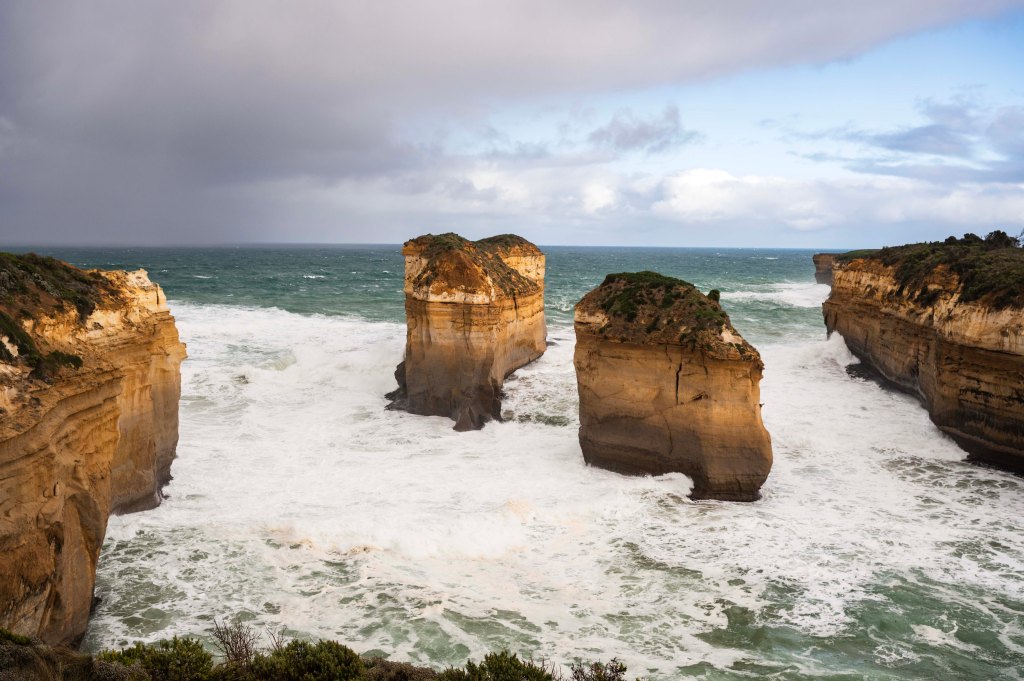
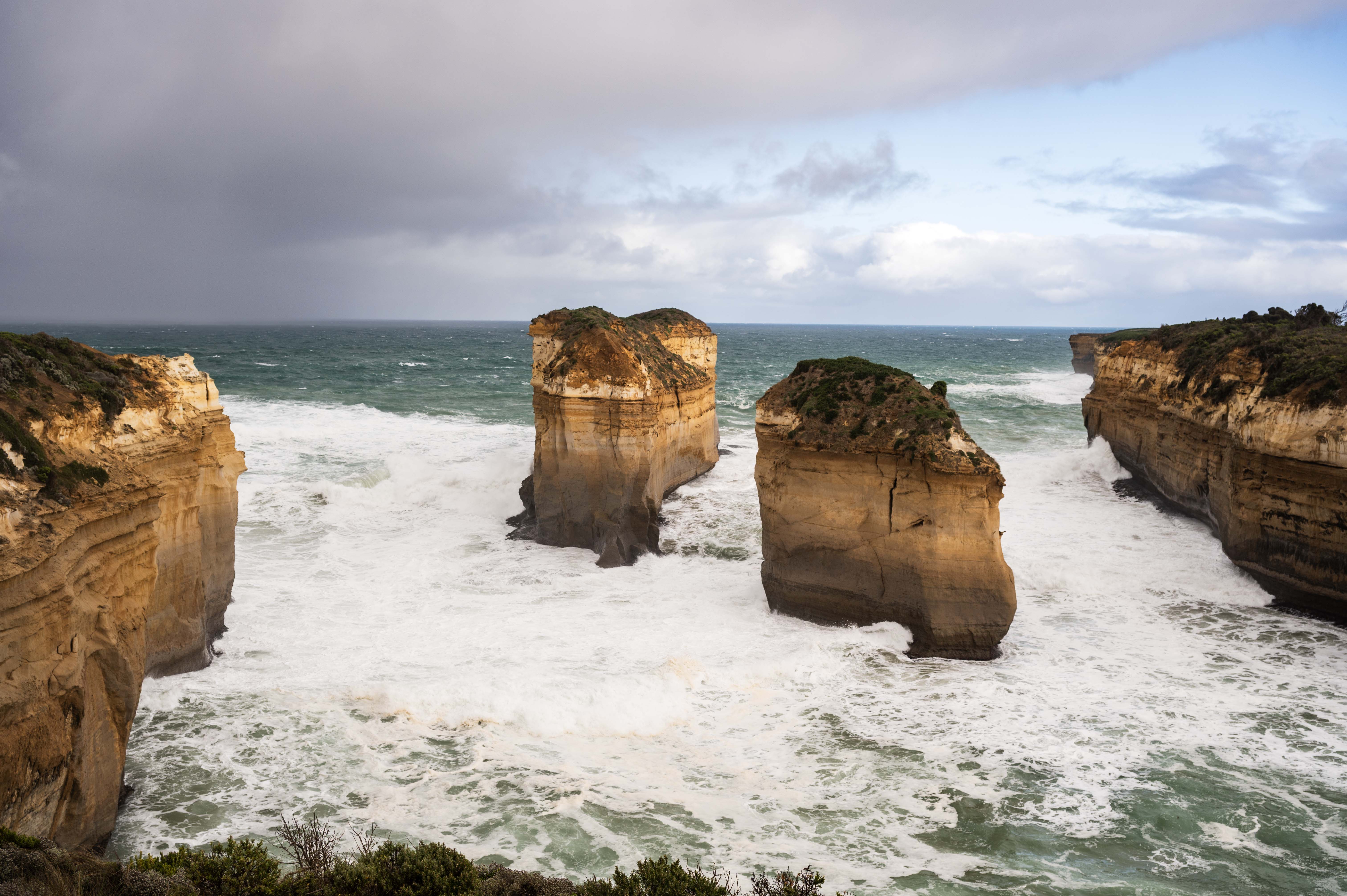
We arrived at our next halt, Twelve Apostles, which was at a short distance from the Arch. The Apostles, though considerably fewer in number than their name suggests, presented a spectacle no less arresting. Beyond the wind-swept coastal scrub, pale limestone stacks rose from the Southern Ocean beneath a sky where rainclouds and patches of blue contested possession of the day. Wind rushed across the cliffs, salt on its breath and the sound of breaking waves behind it. Long lines of swell advanced from the horizon and broke into white turbulence around the stacks, the sea tracing and retracing the contours of the rock as it has done for millennia.
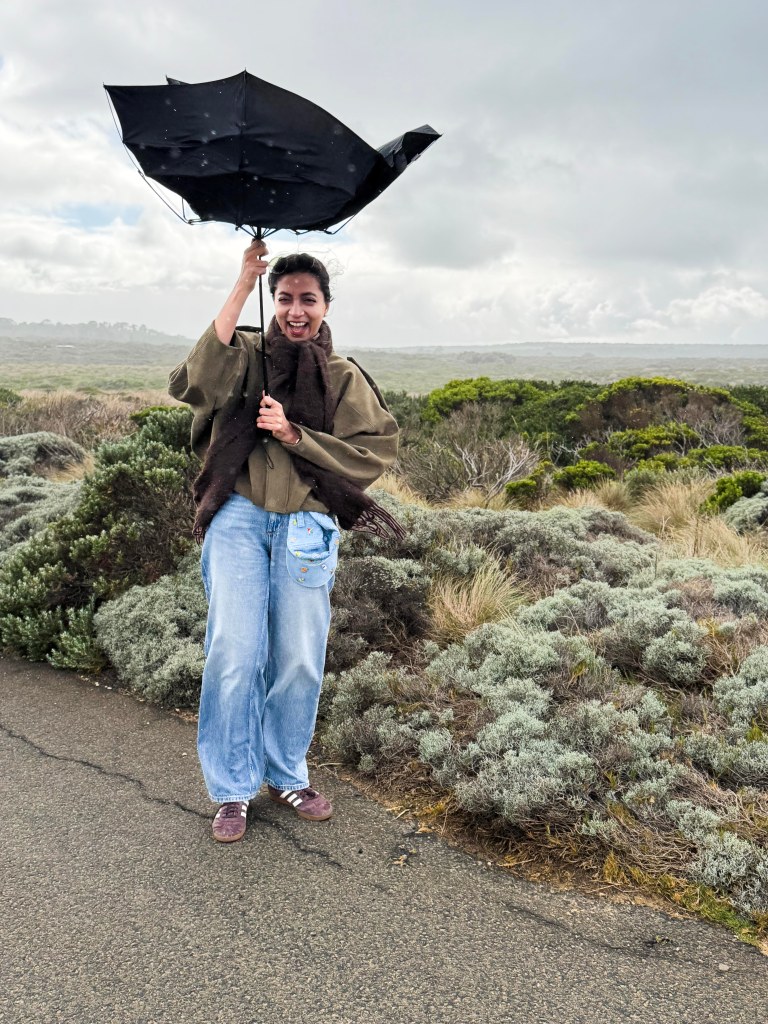
T had her own encounter with the elements on the walk back from the lookout. Armed with a 7-Eleven umbrella, she soon discovered that the local winds regarded umbrellas as little more than suggestions. After a brief but unequal struggle, the contraption inverted itself with remarkable efficiency, possibly as a precaution against its owner being carried off like a reluctant paratrooper.
Not far from the lookout, Daniel deposited us at 12 Apostles Helicopters, just behind the Visitor Centre near Princetown, and recommended a scenic flight over the Shipwreck Coast.
The suggestion immediately triggered a family summit.
The price was high enough for us to suspect a tourist trap, yet tempting enough to make walking away difficult. The expedition divided itself into two familiar factions: those who wished to see the coastline from the air, and those who preferred to keep both feet—and the family budget—firmly on the ground.
Eventually, the restless prevailed. Having watched our discussions with great interest, the rest of the minibus promptly booked their own flights.
Accommodating the passengers called for placing the family in two separate sorties. With headsets fitted and life vests strapped on, we crossed the helipad and squeezed into the smaller of the two helicopters. Painted bright red and accommodating just four people, pilot included, it looked less like an aircraft and more like a determined dragonfly.
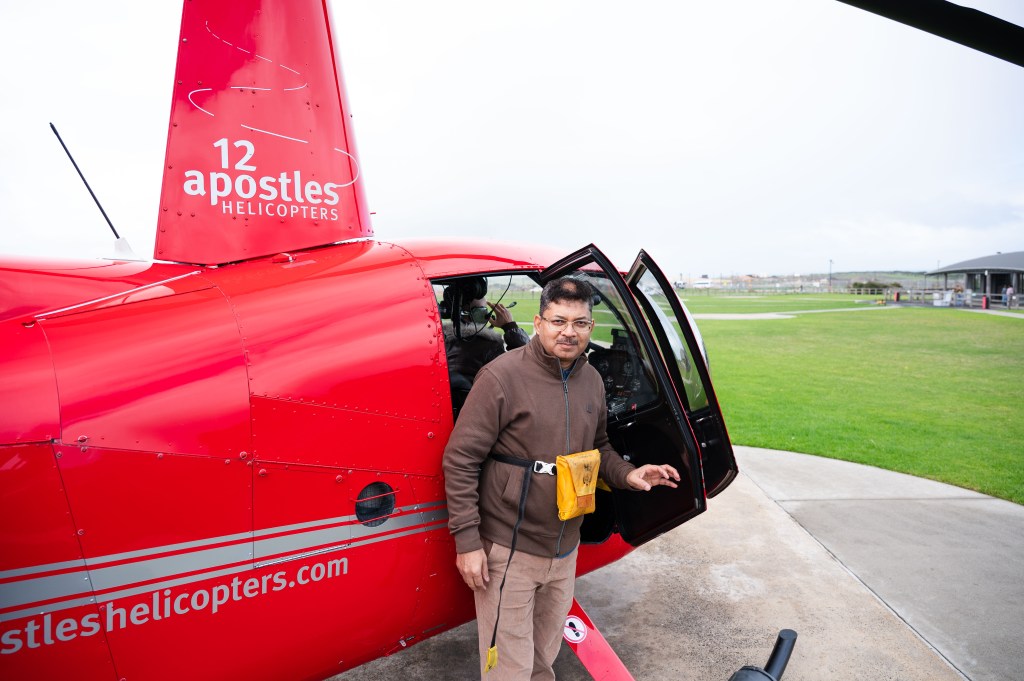
Its rotors blurred into motion. The cabin trembled. Then the ground quietly detached itself from us.
A sharp bank towards the Southern Ocean followed, and the helicopter surged seaward. The view expanded with astonishing speed. Below us, the ocean glowed in shades of turquoise and deep blue-green. Long ranks of waves marched in from the horizon before exploding into white surf against the cliffs. Rain showers drifted across the coast while shafts of sunlight wandered over the landscape, illuminating one headland and then another.
From the ground, the Twelve Apostles appeared as individual landmarks. From the air, they became part of a much larger story. Limestone stacks, arches, caves, and sheer cliffs stretched along the coastline in an almost unbroken procession. The Shipwreck Coast seemed less a collection of attractions than a vast geological manuscript still being written by the sea.
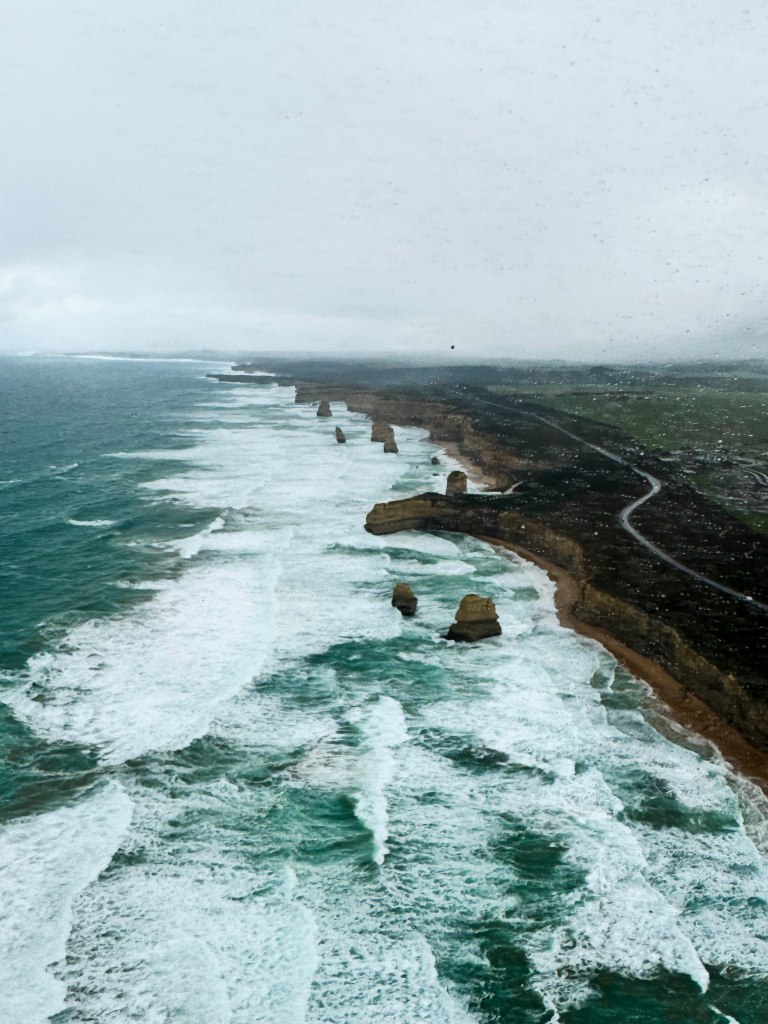
Much of the pilot’s commentary coming through our headsets drifted past unheard. Outside, the coast kept changing beneath us, with cliffs giving way to arches and stacks and the restless ocean breaking against them far below. There was always something new around the next turn. Forty kilometres slipped by in what felt like minutes.
By early afternoon, admiration of scenery was beginning to lose ground to more practical concerns. Several hours of rain, wind, cliffs, helicopters, and geological contemplation had left the expedition increasingly receptive to the idea of lunch.
Daniel steered the minibus towards the Great Ocean Road Wildlife Park at Lower Gellibrand. The plan appeared straightforward enough: eat lunch, stretch our legs, and perhaps make the acquaintance of a few iconic Australian residents. The latter possibility immediately threatened the former. Kangaroos, wallabies, koalas, wombats, and other creatures were all within easy walking distance, and we were on the verge of postponing food in favour of our first encounter with Australia’s most celebrated citizens.
At this critical moment, Daniel intervened.
Leaning towards us with the air of a man sharing classified information, he advised that we order lunch before a large coachload of tourists arrived and laid siege to the café. Once that happened, he warned, both tables and food would become matters requiring patience and diplomacy.
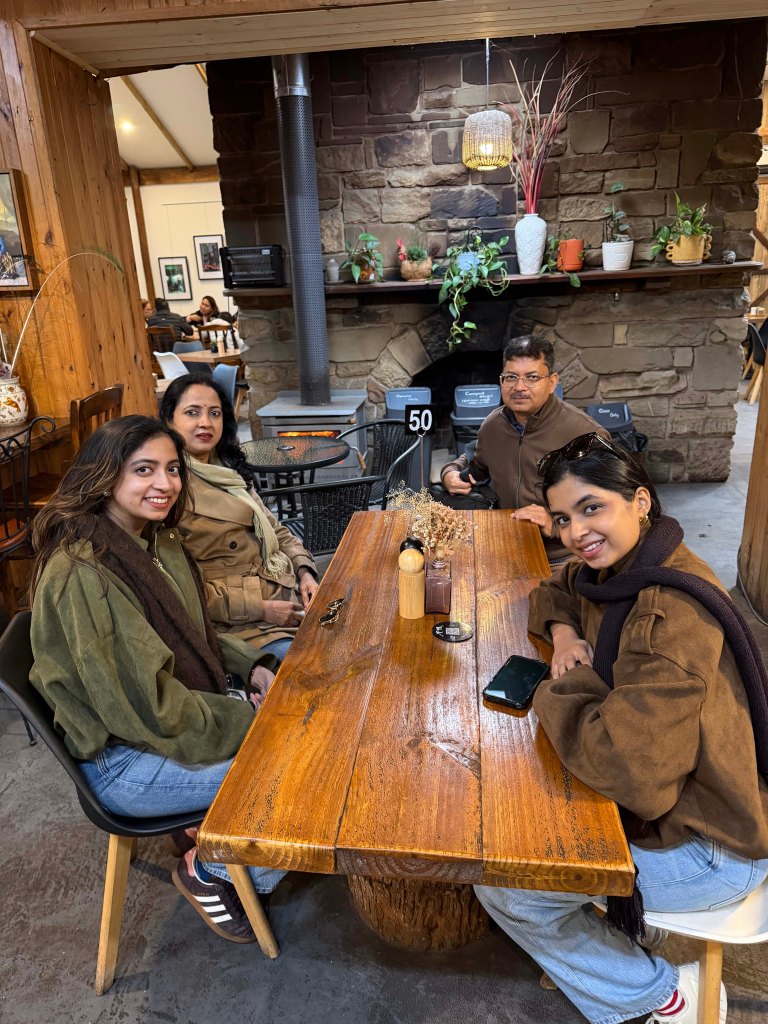
Wisdom prevailed. We secured a table in a cosy corner of Clean Cravings and turned our attention to the menu. The mood improved immediately. After days of travelling, R was delighted to discover a selection of vegetarian dishes substantial enough to require actual decision-making rather than negotiation. The staff guided us through the options with cheerful efficiency, and before long the table was occupied by sandwiches, salad bowls, hot cacao, and coffee.
Perhaps it was the sea air, perhaps the long morning, or perhaps we were simply very hungry. Whatever the reason, the meal was immensely satisfying. The sandwiches were crisp and generous, and the coffee excellent. For a few contented minutes, the expedition devoted itself to the serious business of eating while the wildlife waited patiently outside for its turn.
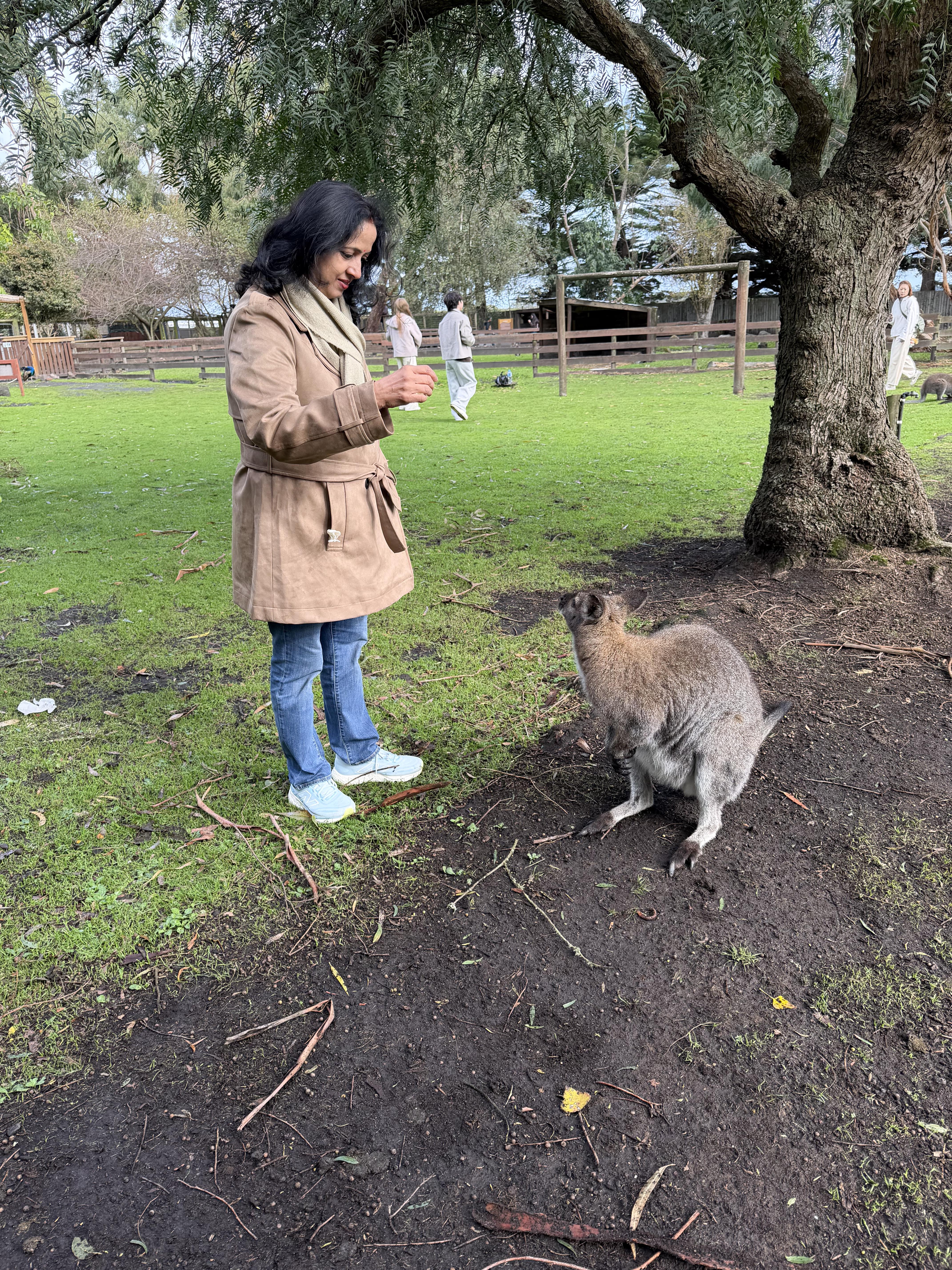
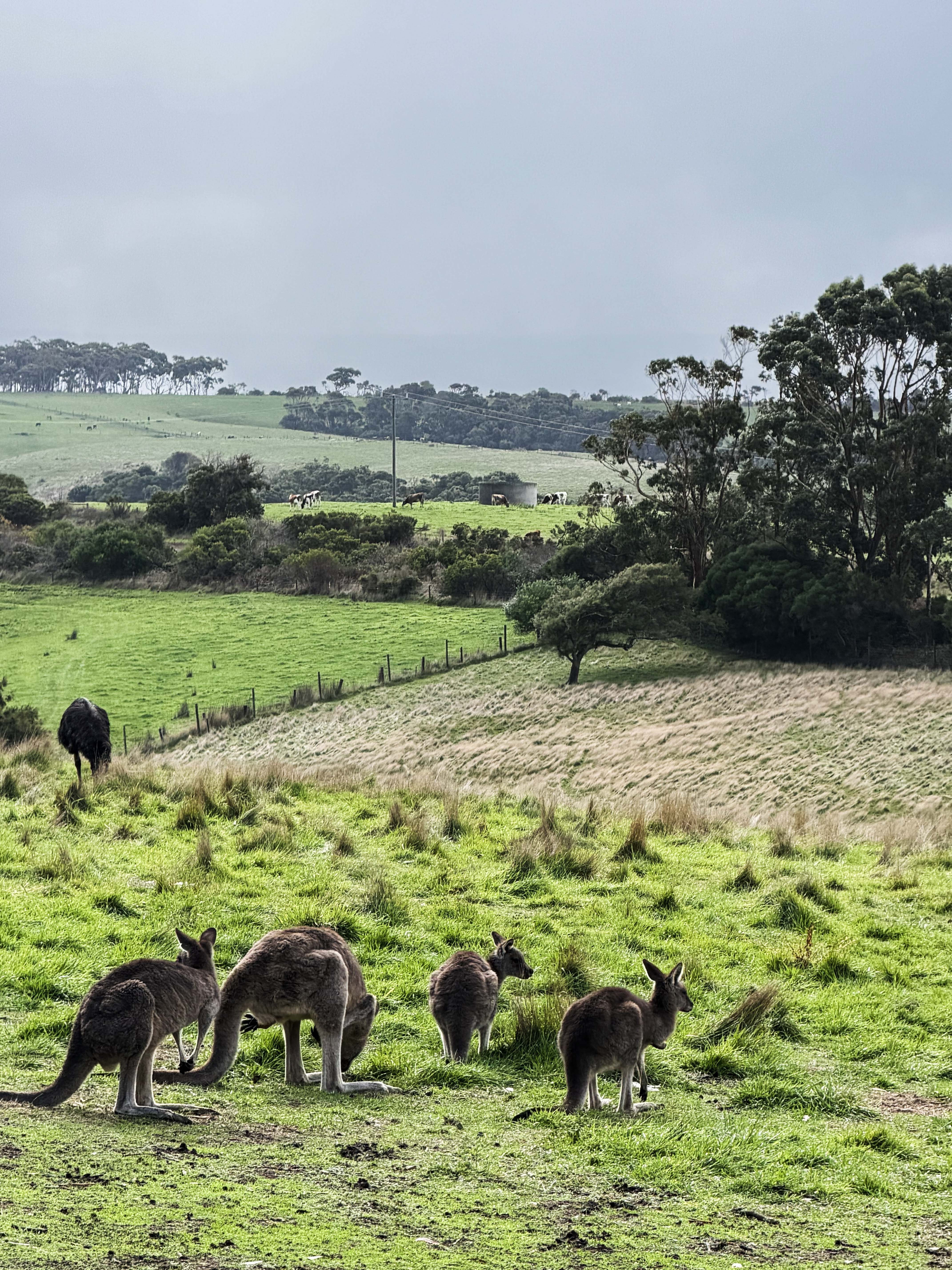
And we finally met our first kangaroo. Then the second. Then the third. Before long, the census collapsed completely. Most were young, amiable creatures, perfectly at ease with the steady stream of visitors arriving with pockets full of approved snacks and good intentions. They hopped about in their distinctive two-plus-tail-legged fashion, displaying none of the caution one might expect from wild animals and every sign of having successfully trained humans to serve as mobile feeding stations.
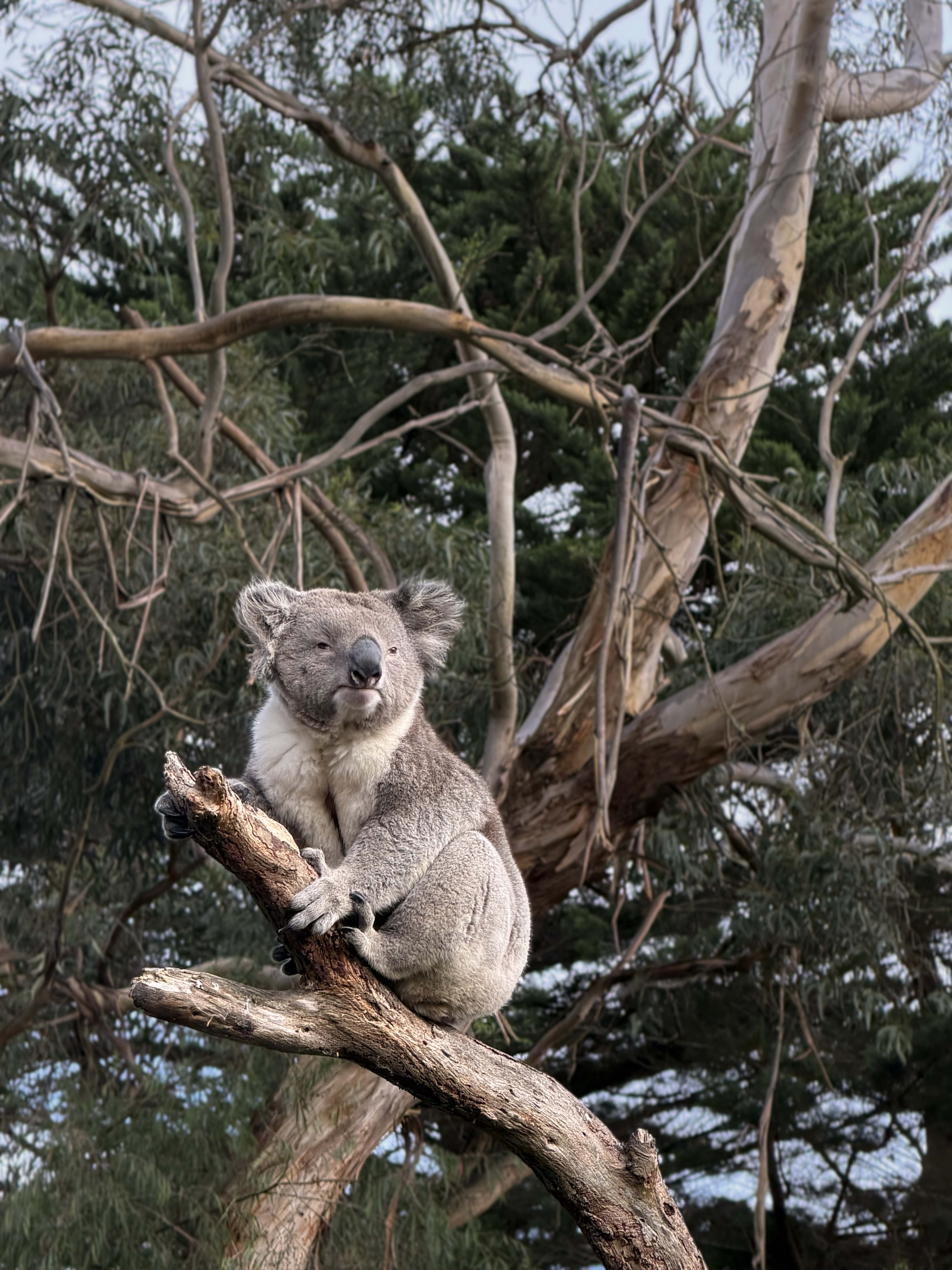
We met the celebrated koala too. Perched high among the branches, it regarded us with the air of a creature whose appointment with indifference had just been interrupted. When not contemplating the futility of existence, it devoted itself to scratching its head with admirable concentration.
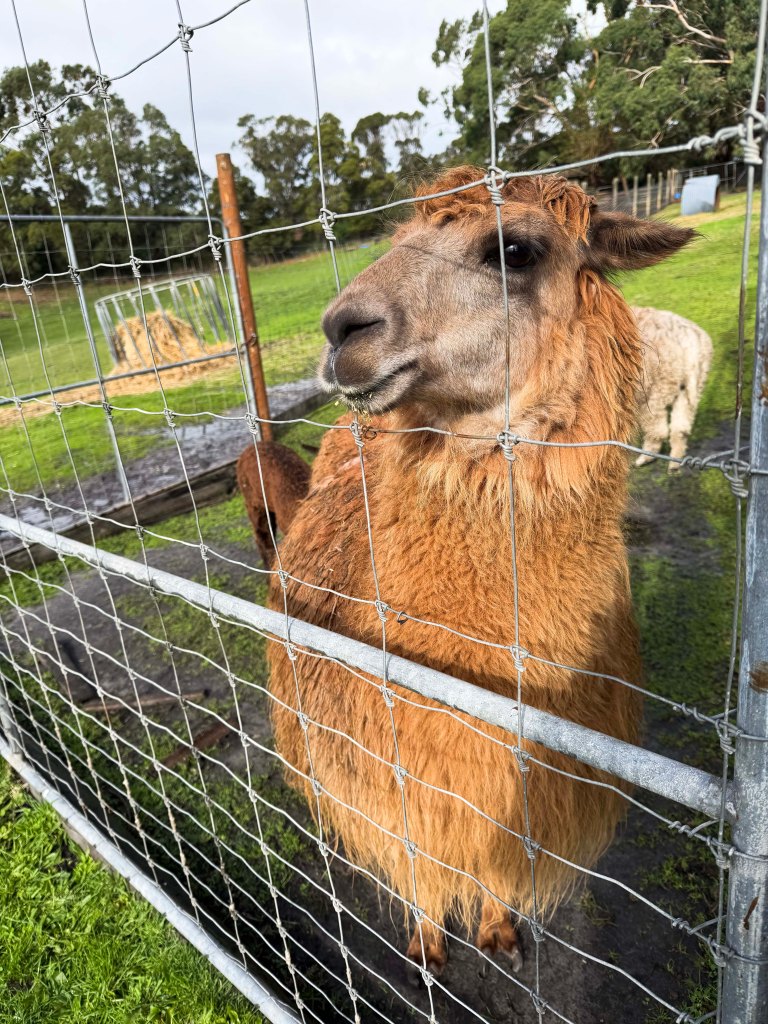
There was also a white kangaroo, perhaps an albino, who seemed to keep largely to himself. R took a particular interest in the fellow and spent several minutes feeding him. The emus, peacocks, and other residents received due attention, but the surprise package of the afternoon turned out to be the llamas. They appeared genuinely interested in meeting us, which raised an obvious question: why do kangaroos and koalas receive all the publicity while these personable creatures remain largely absent from Australian postcards?
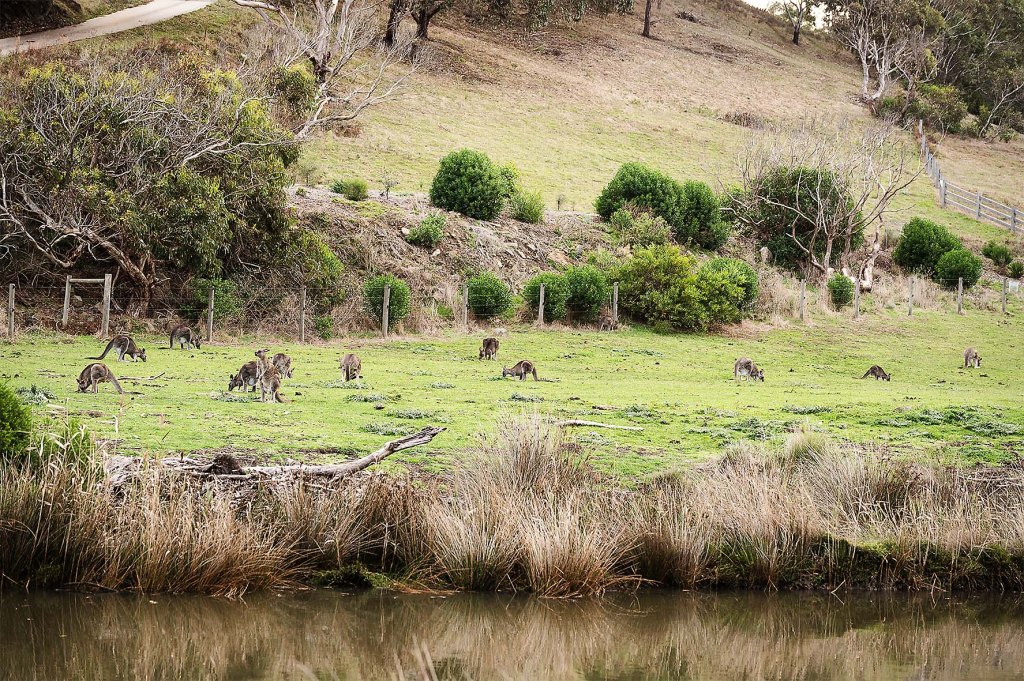
In the distance, we spotted a mob of free-ranging kangaroos. Unlike their counterparts near the visitors, they displayed a refreshing independence and showed no interest whatsoever in the proceedings behind them.
After about an hour, it was time to bid farewell to our non-human acquaintances. Daniel, having used the interval to acquire a strategic nap, emerged refreshed and full of purpose.
“Now,” he announced, “get ready for the spectacular drive along the sea.”
For once, he was not overselling the experience.
The road wound south through the rain-washed folds of the Otways beneath a sky that could not quite decide whether it wished to be silver or gold. Patches of sunlight drifted across the hills, only to be replaced moments later by passing showers. Then, shortly after Apollo Bay, the landscape changed.
The ocean arrived.
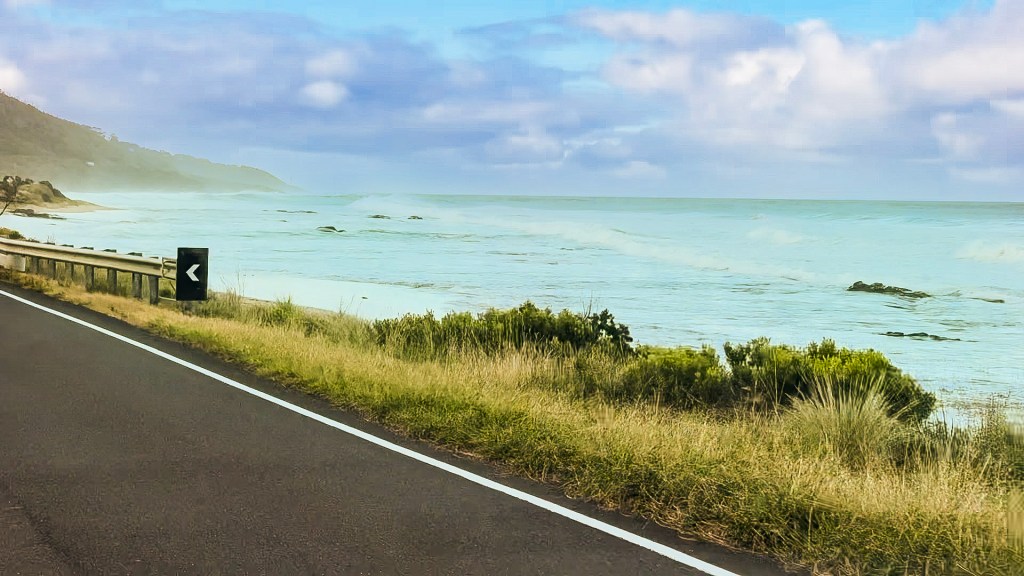
For much of the day we had travelled through forests, farmland, and rolling countryside. Now the Southern Ocean drew alongside the road and refused to leave. To our left stretched a vast expanse of blue-green water, darkening towards the horizon where sea and sky merged into a hazy boundary. Long swells advanced in endless procession from distant latitudes, rising gradually before collapsing against the beaches in bursts of white.
The road now followed the ocean’s every turn, climbing the green shoulders of headlands and curling down towards little coves where white surf ran up the sand. At times we were high above the water, looking down upon waves breaking against dark rocks far below; then a bend would bring the sea suddenly close, flashing blue-green through the roadside trees. Sunlight moved across the water, rain darkened it again, and the wet road shone ahead of us as it twisted along the coast.
Every now and then, a name by the roadside reminded us that people lived among all this splendour. Wongarra, Skenes Creek and other small settlements came and went, sometimes little more than a scattering of houses between green hills and the sea. Farms climbed the slopes, roofs flashed through the trees, and narrow roads wandered away towards places we would never know.
This was the Great Ocean Road we had come looking for. There was no single view to carry away, for the landscape refused to stay still. Cliffs opened into beaches, wooded slopes fell towards the sea, and headlands slipped behind us only for another to appear ahead. For mile after mile, we simply watched the road and the Southern Ocean travel together.
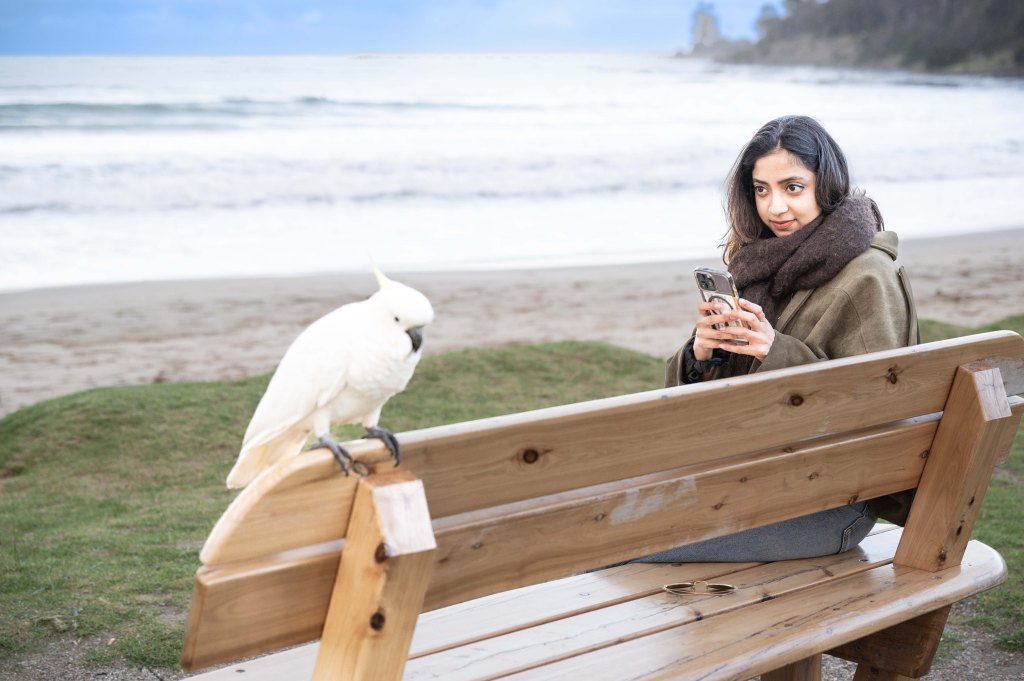
A little after four, we rolled into another improbably picturesque coastal town: Lorne. Unlike Apollo Bay, where we had merely passed through, we stopped here and wandered down to the beach. For a while, we occupied a row of benches overlooking the water, watching sulphur-crested cockatoos strut about with the confidence of local celebrities. Before long, we found ourselves following them along the foreshore, attempting to persuade our cameras to capture something of their personality.
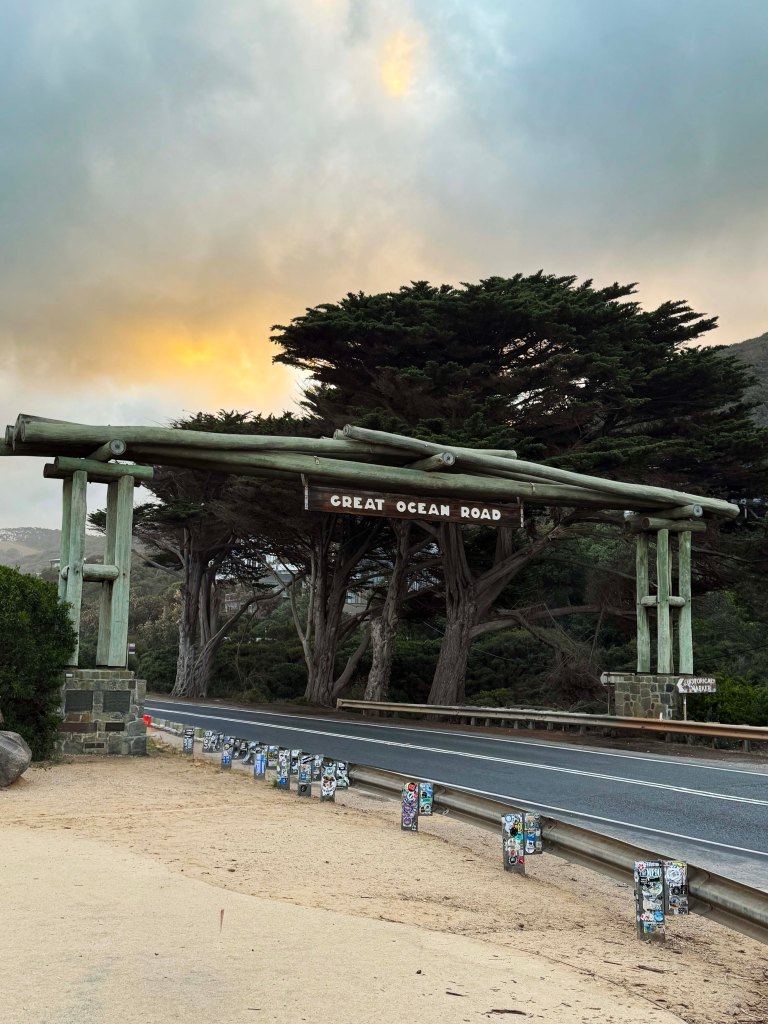
By five o’clock, we reached the Memorial Arch and lingered there for a while. Having spent the day travelling its length, it felt fitting to pause beneath the monument and reflect upon the Great Ocean Road itself.
Standing there, it seemed impossible to regard it merely as a route through magnificent scenery. The cliffs, stacks, arches, and beaches around us were shaped by nature over millions of years through the relentless work of wind, rain, and the Southern Ocean. The road, by contrast, was shaped by human hands over a handful of arduous years.
All day the ocean had been displaying its immense power. We had seen cliffs undermined, arches broken, and limestone formations slowly reduced to sand. Yet beneath the Memorial Arch, another thought suggested itself. The men who built this road had themselves returned from witnessing a different kind of destruction: the devastation of war. Having seen what human beings could do to tear the world apart, they chose instead to build something.
The Great Ocean Road is both a scenic wonder and a war memorial, yet somehow greater than either. On one side stands the ocean, endlessly reshaping the coastline; behind it lies the memory of a war that reshaped countless lives. Between the two runs this remarkable road, carved from rock and hardship by returned soldiers determined to leave behind a monument of creation rather than destruction. The cliffs may one day fall, and the sea will continue its patient work. Yet the Great Ocean Road endures as a reminder that while destruction may be the more dramatic force, creation is often the more enduring one.
Ahead lay Melbourne once more, and beyond it, Queensland.
(Continued in All Quiet on the Gold Coast)


The ceaseless sea has not worn down the wonderful account of your adventure. Doing the driving yourself or getting a Daniel to do the driving would have produced two different accounts – both would have been equally exciting! Even a humdrum event, such as eating lunch or seeing a rainbow, takes on the visage of an epic, astounding quest. Bravo Uma!
I believe I’d take to driving in Australia like a fish to water. Both countries drive on the left, and compared to the organised chaos of Indian roads, Australian roads are sanity itself.
Thank you for the effusive compliment.
I’m happy that you continue to enjoy a tiny bit of what this country offers. How exciting to see that portion of the Great Ocean Road from a helicopter. Queensland will show you something very different.
Our native fauna is always a drawcard; I’m glad they didn’t disappoint.
Australia is a beautiful, inexhaustible country to which I fully intend to return, and this time drive around myself. Flying a helicopter, though, will have to wait for another life!
Its non-human citizens were a particular delight to meet. I would recommend them any day over quite a few of the bipeds back home.
Another enjoyable, informative, amusing, poetic, well photographed episode of your trip. Maybe llamas are not native to Australia, like the other denizens. It is a good thing you didn’t have to drive all that way yourself. When we were in Melbourne we didn’t drive because granddaughter Jessica was only 10 months old and Errol was the only driver which didn’t seem fair.
“I agree, Derrick. Driving on that dramatic stretch in an unfamiliar land would have been a bit overwhelming. I could have done the driving and probably enjoyed it, but I would have needed two days to discover what we covered in one.
Thank you so much. Your generous praise has strengthened my resolve to keep writing.
All of these photos are dynamic and beautiful. What a lovely place to visit and I love how you describe everything.
Thank you. I’ve tried to relive the moments and the moods.
While driving one does miss some of the charms of the road. Not to speak of the mistakes one may make in new territory, though. I used to be the enthusiastic official driver on long family road trips. Over the years I have been persuaded to cut down. Would love to see more photos of the road along the ocean.
There are advantages and disadvantages of being behind the wheel. Given the timeline we were working with, joining a tour group was the most sensible thing to do.
I have added a video today of a stretch of the Great Ocean Road near Wongarra (between Kennett River and Apollo Bay). Don’t miss it.
Found it interesting.
I can’t tell you how much I’m enjoying reading about your Australian adventure! Thank you so much for taking the time to share it with us.
As I write, I realize that memories resist translation into text. I am delighted that you like it. Thank you ever so much.
Metamorphosis from a temporary Melburnian to a wholehearted lover of the Australian bush!
Before I comment on yet another literary excursion as enthralling as the earlier instalments, let me first marvel at those breathtaking photographs of the rainbows and the sea. Whether they were captured by Mr Pandey, T, or V, they are truly stunning. I am familiar with Mr Pandey’s photographic prowess, but if some of these images were indeed immortalised by T or V, it would serve as splendid vindication of Gregor Mendel’s proposition that characteristics are transmitted across generations through discrete hereditary units—now more elegantly known as genes!
Opting for an organised tour and simply sitting back to absorb the landscapes was undoubtedly the wisest decision. Had Mr Pandey been behind the wheel, we readers might have been deprived of many of the exquisite observations that enrich this narrative.
The banker in Mr Pandey, however, could not entirely go on leave. It surfaced promptly when he noted that the Twelve Apostles were rather short of the advertised number! Old habits, evidently, refuse to retire even during a family vacation. Mercifully, he resisted the temptation to investigate the reasons for the numerical discrepancy and instead proceeded to make the acquaintance of the distinguished citizens of the Australian outback.
For me, though, the crowning gem of this literary journey is undoubtedly this description of the koala:
“Perched high among the branches, it regarded us with the air of a creature whose appointment with indifference had just been interrupted. When not contemplating the futility of existence, it devoted itself to scratching its head with admirable concentration.”
That, to my mind, is verbal artistry of the highest order. One cannot help wondering whether Mr Pandey himself borrowed a leaf from the koala’s philosophy and spent a few contemplative moments in the eucalyptus groves; otherwise, such effortless literary musings could scarcely have flowed with such grace.
I fear that if I write any further, I might disturb the profound contemplations of both the koala and Mr Pandey. Prudence, therefore, demands a respectful retreat.
Somewhere between the beautiful coastal cities and the vast, bewildering outback of Australia lies the inviting bush, and we readily crossed over into it. We were glad we did, though we stopped there and ventured no further.
I have seen Gregor Mendel at work. His theories prove themselves time and again, and occasionally fail with equal splendour. T and V shoot very well indeed, and they possess strong artistic instincts of their own. While I cannot thank you enough for commending my photographic skills, there remains, in my own estimation, a fellow who knows rather more than he manages to demonstrate in his photographs. Somehow, I always find myself short-changed by a lack of time, a missing tripod, or even simpler matters such as presence of mind—like forgetting to stop down the aperture to f/8 when the situation plainly demands it.
The matter of the Twelve Apostles failing the census remains an anomaly with which no banker, living or spectral, is likely to be comfortable. Come to think of it, I am now little more than a cocktail of residues, simultaneously haunted by the ghosts of a literary student, a photographer, a banker, and an intrepid driver on unfamiliar roads.
I am particularly fond of your clubbing me together with the koalas. Like them, I enjoy sitting alone on my perch, quietly contemplating the restlessness of the world passing by.
Thanks again for this comprehensive comment. It gave me many reasons to smile, gloat a little, and scratch my head.
‘Gloat a little’ shows your modesty!! You are a multi-talented person, and I am happy that your talents are coming to the fore, one by one, leaving some not so pleasant (euphemism for unhappy) memories behind!! Looking forward to more visual treat and literary as well in your forthcoming posts!!
Sir, I am grateful for the generous appreciation, and for nudging me to keep going.
It’s been a pleasure to catch up with you Uma and to read about your adventures so far. You’ve seen some spectacular sights, both human-made and natural and you describe them in an engaging and amusing way.
I am delighted that my adventures Down Under met with your approval. Thank you ever so much for reading them.
I enjoyed this account so very much. I would have had trouble giving up the wheel (and I did, on one of our trips when I needed to) but I can see what riches to be able to look at everything. I will probably never be in that part of the world, so I am thoroughly engaged. Even down to the little cafe, and how lovely those moments together were. I would love to get my entire family on a trip together. I will keep trying, as I am inspired.
If you can get the seat next to the person behind the wheel, you can fully relish the views unfolding before you, and, I suspect, share a little of the thrill of the drive as well. That was one corner of the world we had all longed to visit for its beauty and sense of adventure. Experiencing it together as a family was an added blessing. I do hope you succeed in bringing your entire family together for such a journey someday. Thank you so much for reading and for your generous appreciation.
I thank you for your good wishes, I want this more than anything.
Allbest–
Truly a chapter full of experiences—rainbows, kangaroos, helicopters and even a rebellious umbrella! 😄
Yes. Those will remain very precious memories. Thank you very much.