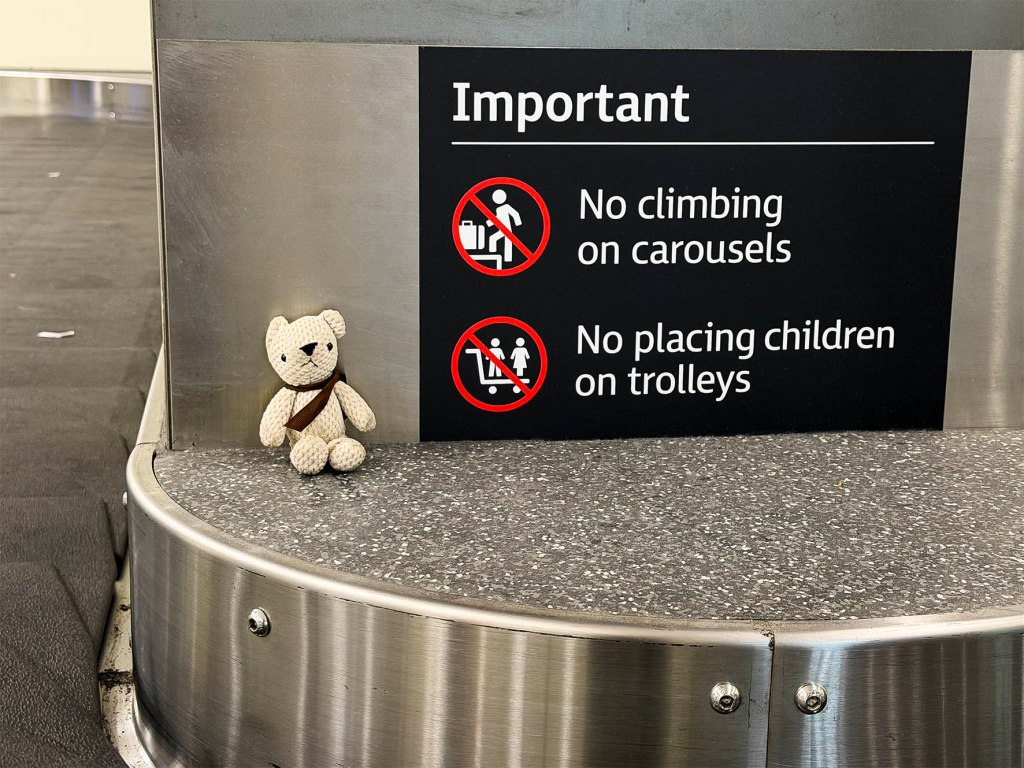
While waiting for our luggage at Sydney Airport, my eyes settled on a tiny teddy bear in a brown muffler, sitting beside a warning sign near the carousel. It had parted ways with its owner and now sat on the tiny ledge, perhaps helped there by a thoughtful stranger, waiting to be found.
It was probably just a lost toy that had nothing to do with Sydney’s history. Yet, travelling in that exciting corner of the planet, the mind was fertile ground for private metaphors. I wondered if the tiny crocheted bear beside those stern safety notices had greeted me with a gentle reminder of the resourceful and adventurous spirit of Sydneysiders, even before I had crossed the city’s threshold.
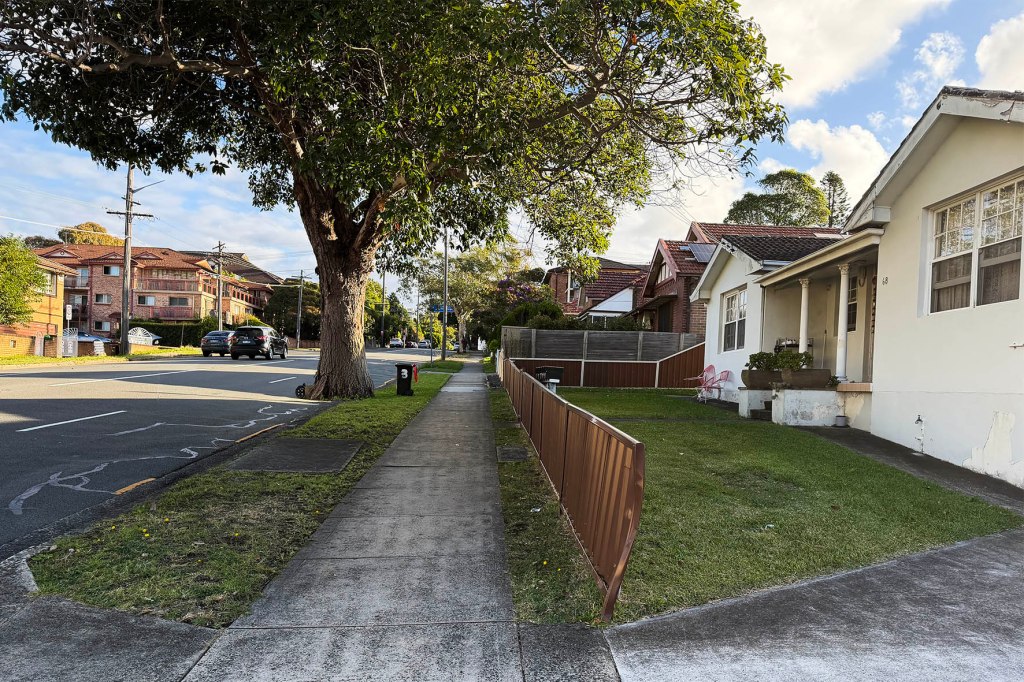
Our twenty-minute drive from the bustling airport to our Airbnb in Hurstville took us through neighbourhoods of surprising modesty: low-rise buildings, ample open spaces, brick apartment blocks, detached homes, and small commercial strips. There were no gleaming towers or sweeping boulevards, only sunlight with a brilliance all its own.
We had chosen Hurstville deliberately, sidestepping the sky-high prices of the CBD. Its proximity to the railway station, providing an easy ride to Circular Quay, and its reasonable rates sealed the deal. I found Hurstville a seasoned suburb: more capable than charming, more comforting than unforgettable. Compared to the compact accommodation we had at the Gold Coast, our Airbnb here was refreshingly spacious and modern. It was a self-contained wood-and-glass dwelling built at the rear of a house on Wright Street.
Delighted to find a capable-looking washing machine, R couldn’t resist tackling the growing pile of laundry in our bags—a decision she would soon regret, as the freshly washed clothes hung stubbornly on the drying stand, refusing to dry for the next three days.
We had been under this glittering southern sun for nearly a week, in the only continent that is also a country, yet we had still to meet the icons of Australia. Ever since childhood, this land had become synonymous with the Harbour Bridge and its younger companion, the Opera House, whose mere glimpse was enough to conjure images of kangaroos, koalas, redback spiders, taipans, sharks and stingrays. Between them, they embodied a land whose prosperity took root along its south-eastern coastline, yet whose vast, unforgiving Outback still dominated its heart; and a country whose people embraced the sun, surf and sand, and had repeatedly weathered adversity with remarkable resilience.
The cinema of Australia had been been unfolding before us for nearly a week. That afternoon, however, it was time for its leading actors to step into the frame. We set off from our new abode that afternoon to greet them, walking through the quiet residential streets of Hurstville, enjoying its wide roads, spacious footpaths, and broad grassy verges. Even the utility poles and overhead wires seemed unobtrusive, separated by so much open space.
Hurstville Central, with the railway station concourse below street level, was a leisurely fifteen-minute walk away. Its upper floors housed a Coles supermarket, fresh-food retailers, and a variety of other shops. As we intended to spend more than three days in Sydney, we bought Opal cards for our travels on the city’s public transport. Most of the suburban trains we saw were double-deckers, a novelty to us. We promptly occupied the upper deck of a T4 Eastern Suburbs service, hoping to catch wider glimpses of the city.
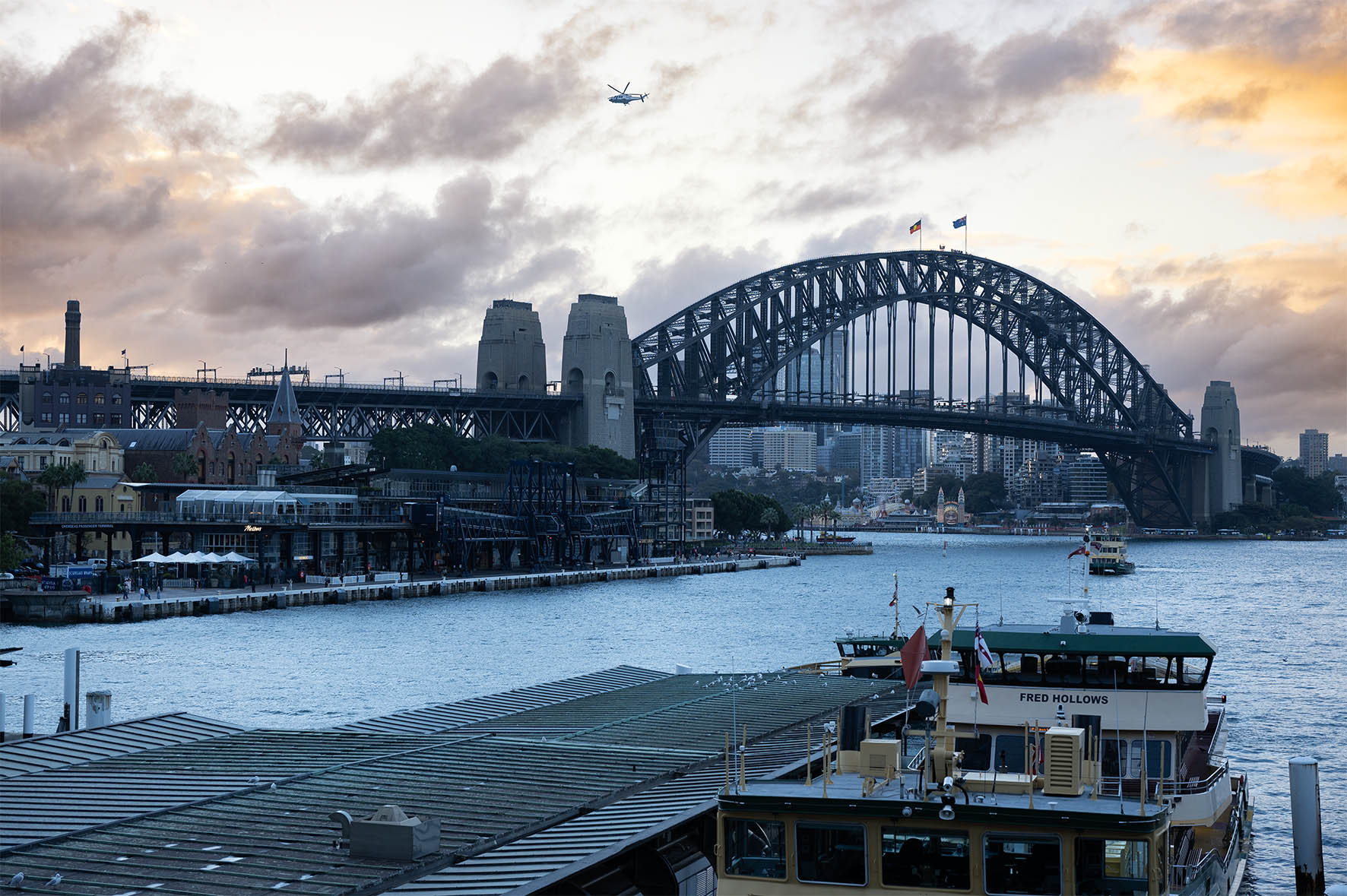
Sydney extended before us as a remarkably low-rise expanse, unlike the forest of skyscrapers one encounters in Singapore or Hong Kong. From the upper deck of our double-decker train we saw little beyond rooftops and gardens. Quiet service roads, rear fences, garages, warehouses, and ageing apartment blocks made a deliberate visual understatement that I later learned owed much to Sydney’s planning policies and heritage protections. Only as we approached Central did the skyline begin to gather itself. We changed to a City Circle service, plunged underground, and emerged moments later at the elevated station of Circular Quay.
Before the train had even come to a halt, we were already on the lower deck, brimming with anticipation. The twins, amused by my lingering habit of pronouncing “Quay” to rhyme with “tray”, kept reminding me that it was simply “key”. As soon as we stepped out onto the concourse, the Harbour Bridge burst into view over the shimmering waters, silent and immense. To its right, the Opera House completed the scene, its sail-like roofs glowing in the afternoon light.
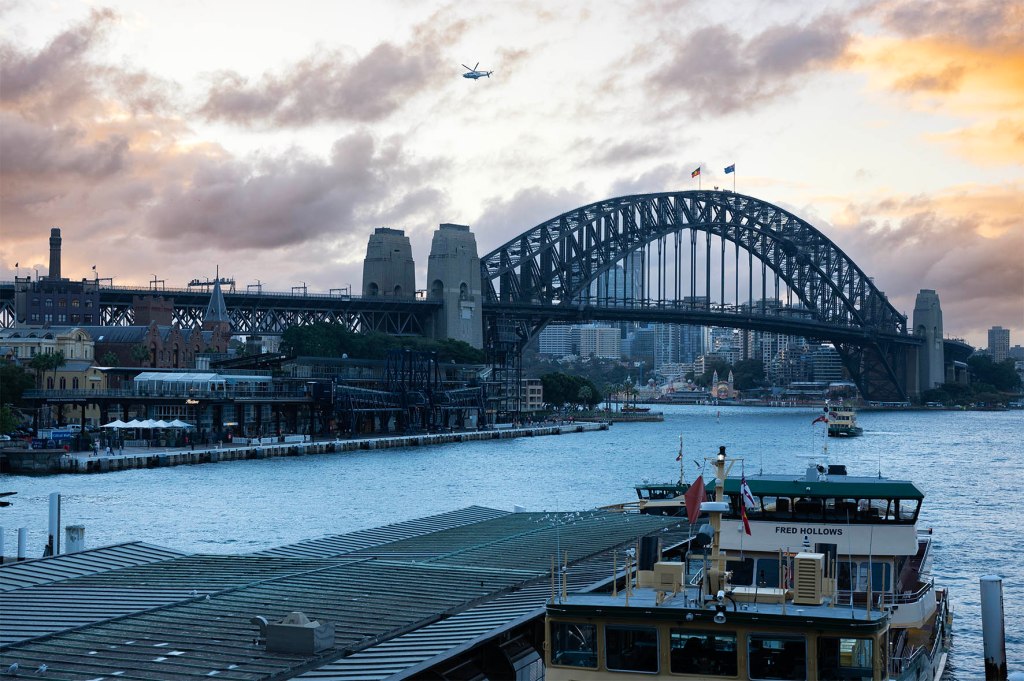
We had all seen these icons in countless photographs, yet seeing the Bridge in person, arching across the harbour, was so breathtaking that we found ourselves exclaiming in unison. Ferries glided in and out of the wharves, while the promenade teemed with people, mostly tourists, many wearing the unmistakable expression of those who had finally arrived somewhere they had long imagined. Unlike the quiet suburbs, Circular Quay seemed to distil Sydney’s grandeur into a single waterfront, its towers gleaming, ferries weaving across the harbour, and the air alive with movement.
The Opera House refuses to settle into a single identity. We first encountered it as the familiar image known to the world: a cluster of white sails poised above the harbour. Yet the moment we began walking around it, the picture dissolved. Its geometry rearranged itself with every few paces. Seen from closer quarters, the sails gave way to majestic concrete ribs, timber-lined ceilings, and vast walls of glass. Then, as we stepped back for a longer view after nightfall, the fragments quietly reassembled themselves into the elegant silhouette that had first greeted us from Circular Quay.
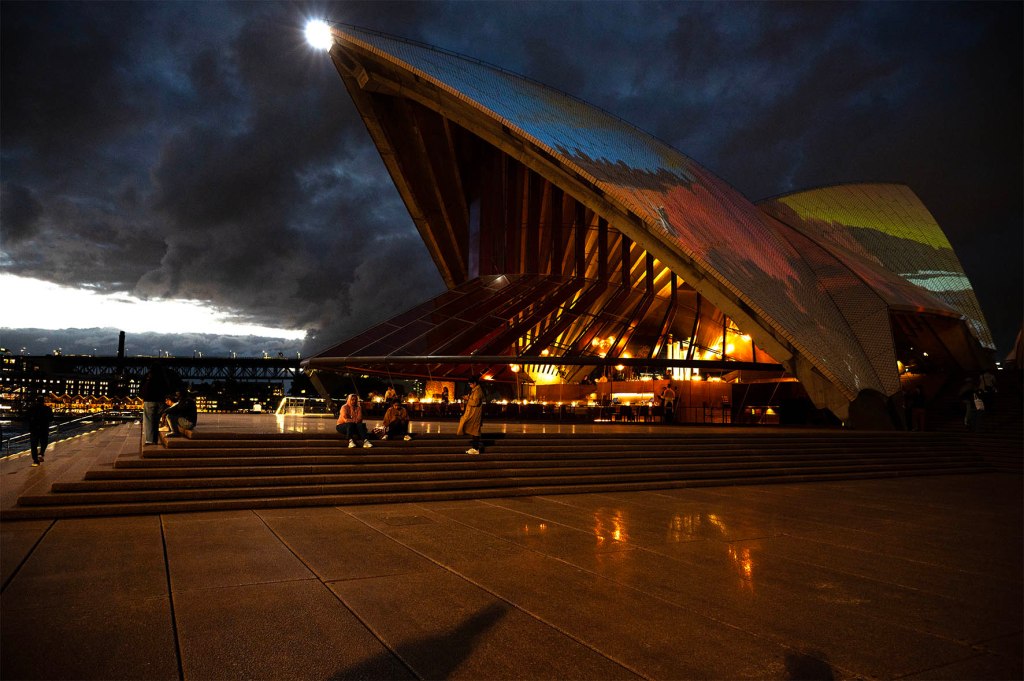
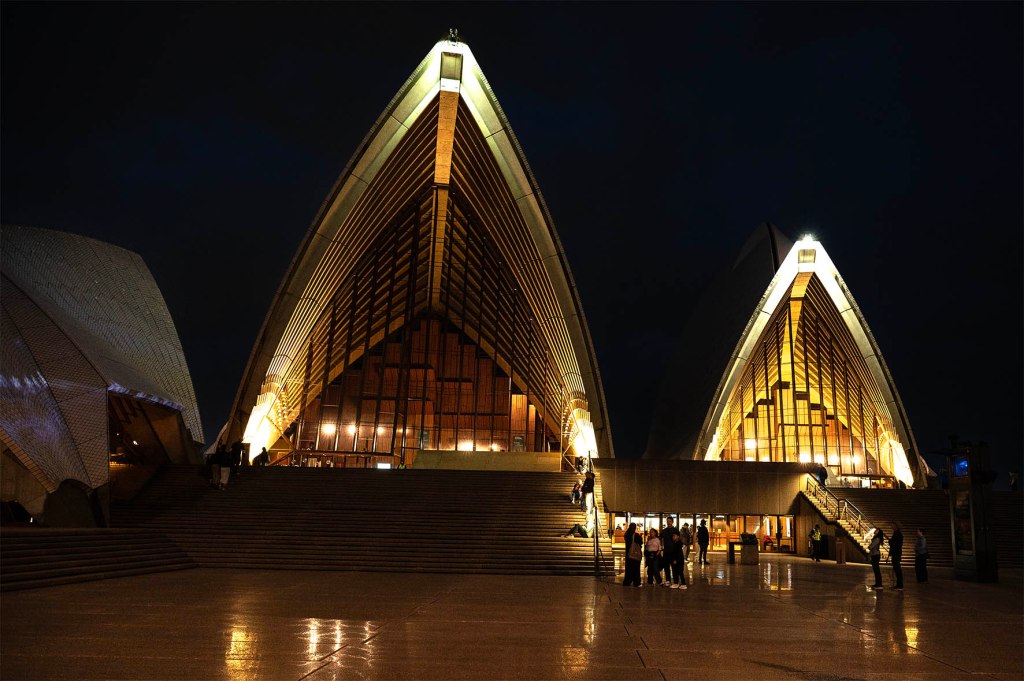
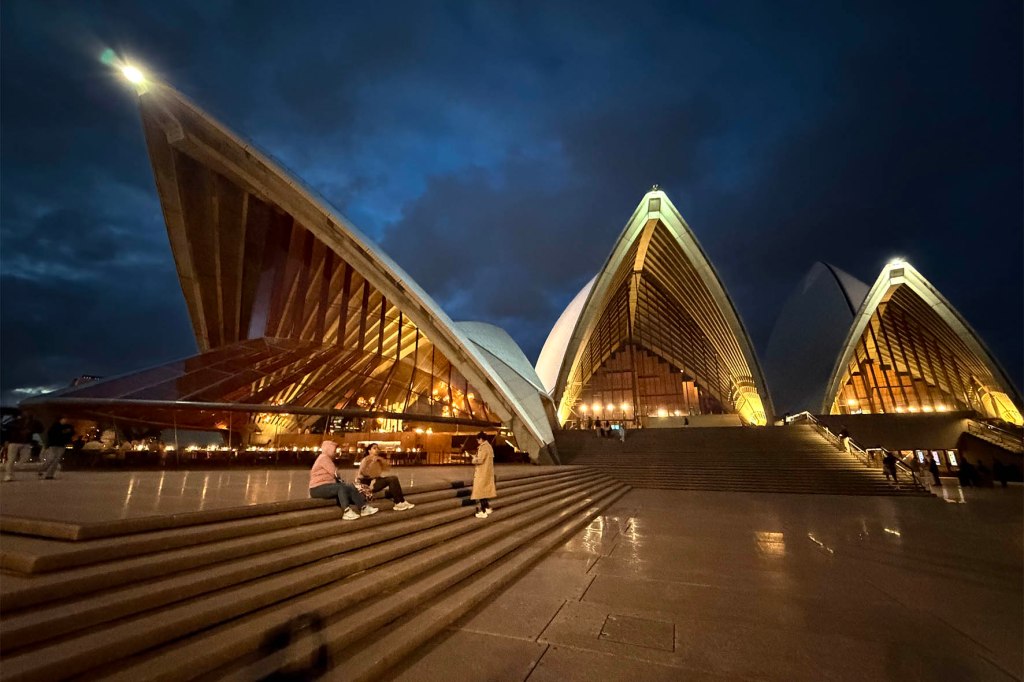
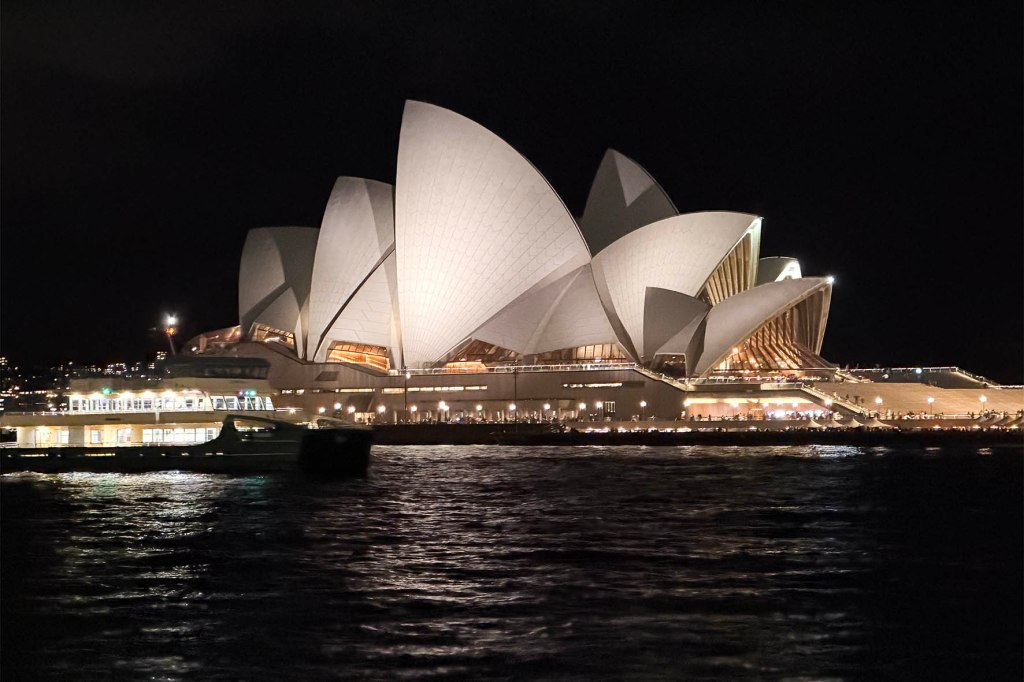
In Opera House, Jørn Utzon designed not merely a building to be seen, but one to be explored. From afar, it is sculpture; from the forecourt, architecture; beneath its shells, engineering; and from the harbour at night, it dissolves into light. It seemed less like a static monument than a living work of art, rewarding every change of viewpoint with a fresh composition. A few paces were enough to persuade us that the Opera House was not one monument, but many.

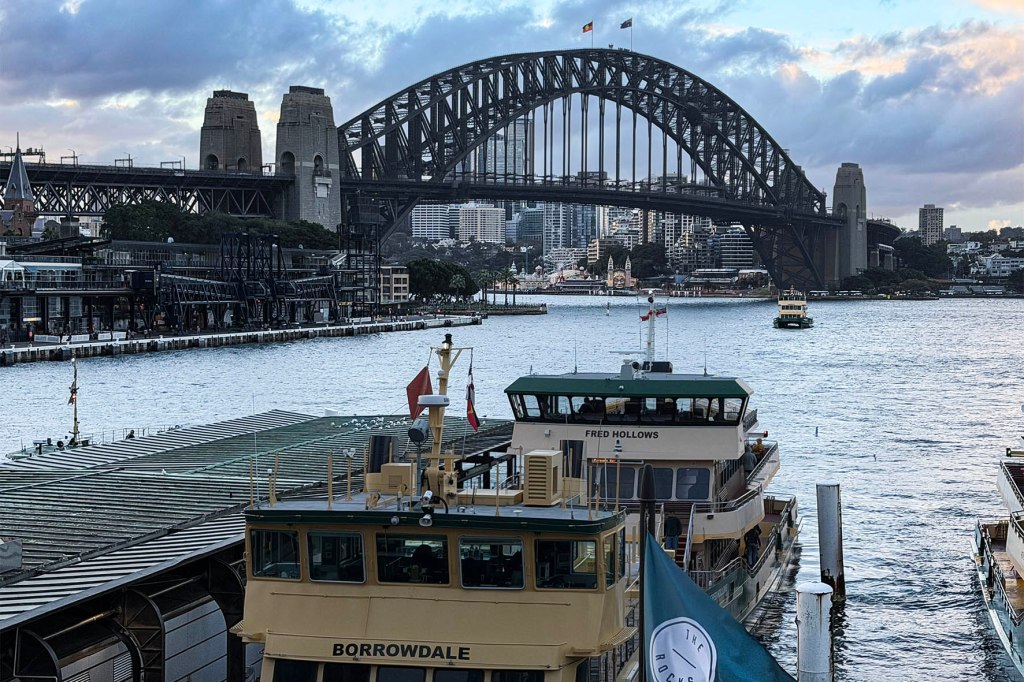
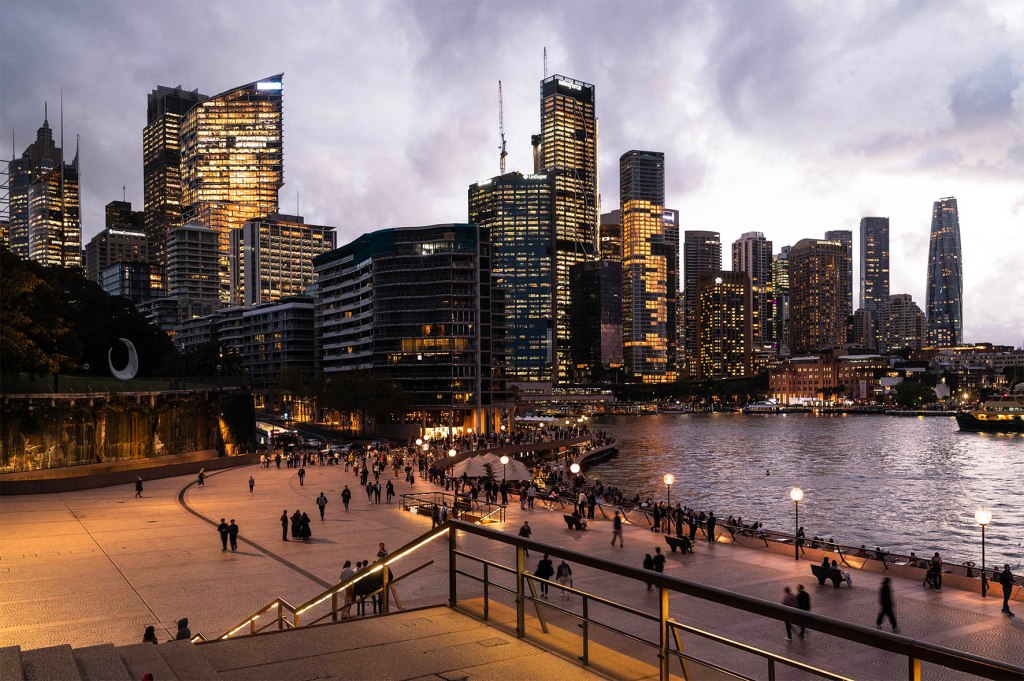
Unlike the chameleon-like Opera House, the Harbour Bridge retained its reassuring permanence. It stood above the harbour like an elder sibling—protective, immense, unwavering, and quietly majestic, never failing to satisfy the eye. As twilight deepened, however, the harbour acquired an altogether different aura. Countless shimmering reflections danced upon the dark waters, while the steady murmur of the evening crowds drifted across the waterfront.
We lingered at Circular Quay for the next three and a half hours, strolling repeatedly between the Harbour Bridge and the Opera House. Every change of position offered a fresh composition, and we found ourselves stopping again and again, sometimes to admire the view, sometimes to photograph it, and often to ask passing strangers to capture the four of us together, before happily returning the favour in turn. The splendour of the harbour was impossible to ignore. Yet all the while, we remained aware that we were standing where modern Australia had taken its first tentative steps.
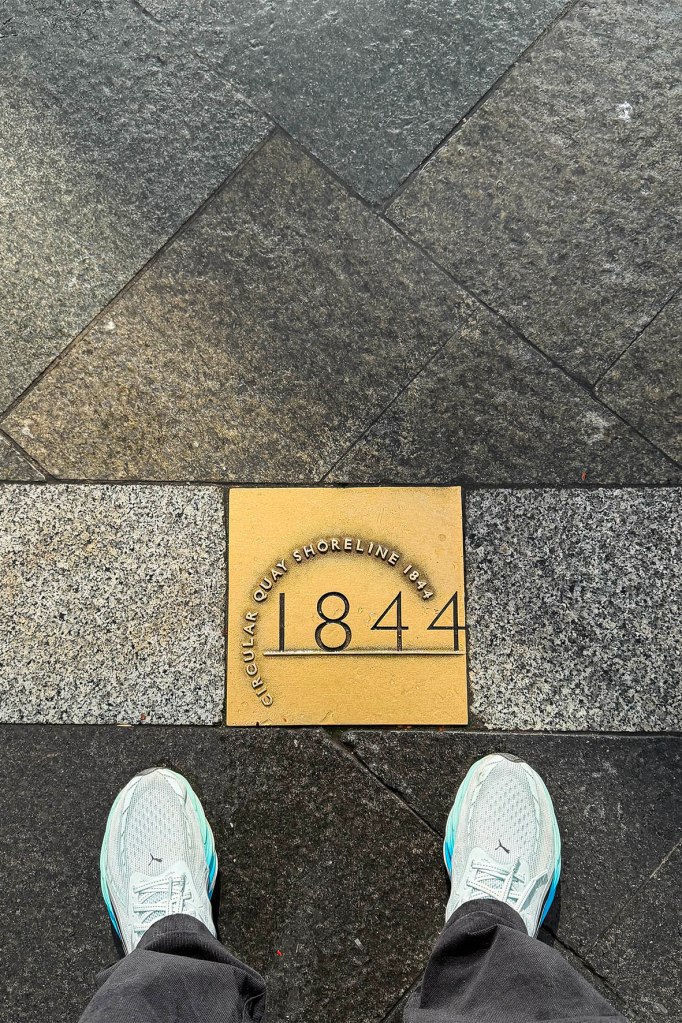
The trouble with history is that it cannot be observed directly. It must be reconstructed from the clues that survive, leaving the imagination to bridge the centuries. At one point on the promenade, the present was interrupted by a square of brass, pointing out that I was standing on the shoreline of Circular Quay in 1844.
Nothing about the bustling waterfront around me suggested 1844. The wooden sailing ships that had once relied upon wind, tide and stars were gone. Engines, radio and radar belonged to a future beyond imagination. The Opera House did not exist, the Harbour Bridge would not rise for another eighty-eight years, and the harbour still reached the spot where I stood.
The plaque invited another leap backwards. In January 1788, Governor Arthur Phillip rejected Botany Bay in favour of Sydney Cove, drawn by its deep natural harbour and the fresh water of the Tank Stream. Even then, the survival of that ragged company of convicts, marines and officials was far from assured. The fledgling settlement stood at the very edge of the known world, sustained by dwindling provisions and fragile hope. Crops failed, the Tank Stream was gradually fouled, and every relief ship lay months away across the oceans.
The isolation is difficult to comprehend today. A modern city in distress can expect assistance within days. Sydney Cove could wait many months, and there was no certainty that every voyage would reach its destination. There came times when the colony’s future hung by little more than endurance, prudent leadership, good fortune, and perhaps a measure of providence. As I stood watching ferries glide across the harbour in effortless succession, it was difficult to imagine that these same waters had once carried a handful of sea-worn sailing ships upon whose survival rested the future of a colony that would one day become a continent-sized nation.
From Circular Quay, it was impossible not to wander into The Rocks. By then, evening had given way to night as we entered Sydney’s oldest precinct of sandstone buildings, narrow streets, outdoor cafés, and trees wrapped in fairy lights. It was easy to imagine oneself in an old European quarter, were it not for the unmistakable cadence of Australian voices floating from the cafés.
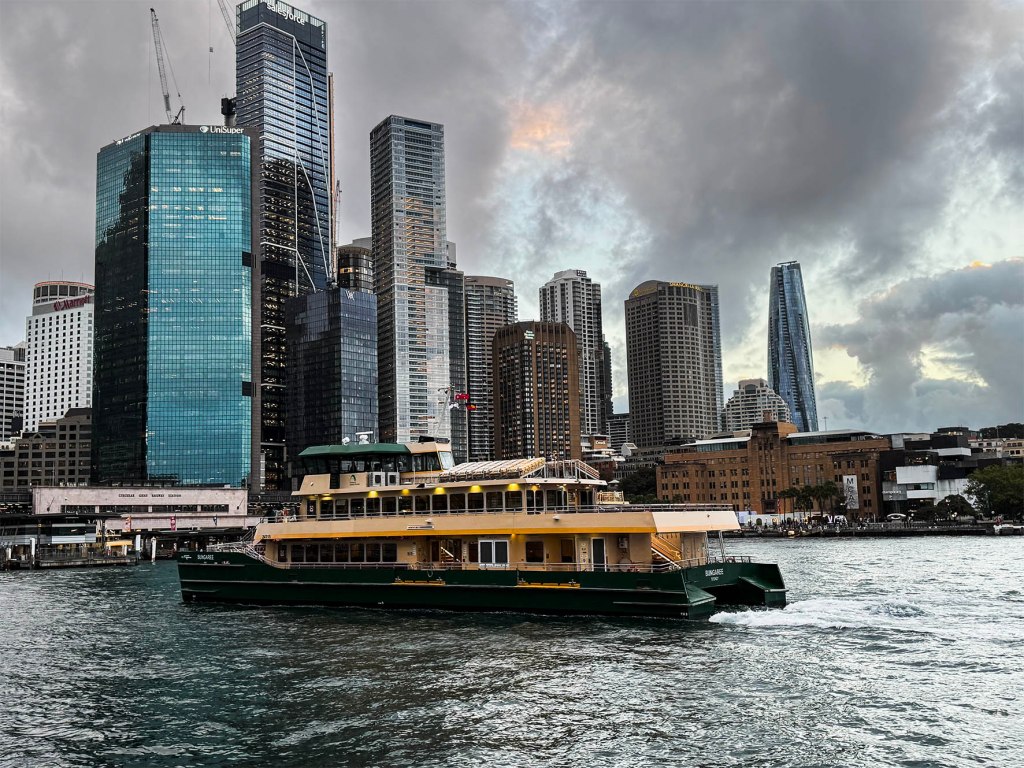
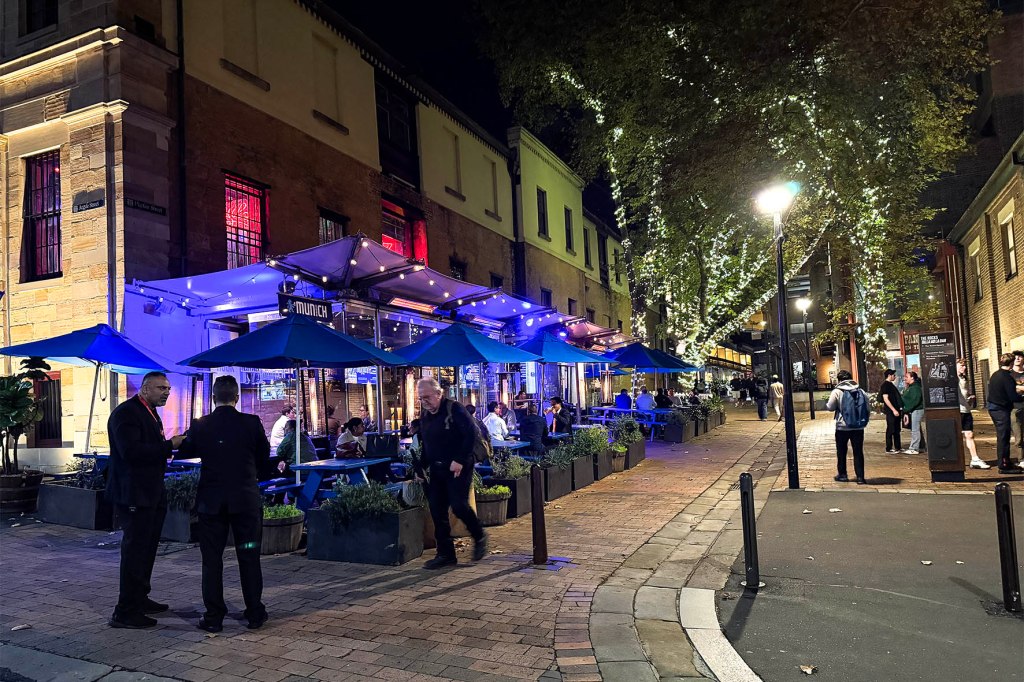
Circular Quay is the undeniable jewel in Sydney’s crown, but The Rocks is where the city remembers itself. The precinct possessed a distinctly old-world atmosphere, inviting not admiration so much as unhurried wandering. Our wanderings ended at an outdoor table of a small restaurant spilling onto the footpath, bringing a memorable first evening in Sydney to a fitting close.
The return to Hurstville was uneventful, the Metro carrying us back with the hallmark efficiency of Sydney’s public transport. We emerged from the station with a throng of passengers, only to watch the procession gradually dissolve into smaller streams as people peeled away at one intersection after another. By the time we neared our Airbnb, we had the streets to ourselves.
Night was only beginning to settle over Hurstville. The air was cold but not biting. It was crisp and remarkably clean. Above us, an indigo sky stretched across the suburb, its scattered clouds drifting silently overhead. Traffic rushed along the main road at impressive speed, yet we never felt uneasy. The pedestrian crossings inspired confidence, and motorists unfailingly yielded when the lights demanded it.
Along this quiet walk, we found abandoned shopping trolleys here and there on the residential streets, sometimes still carrying a can of soft drink or an open loaf of bread. They seemed oddly out of place amid the otherwise orderly suburb, hinting at lives and stories we could only speculate about.
Later that night, sharp flashes of lightning split the darkness, followed by rolls of thunder. Rain arrived in sudden, forceful bursts, only to retreat as abruptly as it had come. By morning, however, the night’s drama had vanished without a trace. The sky was clear, the streets washed clean, and the morning arrived with a brightness that seemed almost too sharp for the eyes.


I once (1987) changed planes in Sydney when flying from Rome to Auckland. I had quite a few hours to spare so managed to see the Opera House and the Harbour Bridge! Apart from that and the Airport that was my sole Australian experience. You brought it all back! and are adding so much more to the experience!
Nothing less than a month would do justice to Australia. It is vast, startling, and immensely rewarding. I would consider our visit little more than a fleeting introduction to the country. Hang on for whatever I can muster for you. Thank you!
Your insightful poetic prose adds stature to this first rate travelogue
Thank you, Derrick, for your generous appreciation.
A delightful travelogue Uma. You should publish it.
Perhaps someday, I will. Thank you so much, John.
The twins teasing you over pronouncing “Quay” as “tray” instead of “key” — that’s exactly the kind of family running joke a trip like this plants forever. I loved your line that the Opera House is “not one monument, but many”; Utzon really did design it to be walked around. And that brass plaque dropping you onto the 1844 shoreline gave me chills. Traveling as a family of four, those shared gasps at Circular Quay are the whole point. Beautiful piece — looking forward to the next.
I am happy that different notes of the post resonated with you. One of the joys of travelling as a family is sharing the journey itself and growing closer through the experiences along the way. Thank you so much for continuing with us in the pursuit of Oz.
Mr. Pandey at his best again! In his inimitable style of creating a visual travelogue through words, he brings Sydney Harbour right before the reader’s eyes with poetic prose. I could almost see the changing hues of the sky as twilight slowly surrendered to the night; the myriad reflections dancing upon the dark waters, while the gentle murmur of the evening crowd became the perfect background score to the cinematic panorama unfolding before my mind’s eye.
Before I say anything further, let me quote the two highlights of this episode:
“From afar, it is sculpture; from the forecourt, architecture; beneath its shells, engineering; and from the harbour at night, it dissolves into light.”
And…
“A few paces were enough to persuade us that the Opera House was not one monument, but many.”
These are not merely descriptions of a building; they are descriptions of perspective itself.
There are many more gems scattered throughout the travelogue, but if I were to quote all of them, I might as well copy and paste the entire episode here!
My first day in Sydney, in the elite company of the Pandeys, was relaxed, yet immensely enriching. The many leisurely strolls between the older sibling, the Harbour Bridge, and its ever-changing younger companion—the chameleon-like Opera House—revealed countless perspectives and dimensions that can only be truly appreciated by lingering awhile.
Lo and behold! Mr. Pandey’s literary portrayal of the Opera House, changing its identity with every few steps, is certain to leave many readers carrying a vivid image of it long after they have finished reading—one that feels almost as real as reality itself.
Introducing history into a travelogue can easily become tedious—if written by anyone else. Certainly not by Mr. Pandey. Without quite realising it, I found myself becoming an eager student under his gentle tutelage as he transported me across the centuries, tracing the remarkable transformation of Circular Quay from a fragile colonial settlement into the elegant waterfront that today commands the admiration of visitors from around the world.
It has been quite a day, with many miles happily clocked between the Harbour Bridge and the Opera House. Time now to retire for the night with a silent prayer that the little teddy finds its little friend, and the child, in turn, finds the dear little teddy—for a happy reunion.
Good night!
Sir,
I am deeply grateful for this wonderfully generous reading of the piece. Nothing could be more rewarding for a travel writer than knowing that a reader not only accompanied the journey, but also paused to notice the many perspectives—both present and historical—that the city gradually revealed to us. I am especially pleased that those passages about the Opera House resonated with you, for they arose from the simple delight of walking around it again and again, discovering that it seemed to become a different monument with every few steps. Your kind words about the historical interludes are equally encouraging, because my hope has always been that history should enrich a journey rather than interrupt it. And yes, I, too, hope that the little teddy eventually found its young companion. Thank you so much for travelling with us through Sydney, and for leaving behind a comment as memorable as the journey itself.
So here I am, a resident in Australia since 1966, and you bring your wonderful observations that make me appreciate once again, what a lucky country this is. We tend to take our surroundings very much for granted after a while, and then comes a traveller to say “Just look at that” to open our eyes again.
You’re an exceptionally descriptive writer, Uma.
As they say, familiarity breeds contempt. Sometimes, as you have correctly observed, the perspective of a complete stranger is a much-needed reminder of the riches one has grown too familiar with. Thank you so much for your appreciation.
I enjoyed your vivid descriptions and heartfelt metaphors, as if I rode a double decker bus with you. Thanks for the journey. Can’t wait for Part 2!
I truly appreciate you taking the time to read and join me on this journey.
Your keen observation has heightened the entry into the city with that metaphorical welcome. As for as pedestrians are concerned, in our country they are the least priority as sometimes footpaths become alternate driveways for motorists who are always in a hurry. I was amused to know about the pronunciation mentoring you got as my children too often correct my pronunciation. Once again an interesting read.
Entry to Circular Quay is always a dramatic revelation, especially for first-time visitors. Almost without warning, Sydney’s understated cityscape opens onto the magnificent spectacle of one of the world’s great natural harbours, framed by the Harbour Bridge and the Opera House.
Your reflections on wayward Indian motorists, who often treat footpaths—and, if I may add, sometimes even pedestrians—as extensions of the road, are only too true.
Impromptu pronunciation lessons are hardly uncommon, especially when menus wander into exotic cuisines from around the world. But it is precisely such light-hearted moments that make life richer.
Thank you for reading and appreciating.
What a beautifully observed piece. The little crocheted bear at the carousel is such a perfect opening you’re honest that it probably meant nothing, and yet the mind does exactly that when it’s somewhere new and alert. And I appreciated that you gave Hurstville its due rather than rushing to the icons: “more capable than charming, more comforting than unforgettable” is a wonderfully fair way to describe a suburb that’s simply getting on with things. (R’s laundry saga made me laugh three days of stubborn damp is a rite of passage.)
Your reading of the Opera House is the part I’ll remember. Sculpture from afar, architecture from the forecourt, engineering beneath the shells, light from the harbour at night that’s exactly the experience, and I’ve never seen it put so cleanly. Setting it against the Bridge’s unwavering permanence makes both stand out more.
And then the brass plaque. That shift from a crowded promenade to 1844, and then back to 1788 with those ships and dwindling provisions, you make the isolation genuinely felt. Ferries gliding by in effortless succession while you’re thinking about a colony whose future hung on endurance and luck. Lovely writing throughout.
Thank you so much for your generous reading. I am pleased that you found it worthwhile.
You have really lit up the city for us! I am along for the ride.
Incidentally, I have always said ‘quay’ with a long a sound, and use it often in Scrabble games. It will take some time for me to correct that.
I saw that you were noticed on Freshly Pressed. I am so glad that you will have many more reading your words. I am happy for you.
Thank you for the compliment.
Am I glad to be in such exalted company over the pronunciation of “quay”!
Getting noticed on Freshly Pressed is a pleasant surprise.
As an avid teen reader, I always thought quay rhymed with ‘say’, as I also thought corps rhymed with ‘corpse’ and herbs was pronounced with a ‘h’ beginning. It is another world to hear a book on tape… especially when the narrator adds the appropriate setting accent.
I know exactly what you mean! English spelling does like to set traps for unsuspecting readers. And yes, audiobooks add a whole new dimension, especially when the narrator gets the local accent just right. Thanks for stopping by.
Nicely done, mate. I cannot recall another foreigner who has chosen to stay in Hurstville. Sydney, and particularly Coogee and La Perouse, have so much to offer. I hope you got a sense of them?
Thanks, mate! Hurstville was an unusual choice, I suppose, but in retrospect I’m rather glad we stayed there. It gave us a glimpse of everyday suburban Sydney that we might otherwise have missed. We did explore quite a bit of the city, though Coogee and La Perouse unfortunately escaped us this time. Your comment tells me exactly what should be on the list if there is a next visit!