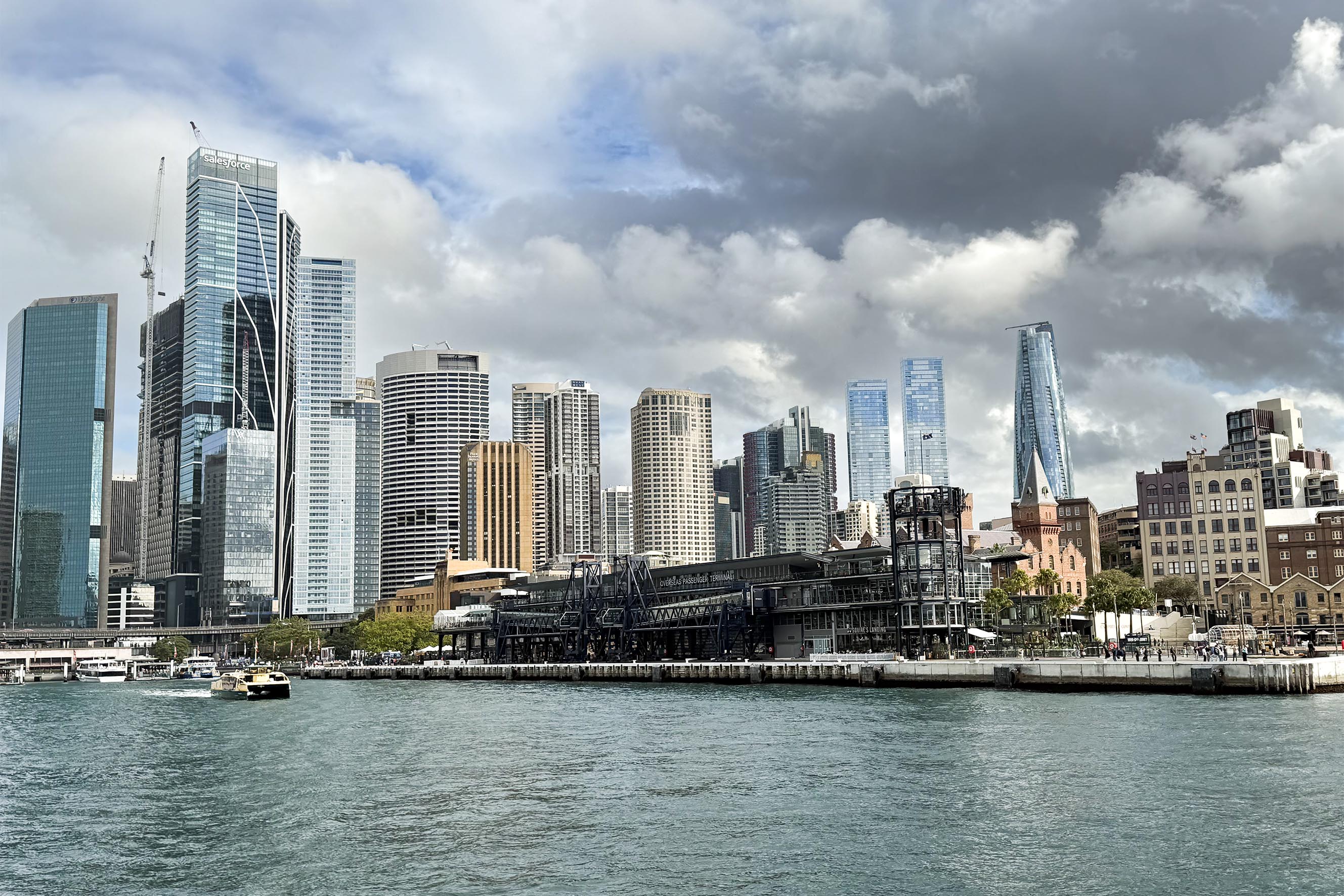
(Further to All That Light in Sydney)
Few places have woven swimming, surfing and sunbathing so deeply into their identity as Sydney. Fittingly, we greeted the fresh day with a visit to Bondi Beach.
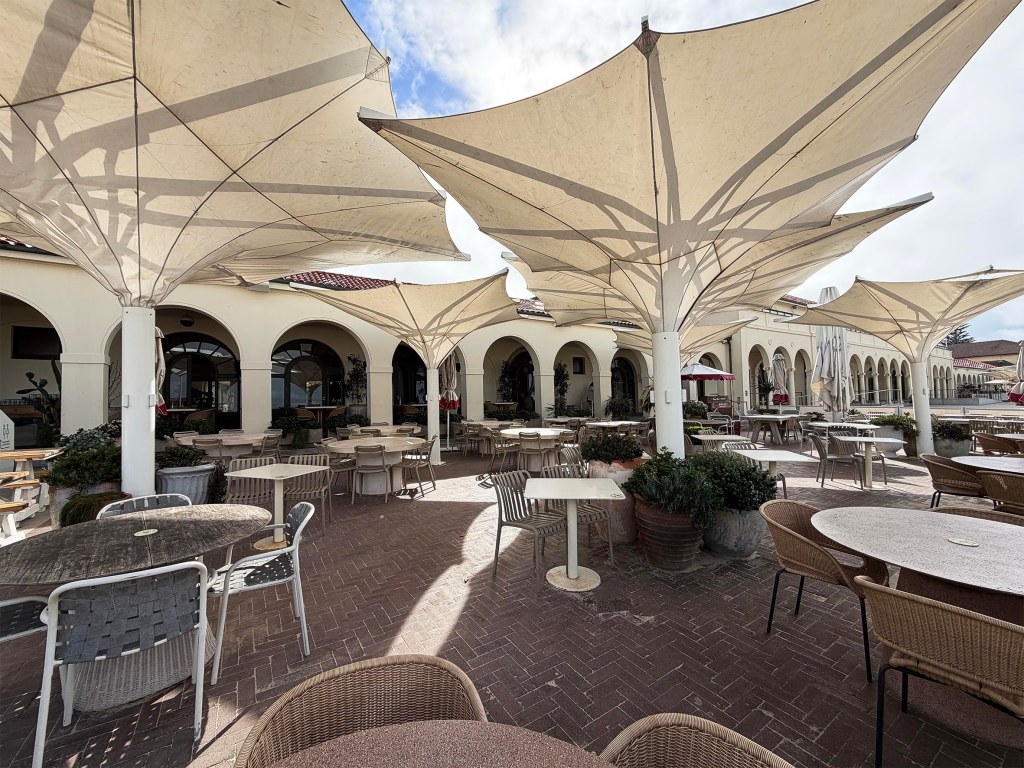
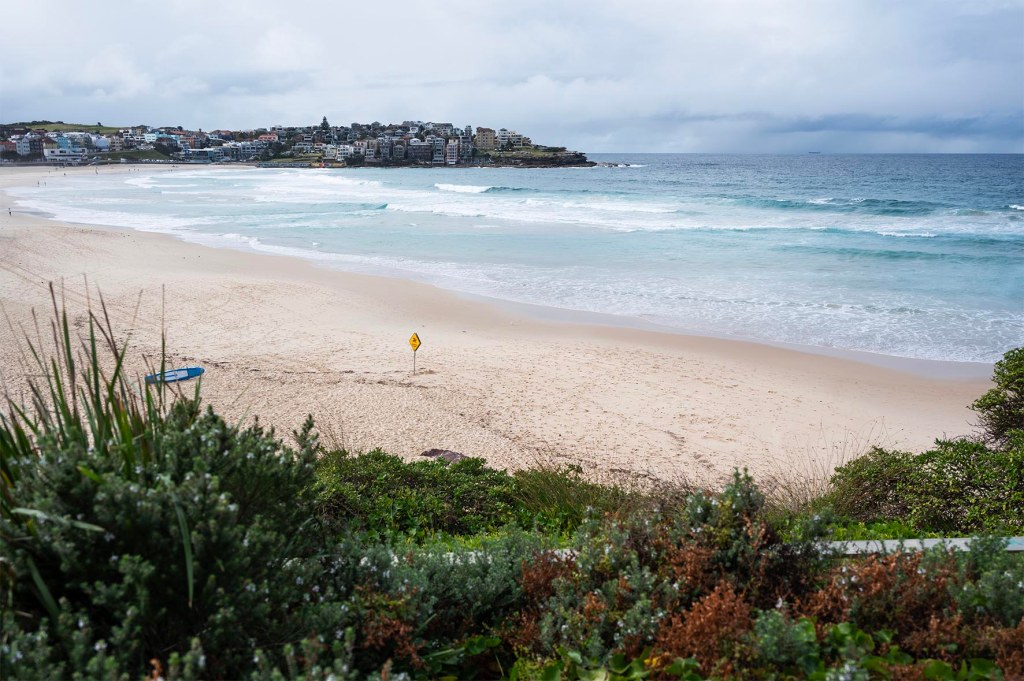
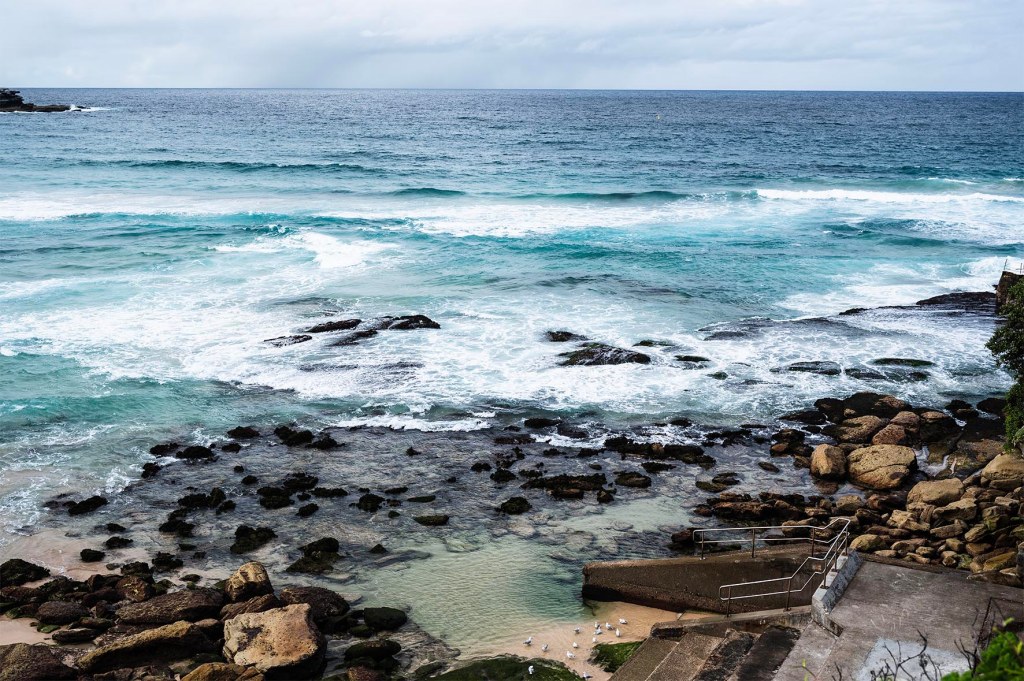
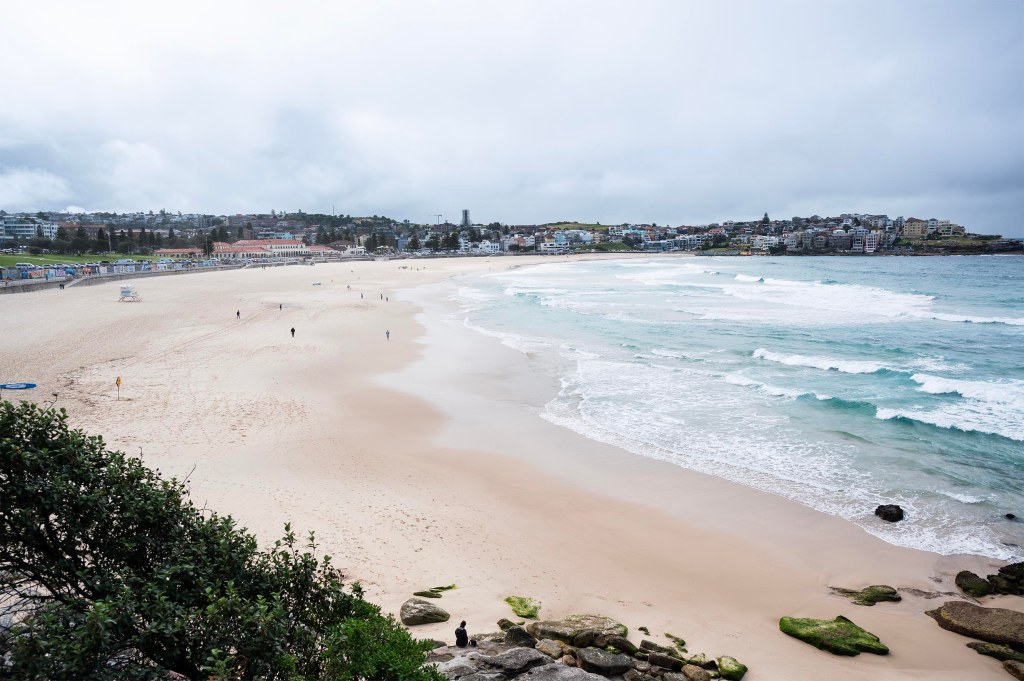
We hadn’t expected Bondi to wear such a quiet face that morning. There were no carnival crowds, nor were sun-worshippers packed shoulder to shoulder. Instead, Bondi offered a wide sweep of pale sand, a handful of walkers and council workers, low clouds drifting in from the Tasman, and a few solitary souls content to let the Pacific whisper its mysteries. The Bondi Pavilion seemed in no hurry to wake, its arcaded terrace and outdoor tables lying almost empty beneath the retreating clouds. Apart from the measured thunder of the surf, only an occasional bird call disturbed the quiet
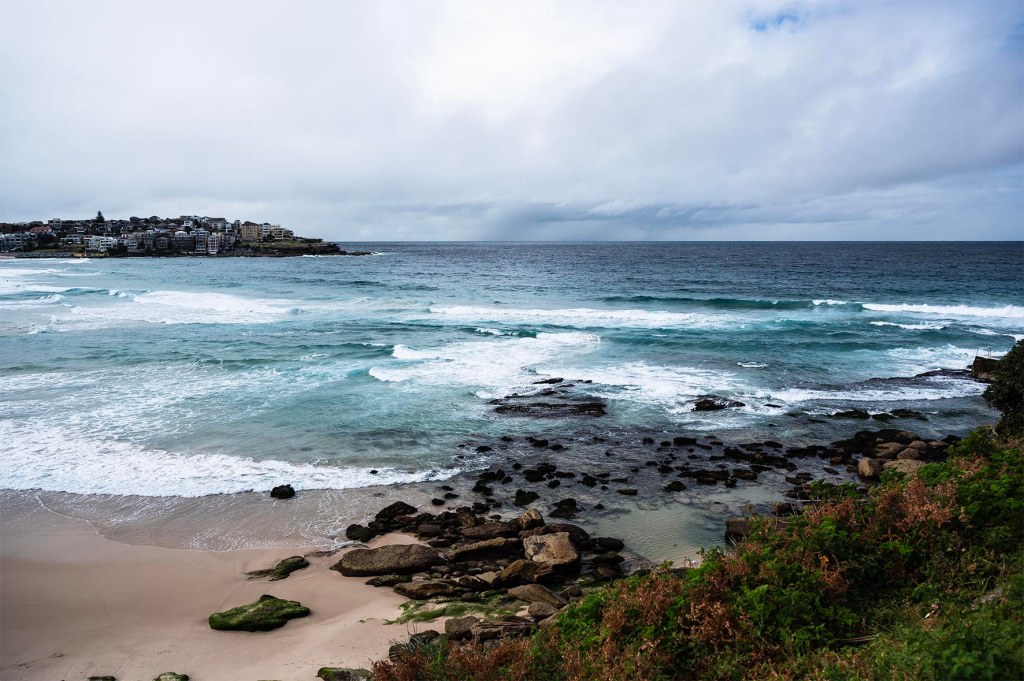
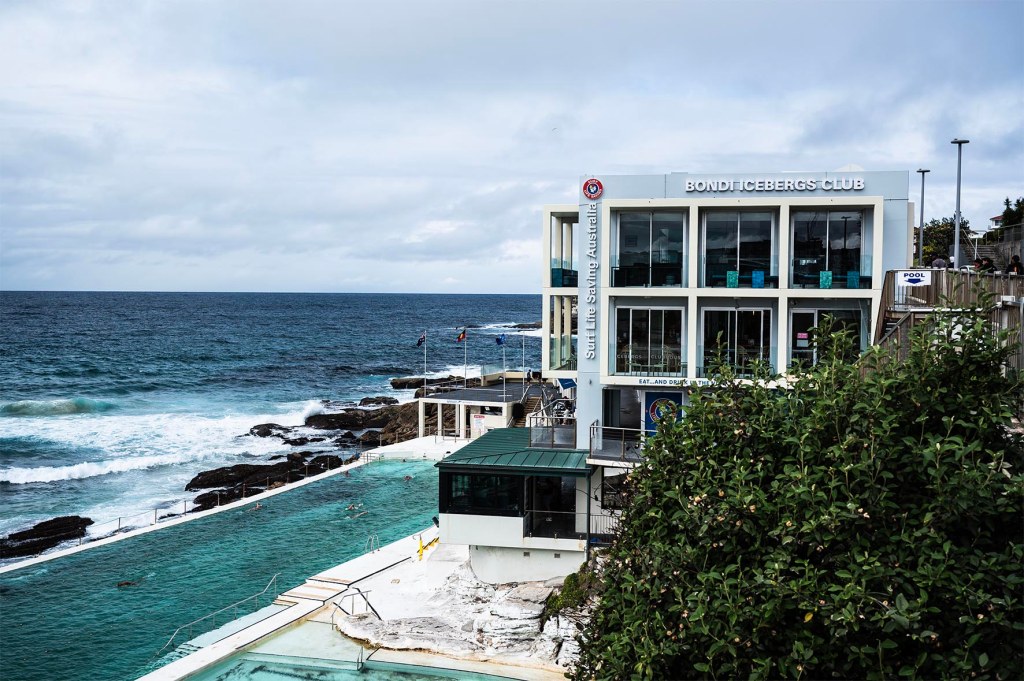
We wandered along the coastal walk towards Coogee, lingering over the coastline no less than the sea itself. Coastal shrubs and wind-bent grasses softened the rugged cliffs; succulents clung to the rock, flourishing on little more than salt spray and sea breeze. The track wound through bays and rocky coves, dipping towards ocean pools before climbing back to the cliffs, with the tang of salt and kelp in the air.
Somewhere along the walk, the clouds parted, and the Australian sun slowly reclaimed the morning. The air remained cool, but the sunlight possessed a brilliance the coolness belied. It was a distinctly Australian paradox: the air felt gentle, the light anything but. R, already under the weather, found the glare oppressive, and before long we turned back towards Bondi.
It was hard to reconcile this languid morning with Bondi’s riotous history. Sydneysiders once debated fiercely whether swimming in daylight was scandalous. Men won that right after persistent and sometimes comical campaigns; women followed, and then mixed bathing became the norm. Still, beach inspectors, tape measures in hand, patrolled the sand, checking whether swimsuits had crept a few inches too far towards moral disaster. Later, counterculture movements challenged these old codes, and Bondi became one of Australia’s principal stages for debates over bodily freedom, censorship and self-determination.
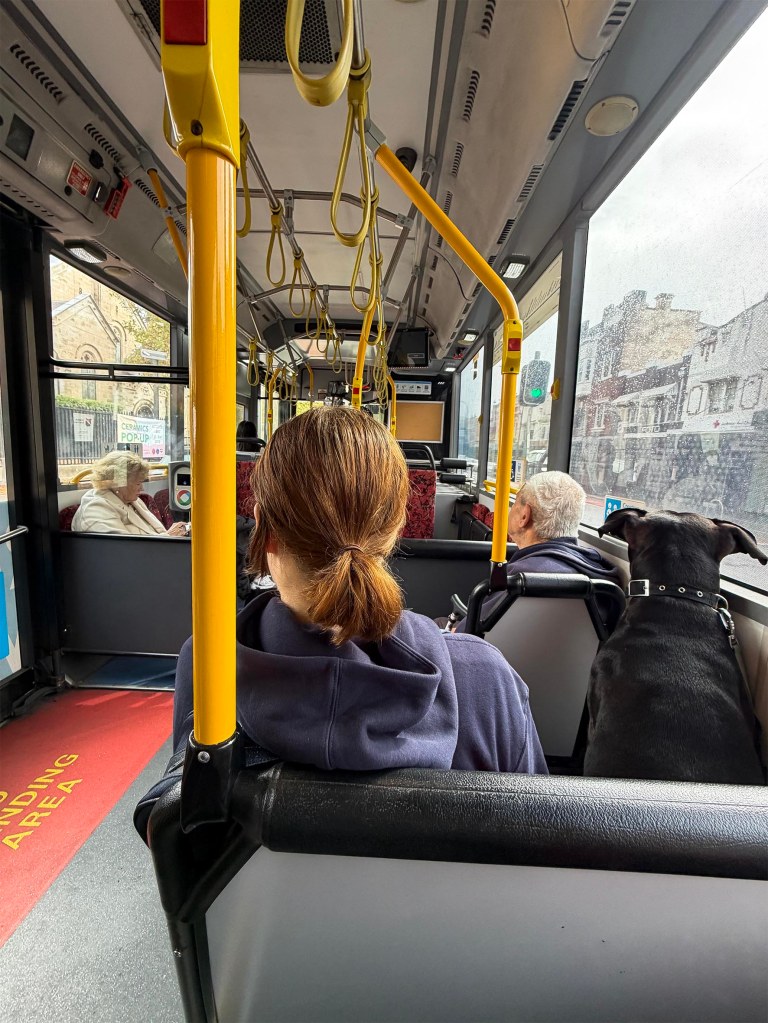
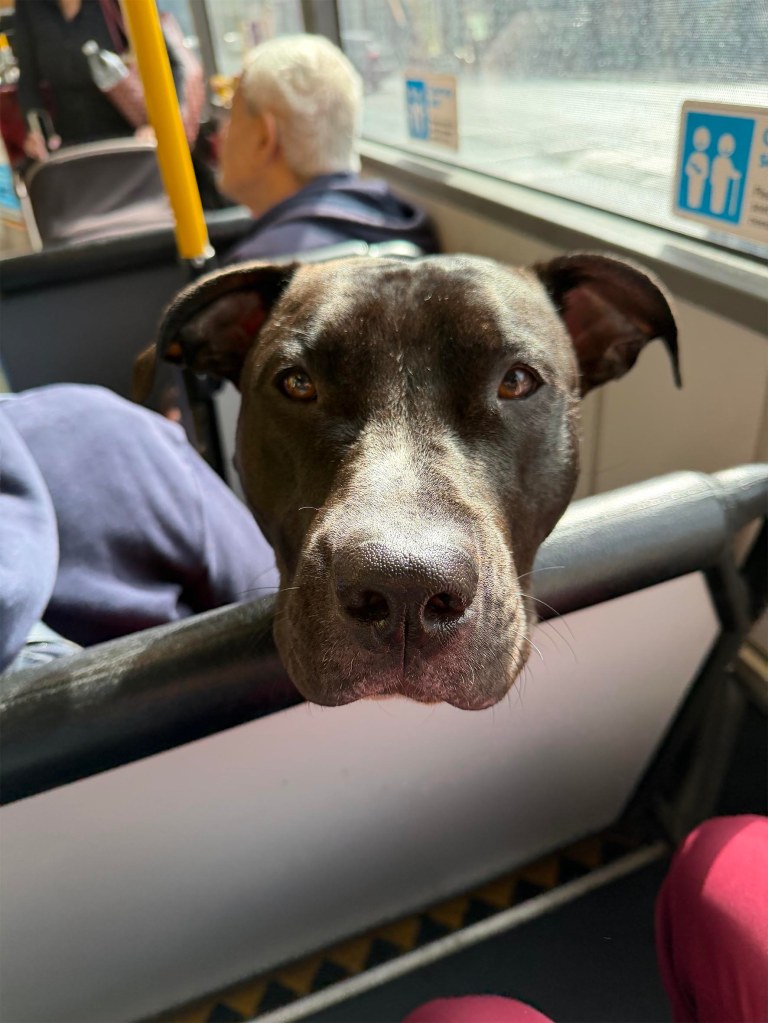
Our morning at Bondi had come to an end. Hyde Park, our next destination, promised a different conversation with Sydney. We boarded a bus for the city, intending to alight on Elizabeth Street near Liverpool Street. Somewhere around Paddington, a woman got on with a large black Staffordshire-type terrier. In its eagerness to board, the dog bumped into a passenger who was getting off. The departing woman was far from amused and delivered a sharp rebuke to the dog’s owner before stepping onto the pavement. Unperturbed, the pair settled into the seats immediately ahead of us. The Staffy had the unmistakable build of a dog that often invites strong opinions. Throughout the journey, however, it displayed nothing more threatening than an insatiable curiosity about its fellow passengers. The passengers, for their part, decided that curiosity was not a transport offence.
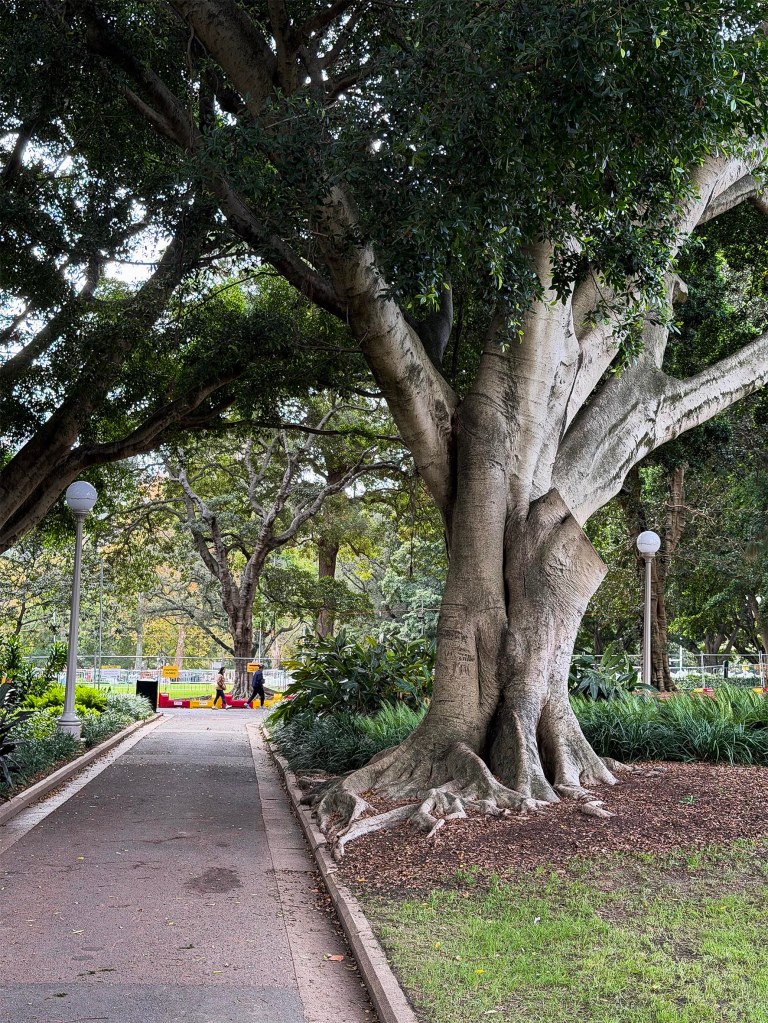
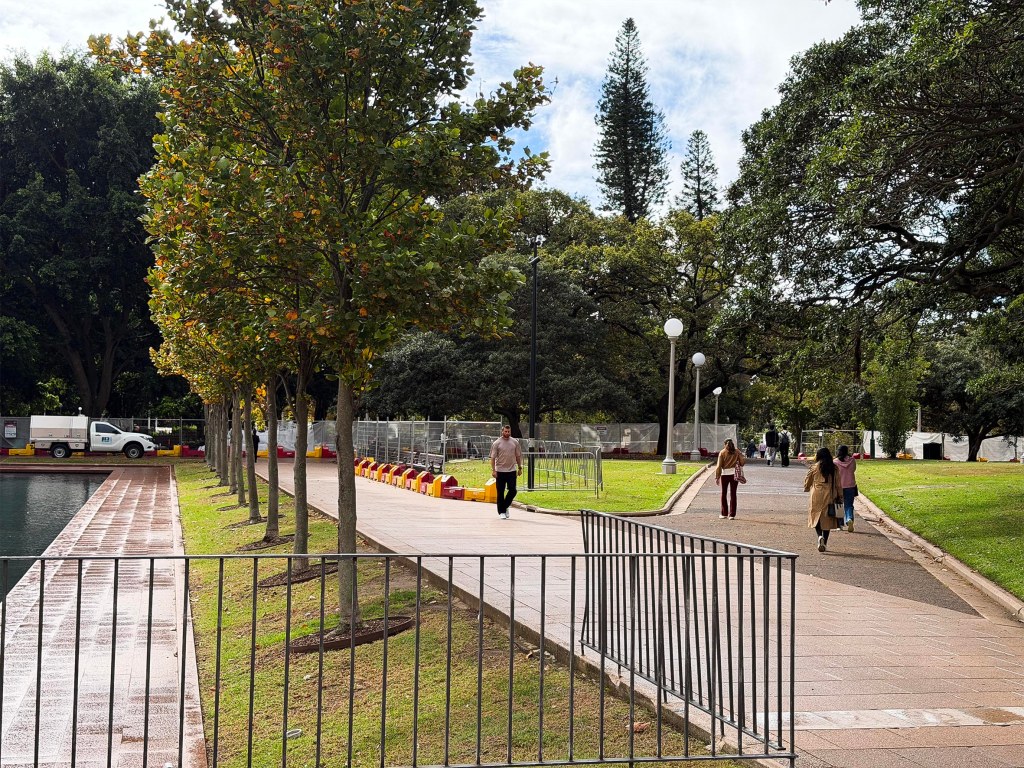
We crossed Elizabeth Street and entered the southern end of Hyde Park. Towering Moreton Bay figs, among Australia’s most magnificent native trees, shared the park with stately avenues of London plane trees, their sweeping canopies softening the heart of Sydney’s CBD. Beneath these Australian giants and their European companions, the city seemed briefly content to exchange urgency for shade. The scattered copper-coloured plane leaves were Sydney’s modest concession to autumn. Office-goers, joggers, cyclists and tourists drifted through the broad avenues, some pausing to photograph the amber carpet beneath the trees. Beyond the foliage stood the ubiquitous office towers, yet the park seemed untouched by their restless business.
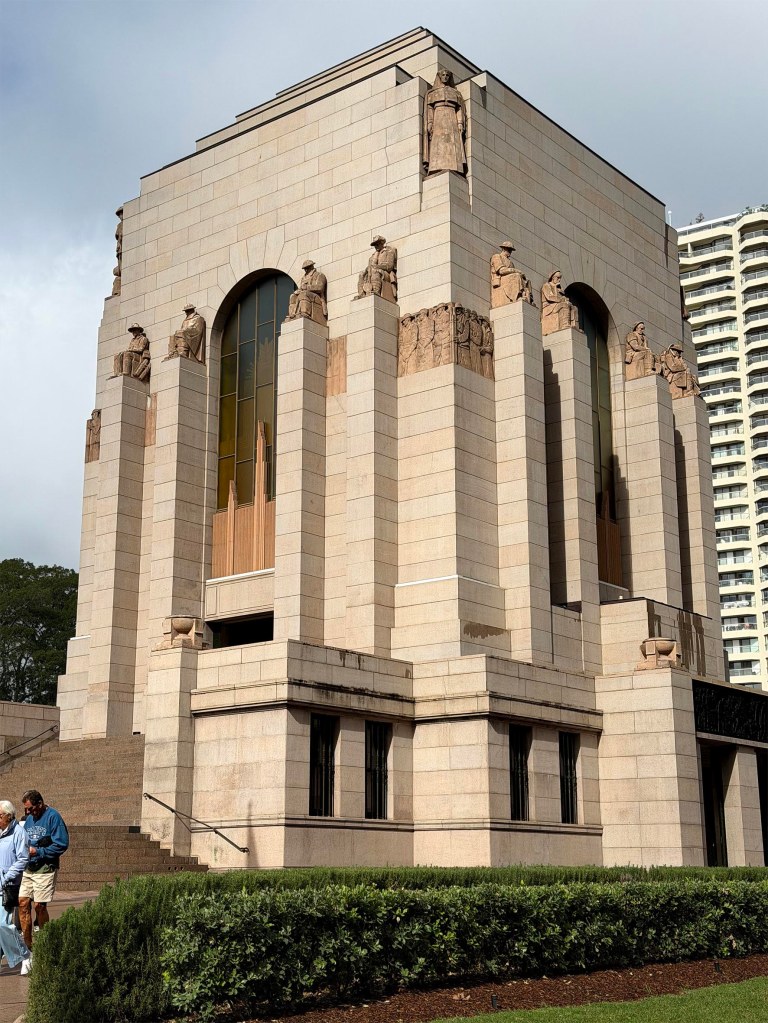
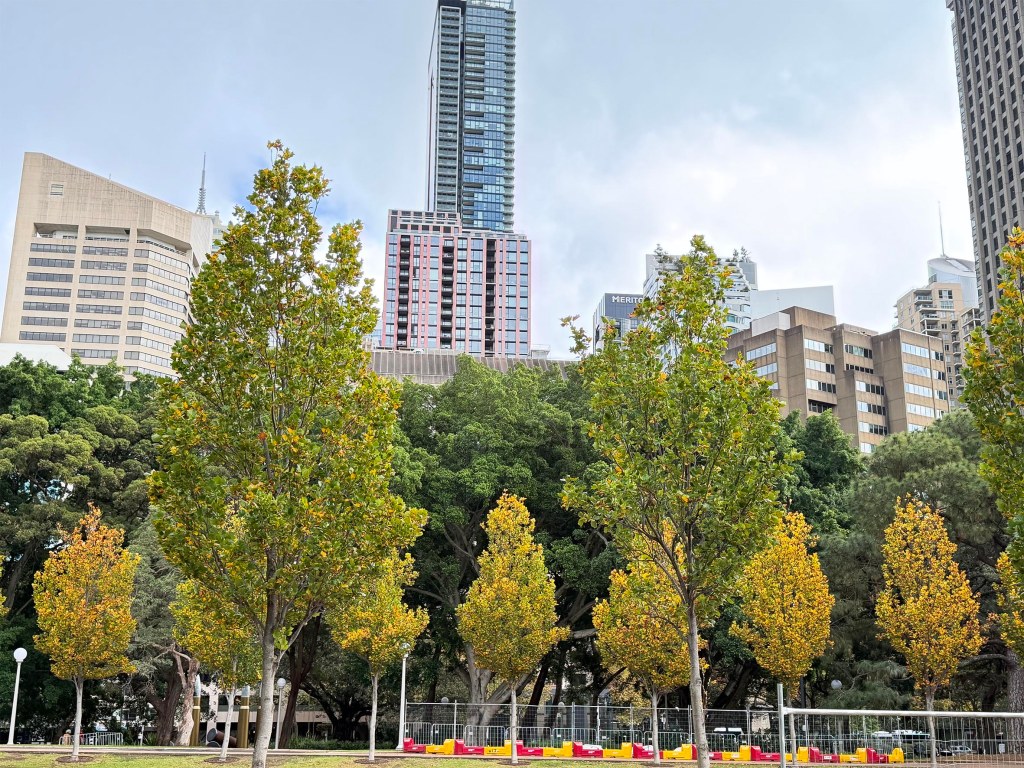
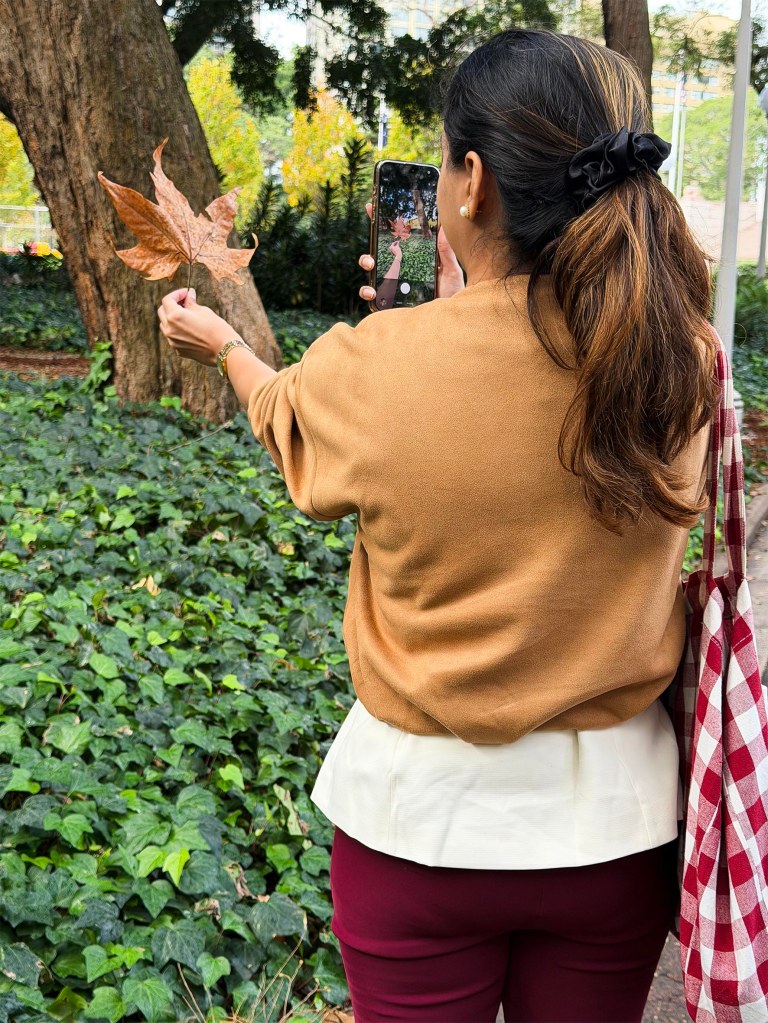
Though occupying only some sixteen hectares, Hyde Park contains an astonishing concentration of civic memory. Beneath its avenues of figs and plane trees, generations have celebrated, protested, marched, mourned, commemorated war, fallen in love, paused for lunch, and simply watched the city hurry by. Amid this long accumulation of public life, the ANZAC Memorial rises quietly from the greenery.
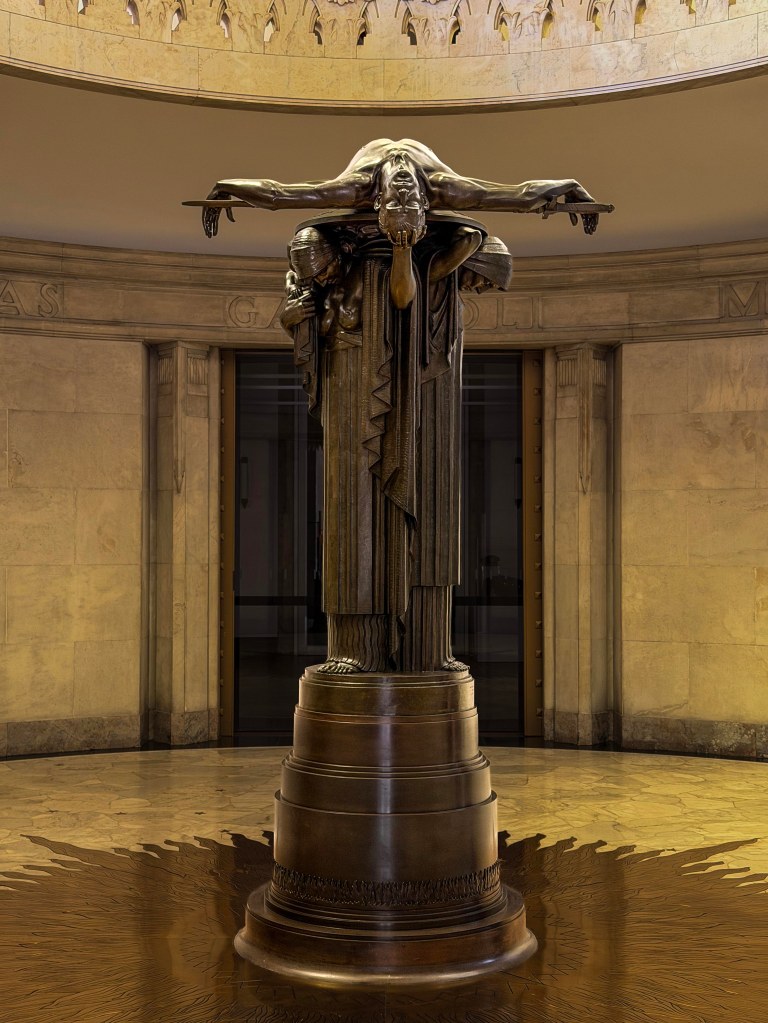
The ANZAC Memorial’s restrained Art Deco exterior was crowned with solemn figures representing Australia’s wartime services, its four corner guardians standing silent watch above them. Inside, a circular Well of Contemplation invited visitors to look down upon the sculpture below. At its heart lay the body of a fallen soldier, borne upon a shield by his mother, sister and wife, with their infant child cradled in his wife’s arms. Few war memorials have expressed so elegantly the truth that while soldiers fight wars, families carry them long afterwards.
A short distance from the memorial, Captain James Cook stood high on his pedestal, a chart held close to his side and one arm stretched firmly towards the distance. He displayed the confidence of an age that believed the world could be mapped, claimed and explained.
We moved on to the long Pool of Reflection, which gathered the trees, clouds and passing skyline into a silent communion. Further north, the exuberant Archibald Fountain restored movement to the landscape. The bronze figures of Apollo, Diana and Theseus celebrated life with a confidence that balanced the memorial’s contemplative mood.
A city reveals its soul through the art it chooses to preserve. With that thought in mind, we set out for the Art Gallery of New South Wales. The gallery lay little more than a kilometre from Hyde Park, yet the walk promised far more than a change of destination. Along that short walk, we would come across memorials, cathedrals, timeworn trees and public institutions, each unveiling another layer of Sydney’s long story.
As though reluctant to let us go, Hyde Park sent us off beneath hesitant drops of rain. By the time we reached College Street the drizzle had settled into a gentle patter. The rain gave us an excuse we scarcely needed. The twin sandstone spires of St Mary’s Cathedral had already persuaded us to abandon the footpath and wander inside.
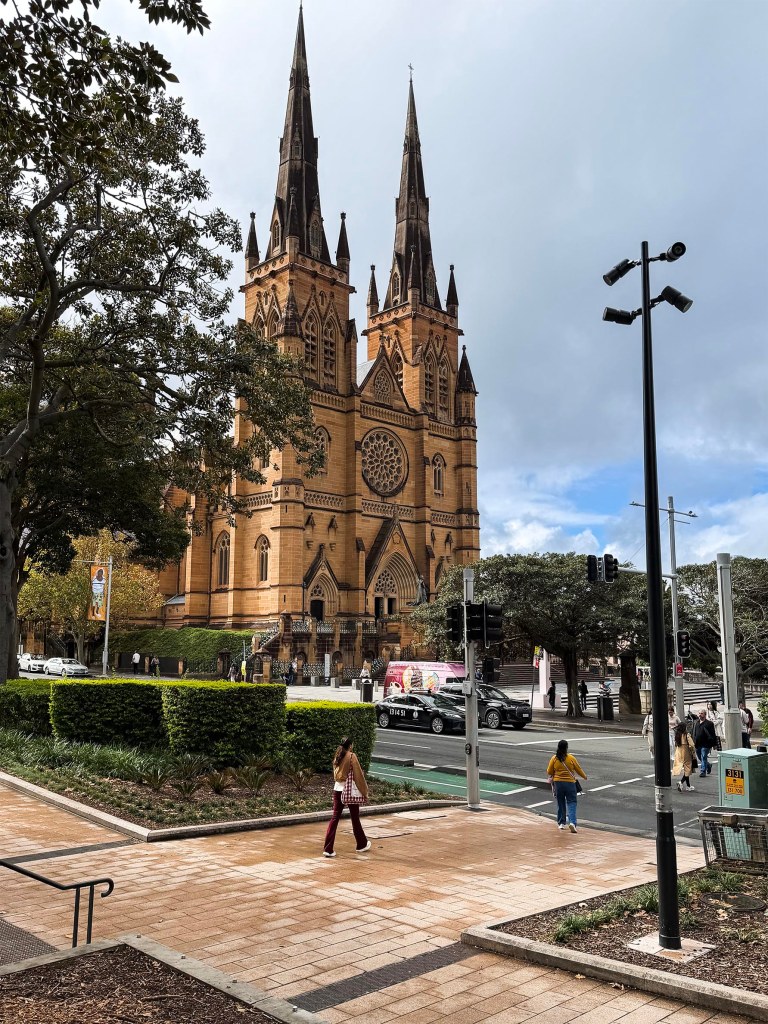
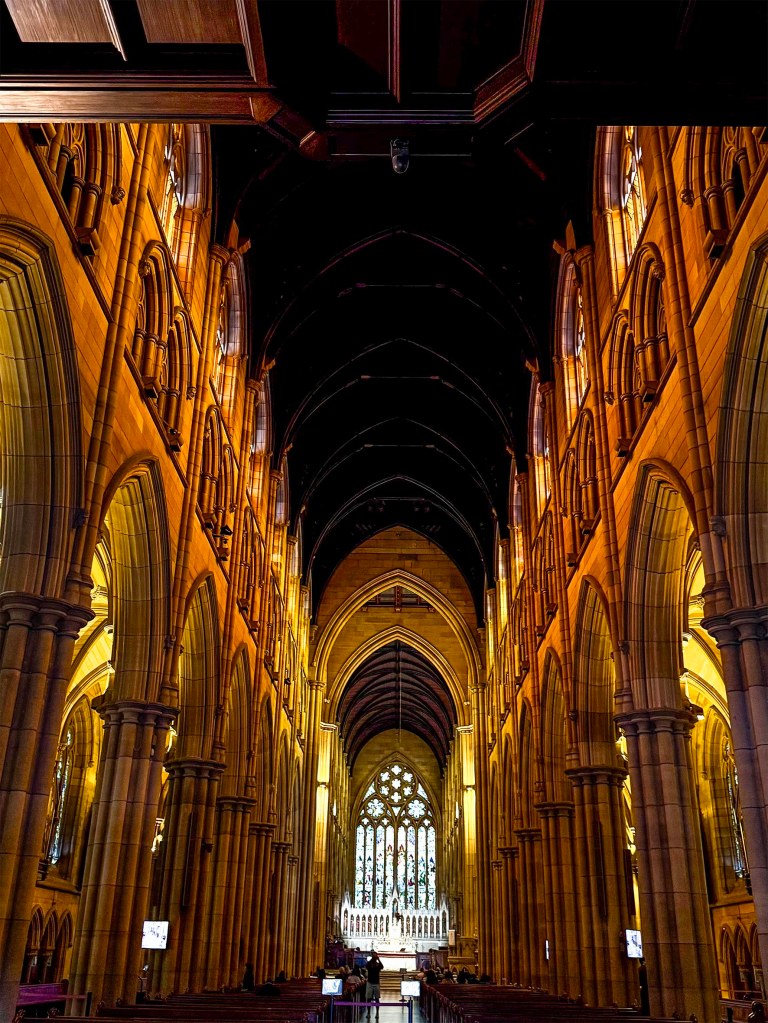
The reward was immediate. Inside, the clamour of the city faded behind us, replaced by a placid stillness beneath soaring sandstone columns, pointed arches and a dark vaulted ceiling that drew the eye heavenwards. Warm amber light trickled through the stained-glass windows and settled softly upon rows of polished pews, while an afternoon service progressed quietly around us. We slipped into one of the rear pews, content for a while to become observers rather than visitors.
Raised by a Catholic community whose story had begun in the penal colony and gradually found its place at the heart of colonial Sydney, the cathedral stood not merely as a triumph of Gothic Revival architecture, but as a monument to a city’s gradual passage from sectarian rifts to religious pluralism.
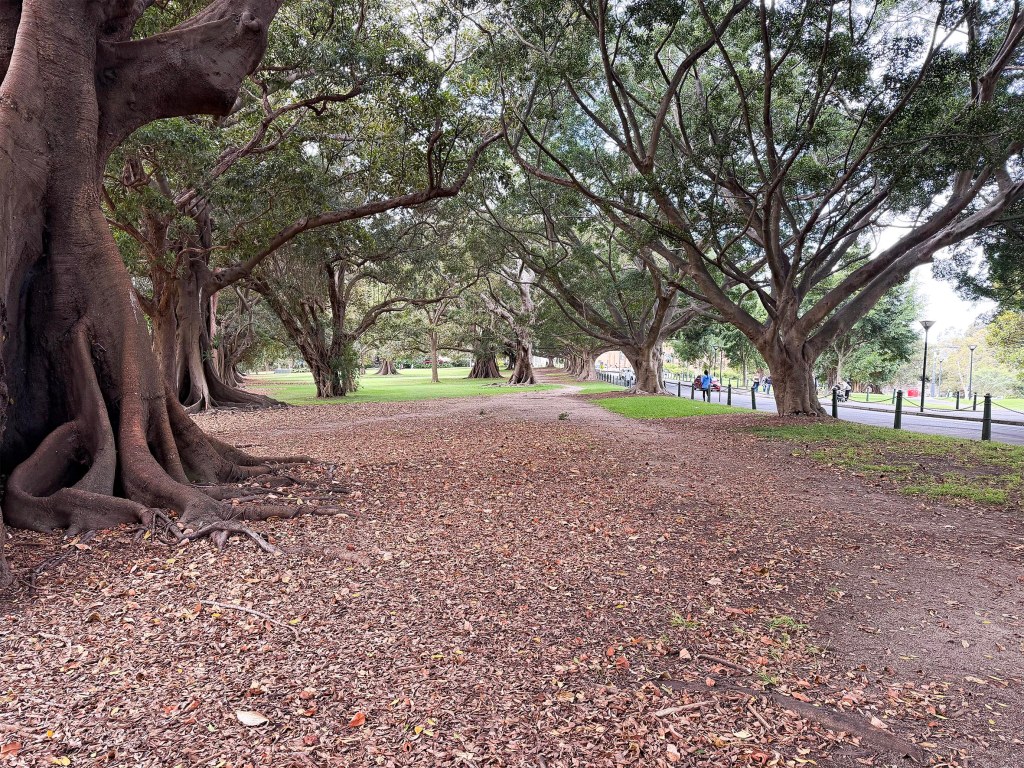
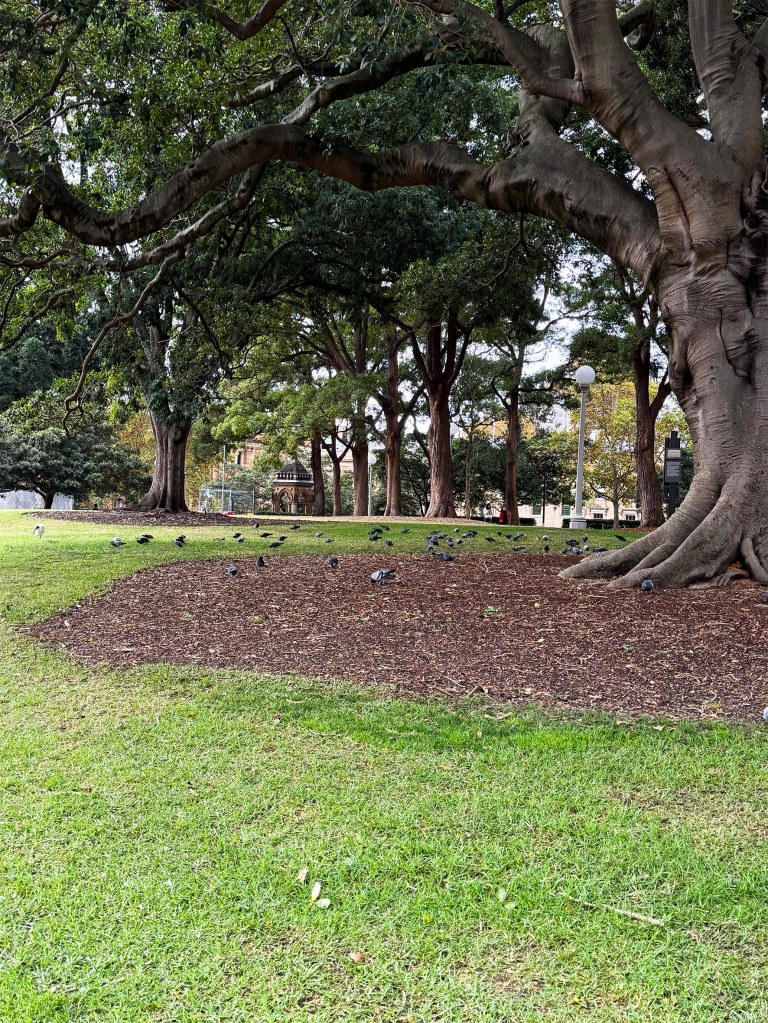
By the time we emerged from the cathedral, the rain had spent itself. We continued through the Domain, once Governor Phillip’s private reserve and today one of Australia’s oldest public parks. There, enormous Moreton Bay figs, planted more than a century ago, spread their colossal limbs across the lawns, making the passing century seem almost incidental. Beneath their immense canopies, the skyline ceased to be the city’s defining feature and became merely something one noticed through the branches. Beyond the trees, the dignified sandstone façade of the Art Gallery of New South Wales came into view, beckoning us to discover how the city had chosen to remember itself on canvas.
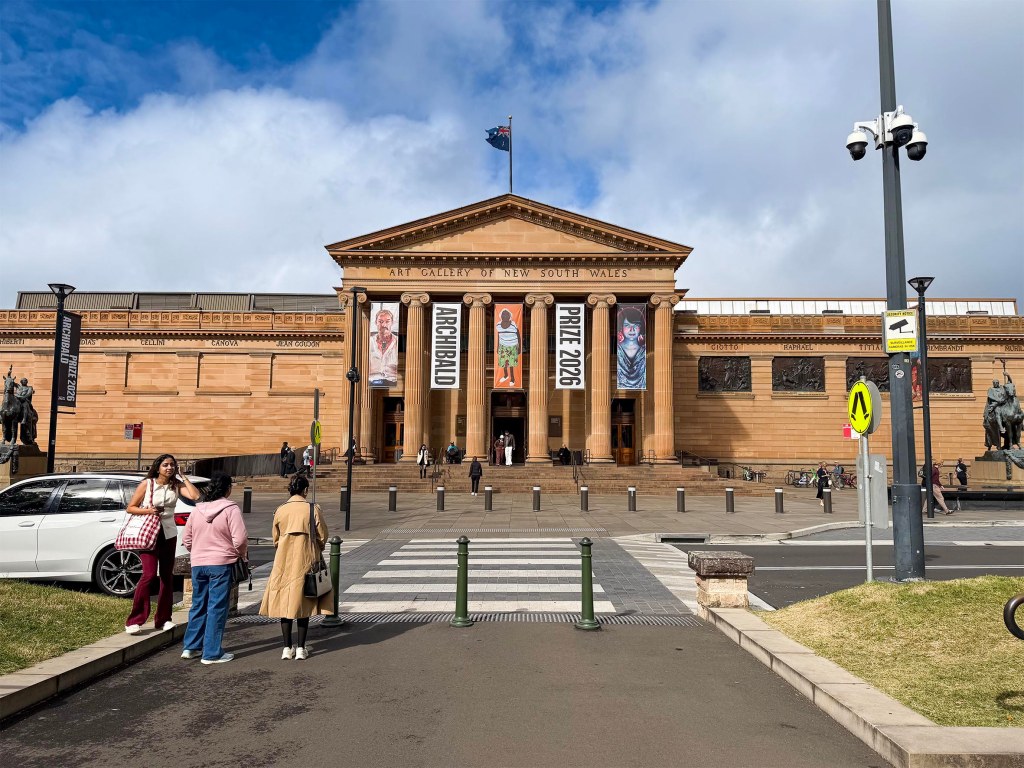
The Art Gallery of New South Wales had a serene, classical presence, set in warm honey-coloured Sydney sandstone. Its elevated position at the edge of the Domain lent it an air of timeless dignity. Banners suspended between the lofty Ionic columns announced the Archibald Prize 2026, affirming the Gallery’s identity as a living institution where Australia continued to question, celebrate and reinvent itself through art.
The interior was as thoughtfully designed as the exterior. Soft daylight filtered through the glazed roofs onto polished parquet floors. We progressed through the rooms from one gilt-edged frame to another, appreciating the evolution of Australian colonial painting from its European inheritance towards an unmistakably Australian vision. As the continent found its own artistic voice, the peculiar brilliance of Australian light, the vastness of its horizons and the unfamiliar forms of its bush found expression.
Beyond painting, the Gallery’s artistic horizons spanned millennia, from the ancient traditions of Aboriginal and Torres Strait Islander peoples to contemporary works revealing an Australian imagination as restless and inventive as ever.
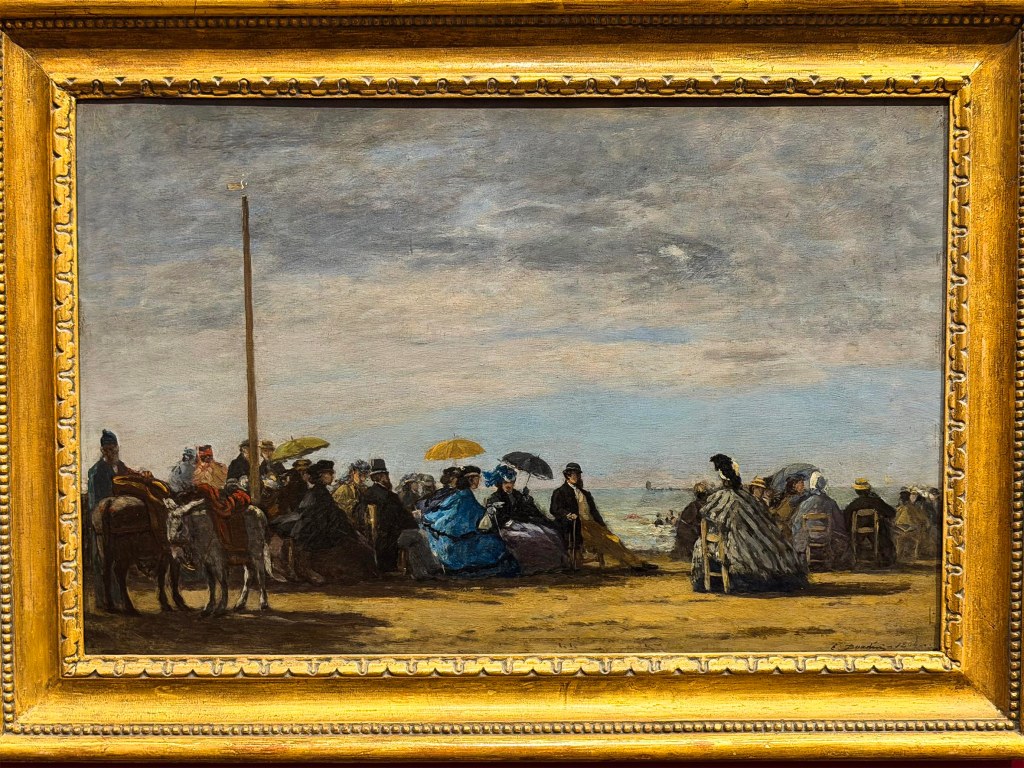
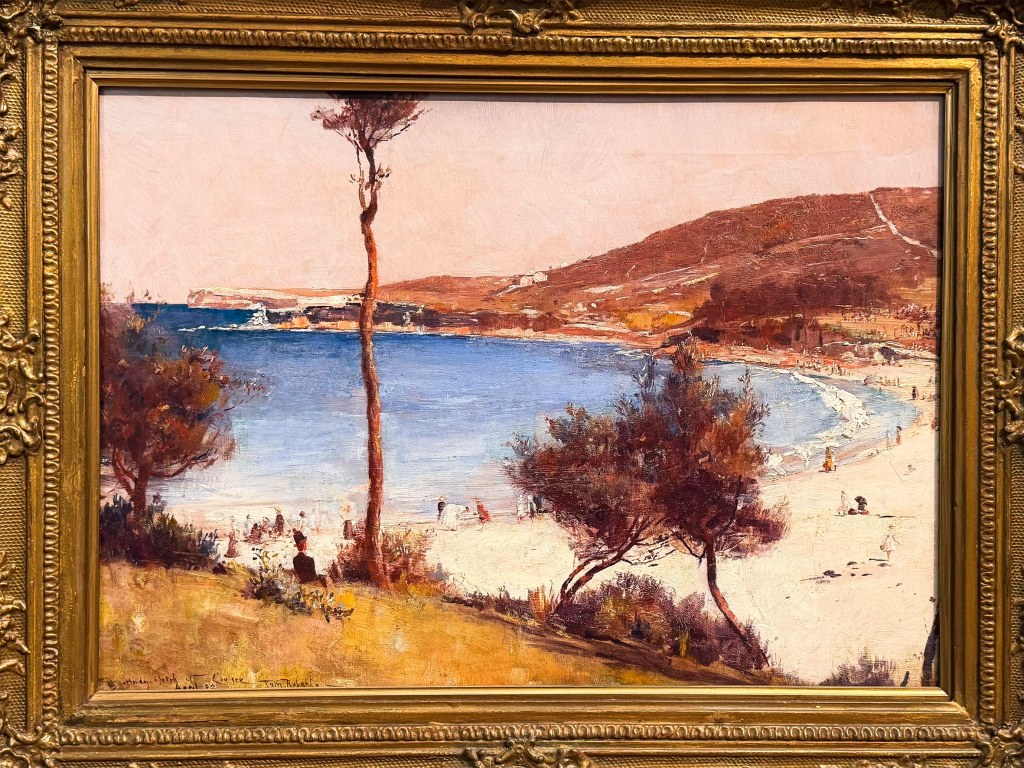
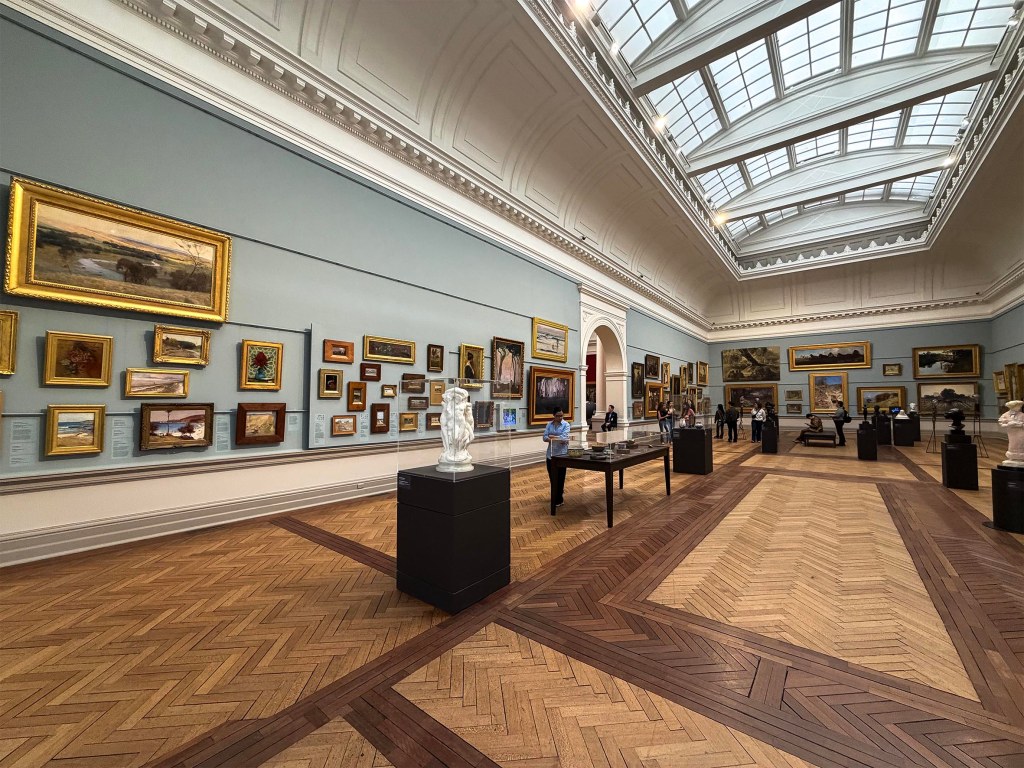
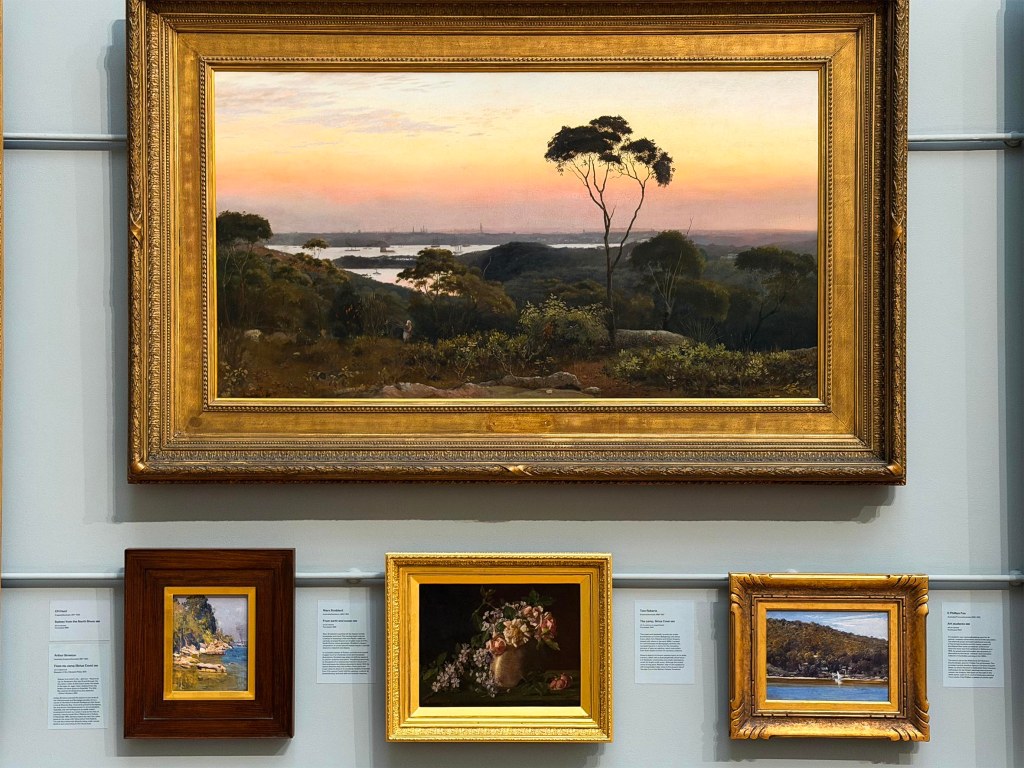
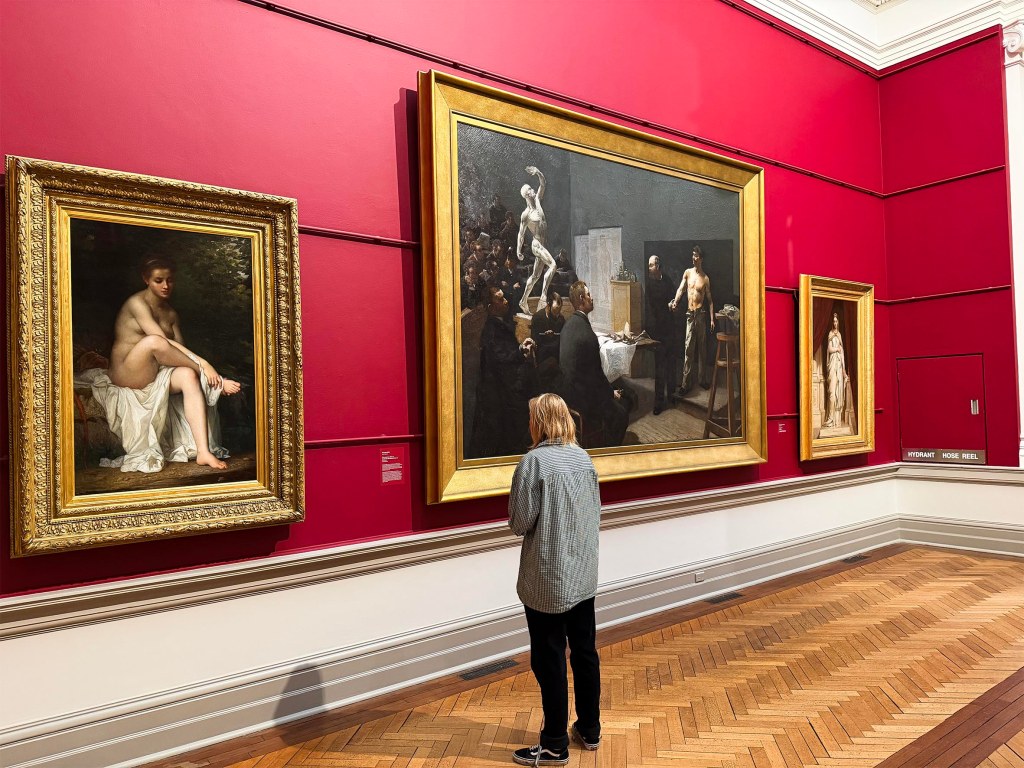
Among the landscapes, a painting of Coogee Beach caught our attention. It was as if the Gallery had introduced us to a place that Sydney had quietly kept in reserve for another visit.
Elsewhere, Eugène Boudin’s beachgoers paused upon another shoreline half a world away. Their anonymity reminded us that, whether in nineteenth-century Normandy or modern Sydney, people have always been lured to the meeting of the land and sea.
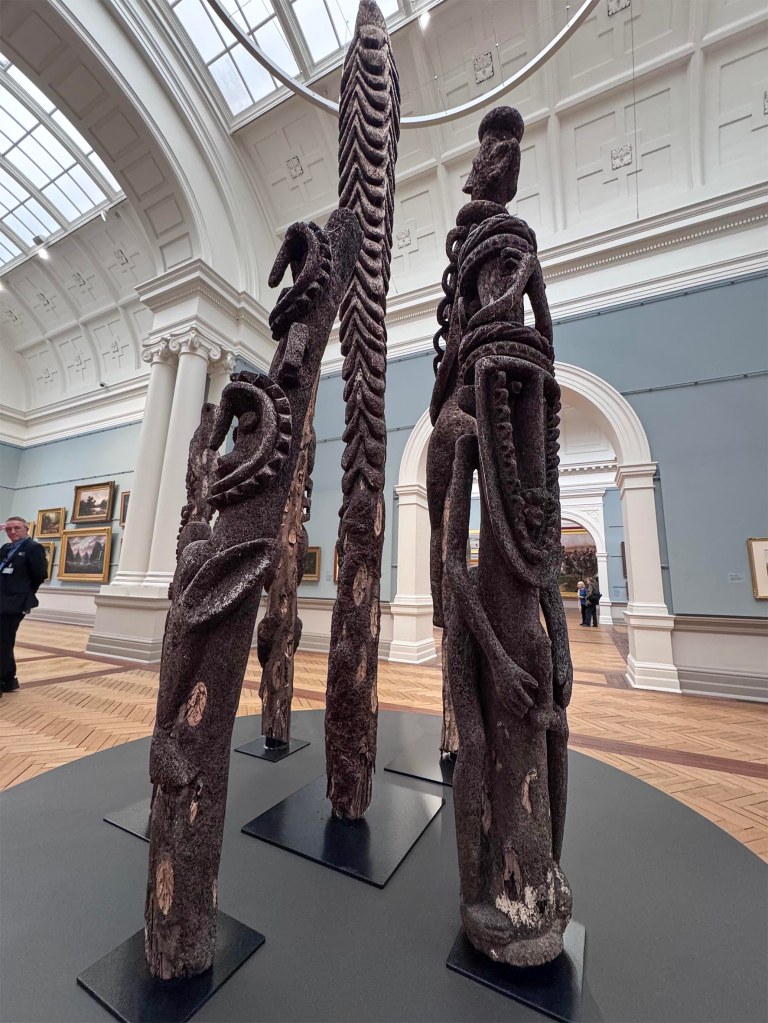
Not far from the European oils and colonial landscapes, towering carved ancestral figures rose from the floor. Their weathered timber, stylised forms and timeless gaze belonged to an artistic tradition devoted to preserving memory, ancestry and an unbroken relationship with the land. These Aboriginal works carried Australia’s cultural story tens of thousands of years into the past, reminding us that the continent’s artistic inheritance long predated its colonial history.
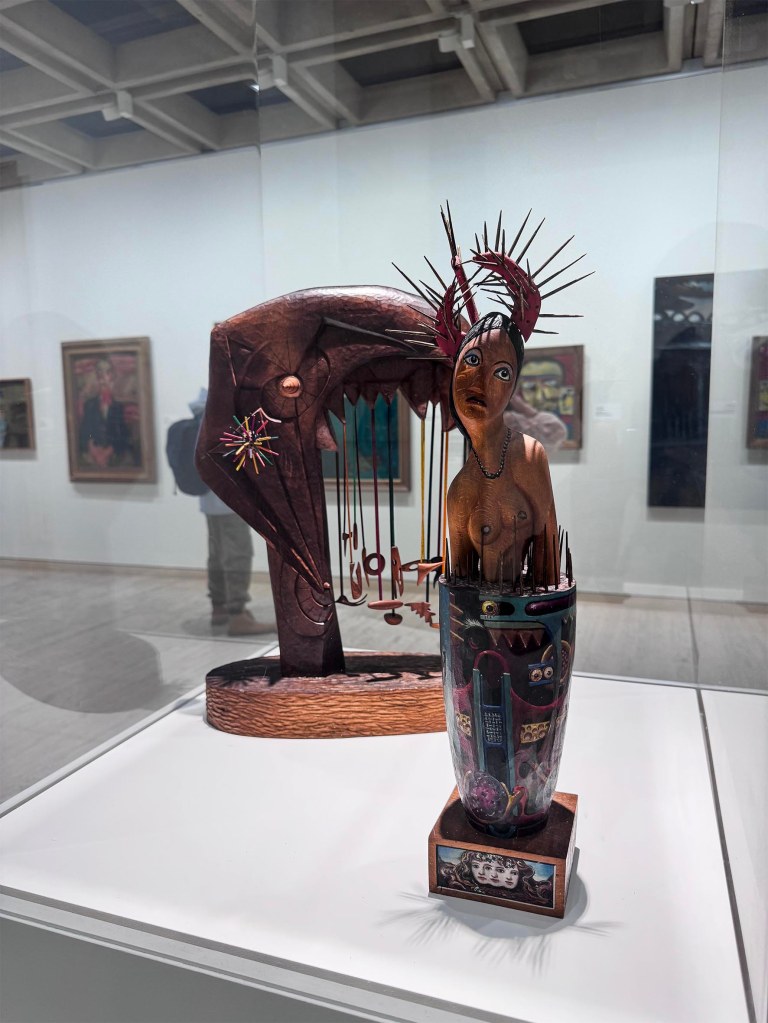
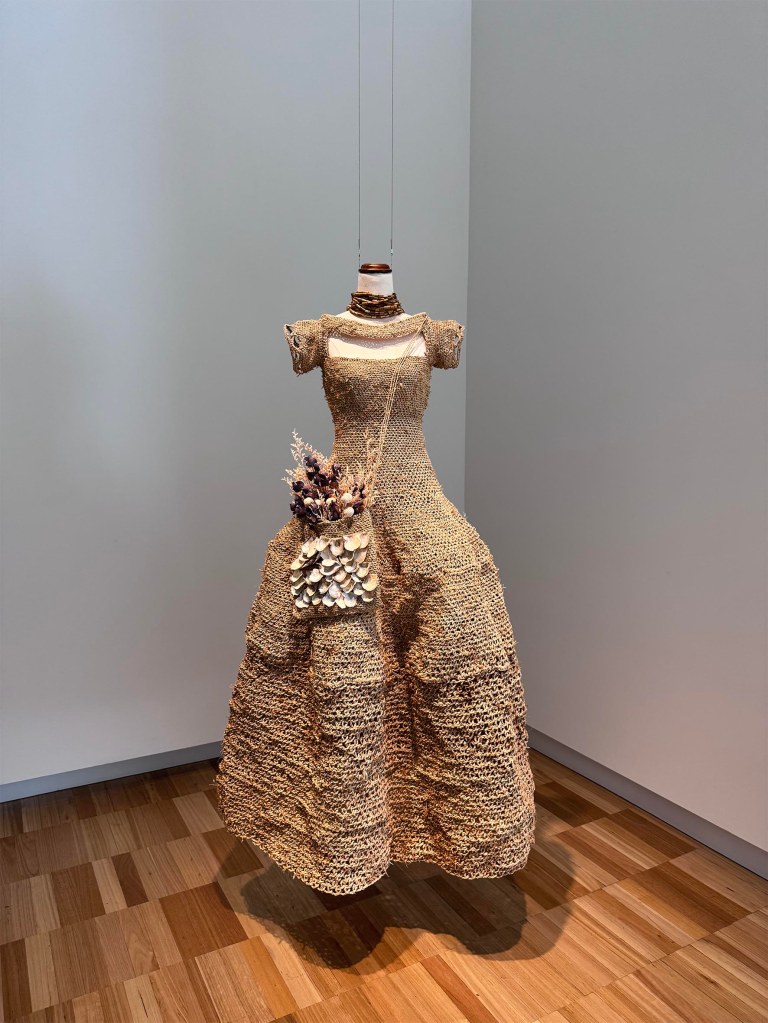
The Gallery then turned to the present. Exhibits fashioned from Tiger Balm tins, Indomie packets and plastic crates transformed familiar objects of everyday life into art. Nearby, intricately woven ceremonial garments demonstrated that textiles, too, could become repositories of identity, while an unmistakable Indian jhumka caught our eye. These works suggested that culture is shaped as much by kitchens, wardrobes and neighbourhood shops as by monuments and museums.
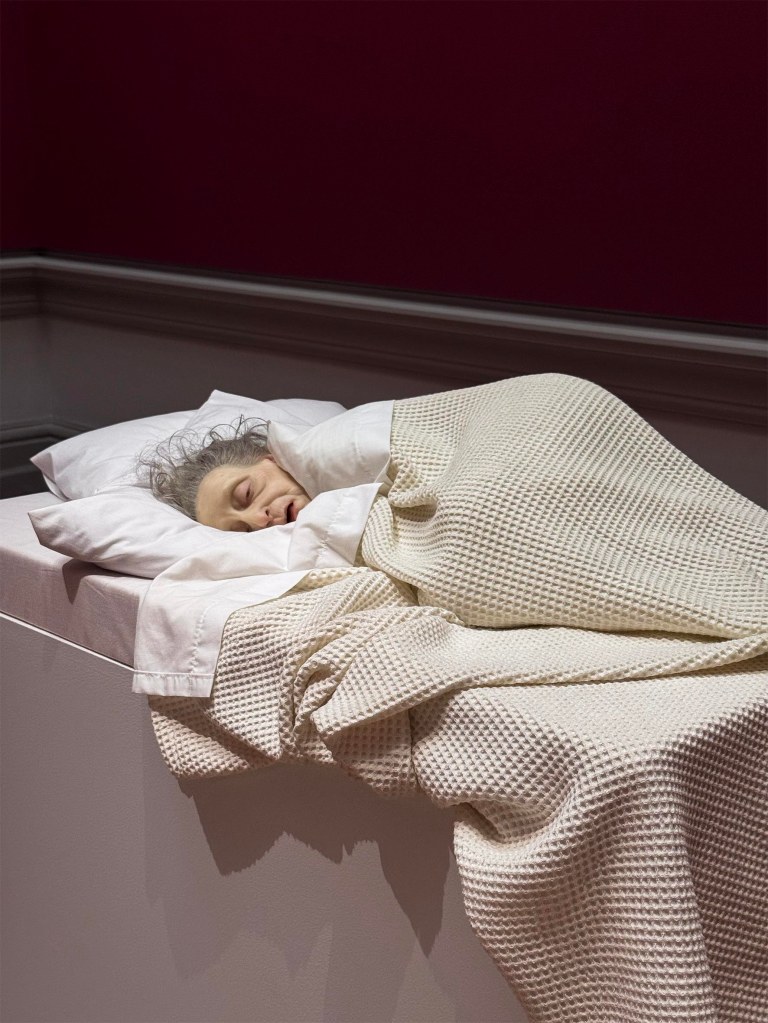
Among all the exhibits, it was Ron Mueck’s miniature sculpture of an elderly woman asleep beneath a white quilt that held us longest. We found ourselves instinctively bending closer, drawn not by its size but by its astonishing realism. Every wrinkle of the blanket, every strand of grey hair and every line upon her face seemed uncannily alive. It was impossible not to think about age, fragility and the tenderness with which ordinary lives deserve to be remembered. After galleries filled with myths, battles and landscapes, this small, silent figure remained with us.
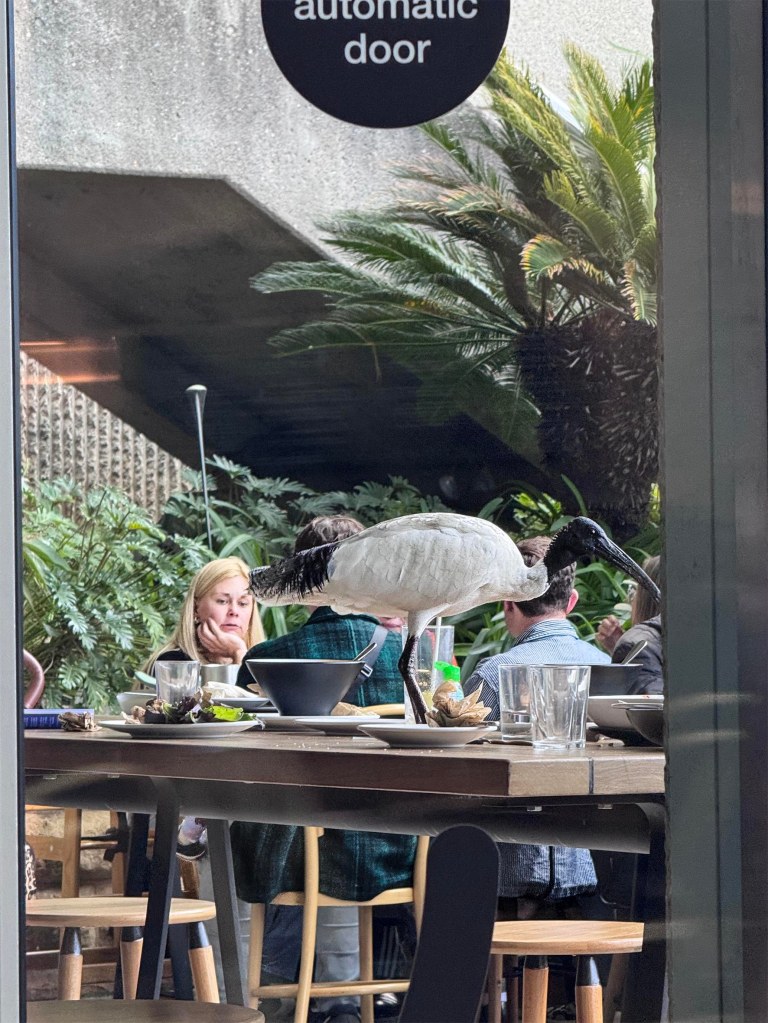
After hours of roaming through galleries that traversed continents and centuries, we finally surrendered to the café below. Coffee arrived, followed by a leisurely lunch. For a while, no one at our table seemed in any hurry to speak. Around us, the conversations of fellow visitors drifted through the room, while outside an Australian white ibis patrolled the tables with the confidence of a regular customer. The paintings and sculptures had begun to give way to quieter reflections.
Perhaps that was what the Gallery had finally given us: not an account of Australia, but the company of those who had made it.
(to be continued…)
 One Grain Amongst the Storm
Another fantastic tour, Uma. That old blanketed lady is extraordinary. When I saw the picture before reading I thought you must have come across a dead person! Look forward – as always – to the continued journey.
The sculptures of Ron Mueck are astonishingly lifelike and shake us out of our complacency. Thank you for your gracious company, Bruce.
You were so lucky to be there when the Ron Muecke sculptures were being displayed. What an extraordinary talent that man possesses.
That’s true. Ron Mueck was a revelation. While the old woman lying beneath her quilt startled us, the extraordinary craftsmanship left us in lasting admiration of the human capacity to create such art.
Your beautifully poetic prose engages all our senses in this eloquent tour. The Ron Muecke sculpture would have held us as much as it did you. Bondi Beach was packed out when we visited in Summer 2008. There was a paucity of female swimsuits on display.
Thank you so much, Derrick, for your kind words and the thoughtful comment. Ron Mueck was unforgettable. We visited Bondi in late autumn, so it was calm and almost reflective. Your summer memories paint a rather livelier picture. It made me smile!
This concluding chapter of the Sydney sojourn evokes a curious blend of emotions. It opens with the brightness of Bondi Beach beneath the Australian sun, yet as the journey unfolds, the cheerfulness gradually yields to quiet contemplation. The travelogue, together with the photographs, assumes a distinctly philosophical hue, gently reminding us that every memorable journey ultimately leaves behind not merely images, but reflections.
From Ron Mueck’s astonishing miniature sculpture of an elderly woman asleep beneath a white quilt, embodying the fragility and quiet dignity of life, to the profoundly moving sculpture of the fallen soldier borne upon a shield by his mother, sister and wife, with their infant child cradled in her arms, Mr Pandey has woven together a meditation on impermanence itself. I have little doubt that the Well of Contemplation remained with him long after he had left Hyde Park. Indeed, it lingers with the reader as well.
Speaking of Ron Mueck’s masterpiece, for a fleeting moment I genuinely wondered whether I was looking at a living person. The sculpture appears more real than reality itself. Equal credit is due to Mr Pandey’s photographic eye, which has preserved that astonishing realism so faithfully within the frame.
The unmistakable signature of Mr Pandey’s writing appears once again in this exquisite passage:
“There, enormous Moreton Bay figs, planted more than a century ago, spread their colossal limbs across the lawns, making the passing century seem almost incidental. Beneath their immense canopies, the skyline ceased to be the city’s defining feature and became merely something one noticed through the branches.”
The words paint a more vivid picture than the accompanying photograph itself. That, perhaps, is the finest compliment one can pay a travel writer.
Just when the narrative begins to weigh gently upon the heart, comic relief arrives on four legs in the form of the delightfully inquisitive Staffy, reminding us that every journey needs its lighter moments.
Before I conclude, however, I must pause at one sentence that quietly overwhelmed me:
“Few war memorials have expressed so elegantly the truth that while soldiers fight wars, families carry them long afterwards.”
There are some lines that one admires, some that one remembers, and a very few that one simply absorbs in silence. This belongs to the last category.
Words fail me here, for the heart has already spoken.
Thank you so much for this wonderfully attentive reading. I am deeply touched that you sensed the journey moving from the brightness of Bondi towards quieter contemplation. That gradual shift was indeed intended, though I could scarcely have expressed it as beautifully as you have.
You have also drawn together two moments that had quietly converged in my own mind: Ron Mueck’s sleeping old woman and the fallen soldier in the Well of Contemplation. One speaks of the frailty of an individual life, the other of the immeasurable cost that war leaves behind for those who remain. Together, perhaps, they whisper the same enduring truth: all things are transient. It is this impermanence that lends human love, memory and compassion their deepest value.
Your generous words about the Moreton Bay figs and the line on the ANZAC Memorial are compliments I shall treasure. A travel writer can hope for little more than to leave a reader with something that lingers after the photographs have faded.
I am equally delighted that the inquisitive Staffy found an appreciative audience. He seemed determined to remind us that even philosophy occasionally benefits from a wet nose and a wagging tail.
As for Sydney, I suspect she has not yet finished her conversation with us. There are still gardens to wander, streets to lose ourselves in, and perhaps a few more unexpected companions waiting around the next corner.
Thank you once again for walking this far with me. Your reflections have made the journey richer than I had imagined.
If these travelogues are ever published—as I continue to hope they will be—I suspect this chapter will be among the ones readers revisit after finishing the book. It is the kind of chapter that grows richer on a second reading.
You are most kind, Sir. Thank you for that generous compliment.