Time, we are often told, is precious. Every millisecond is worth its weight in gold. Sometimes, though, you cannot redeem a day hijacked by an airline with all the world’s magic. Ask Cinderella.
Readers of The Hong Kong Surprise, the opening chapter of this voyage, will readily understand the source of this philosophical rant. Fate had served Melbourne to us in alarmingly rationed portions. We were expected to wander about, see and relish sizeable chunks of the world’s most liveable city in a ridiculously brief time-slot.
It was hardly surprising, therefore, that when Cathay Pacific finally deposited us in Melbourne on the maturing afternoon of 7 May 2026, we regarded the leftover hours with something approaching reverence. These were not hours to be spent lightly. Each moment was to be pursued, captured and wrung for maximum value before it slid into history.
On the drive from the airport to our apart’hotel, our first impression of Melbourne was not that of a city eager to impress. The glass towers, busy streets and commercial urgency were all there, yet what struck us first was the city’s calm.
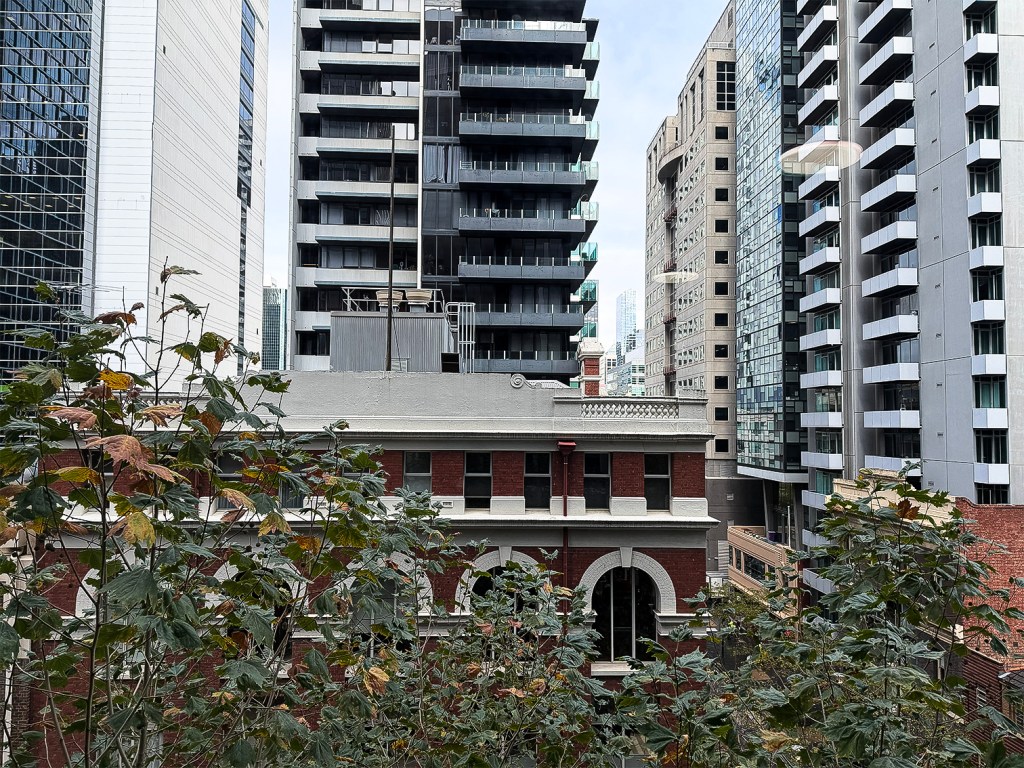
Melbourne seemed reluctant to discard its memories. Red-brick warehouses stood beside gleaming apartment towers. Victorian façades remained woven into a skyline of modern apartments and office buildings. Nothing was frozen in time, yet little appeared erased. Trees were as much a feature of the streetscape as people. These were not ornamental afterthoughts but mature presences that seemed to have earned their place.
The wall-sized window of our apart’hotel confirmed our first impression of Melbourne’s architectural character. Across the street stood an old brick building, sturdy and self-assured amid ranks of glass and steel. Its arched windows and ornamental cornices belonged to a bygone age. In the foreground, the canopy of a tree intruded inevitably upon the scene, its leaves breaking up the hard geometry of the surrounding buildings.
The in-house restaurant was dismissed without much deliberation. Melbourne had a reputation to uphold, and it was unreasonable to travel halfway across the world only to dine within walking distance of the lift.
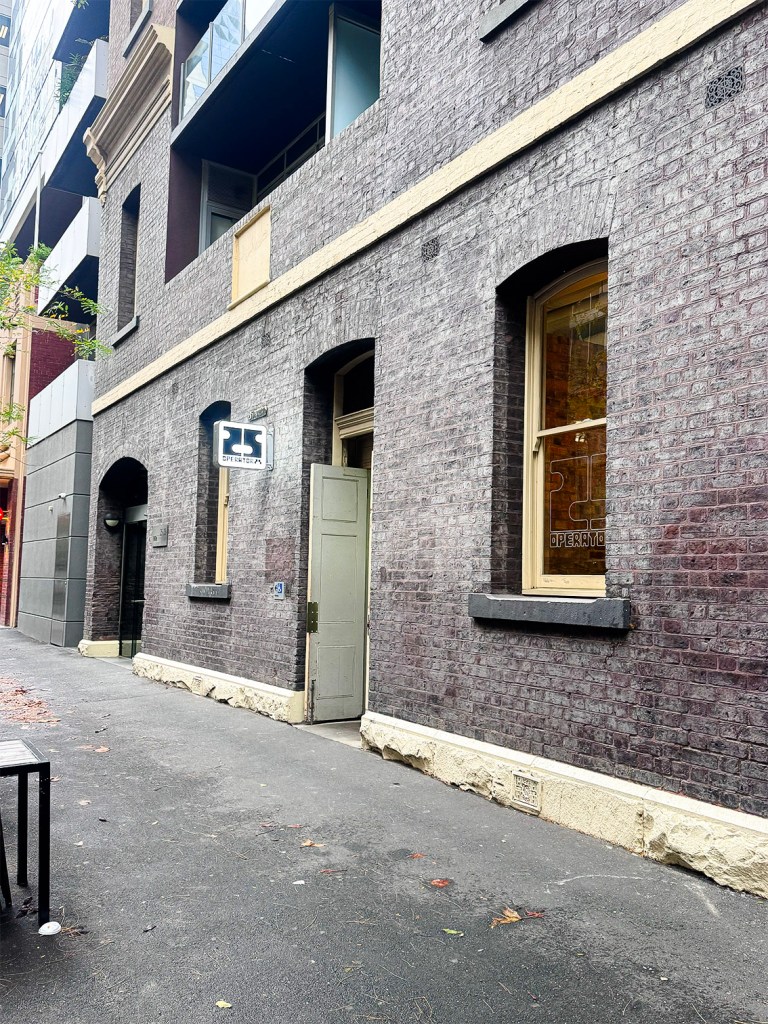
We met the Melbourne breeze the moment we stepped out of the entrance. The credit for the group being covered in proper woollens would go squarely to R, against my instincts of reducing luggage space. A laneway immediately to the right of the hotel offered the first clue that the city intended to take its culinary obligations seriously. The twins had already discovered a restaurant called Operator 25, tucked into what appeared at first glance to be the grey wall of an old warehouse. A discreet sign announced its presence. The lettering seemed almost reluctant to advertise itself, and the windows leaked few secrets unless one paused and peered inside.
Only later did I learn that the building dated back to the nineteenth century and had once housed Melbourne’s first telephone exchange. The name was a small historical joke shared between the city and those who cared to notice.
The unremarkable entrance led to a broad, well-lit space. Original brickwork remained proudly exposed; overhead, old beams, pipes and ducts were left in plain sight. Pale timber, white chairs and a few restrained decorative touches softened the building’s industrial character. The past had left its unmistakable stamp, but was not advertised. The service was delightful: warm, competent and refreshingly free of fuss.
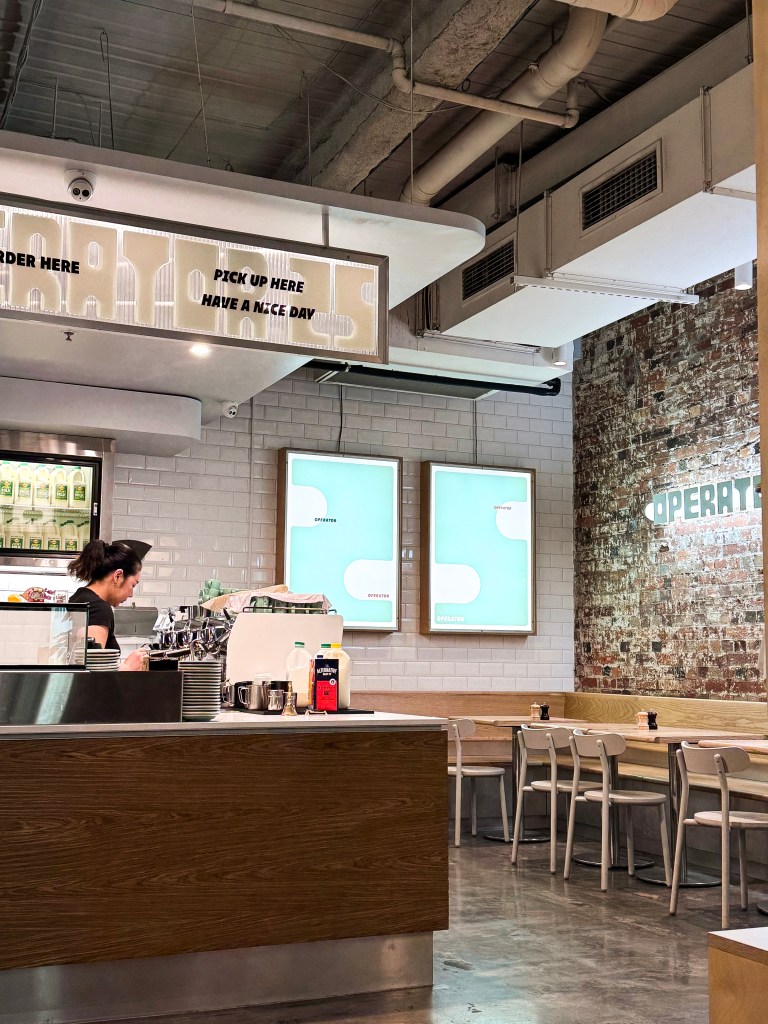
The task of selecting lunch had already been appropriated by the twins, leaving me in an advisory role, a function seldom requested. The menu offered a mixture of Asian-inspired creations and familiar favourites. After a period of consultation that would not have disgraced a diplomatic summit, selections were made and orders placed.
The dishes arrived looking every bit as promising as the menu had suggested. As usual, the cameras were served first. The food justified the ceremony. The Thai grilled chicken in particular was outstanding—tender, flavourful and cooked with remarkable precision. Memory is an unreliable witness in culinary matters, but I still rank it among the finest chicken dishes I had encountered in many years. If Melbourne intended to introduce itself through food, it had chosen an effective opening statement.
Brunch at Operator 25 had fortified us for Melbourne. V had already pulled the expedition free from the gravitational forces of the homeland. Responsibility now passed to T, whose task was to keep the experience alive through improvisation and sudden manoeuvres.
She swiftly set aside the original plan of commencing our sightseeing aboard the heritage City Circle Tram 35. The scheme had much to recommend it: a free ride, a rolling introduction to some of Melbourne’s best-known landmarks, and, somewhere near Parliament, the possibility of satisfying my long-standing desire to pay respects to the Melbourne Cricket Ground. T, however, was suspicious of itineraries that knew too precisely where they were going. She believed that cities were best encountered with a degree of openness to chance and interruption. I was not entirely persuaded by the theory, but neither was I immune to the enthusiasm with which it was advanced. Before long, spontaneity had gained the upper hand.
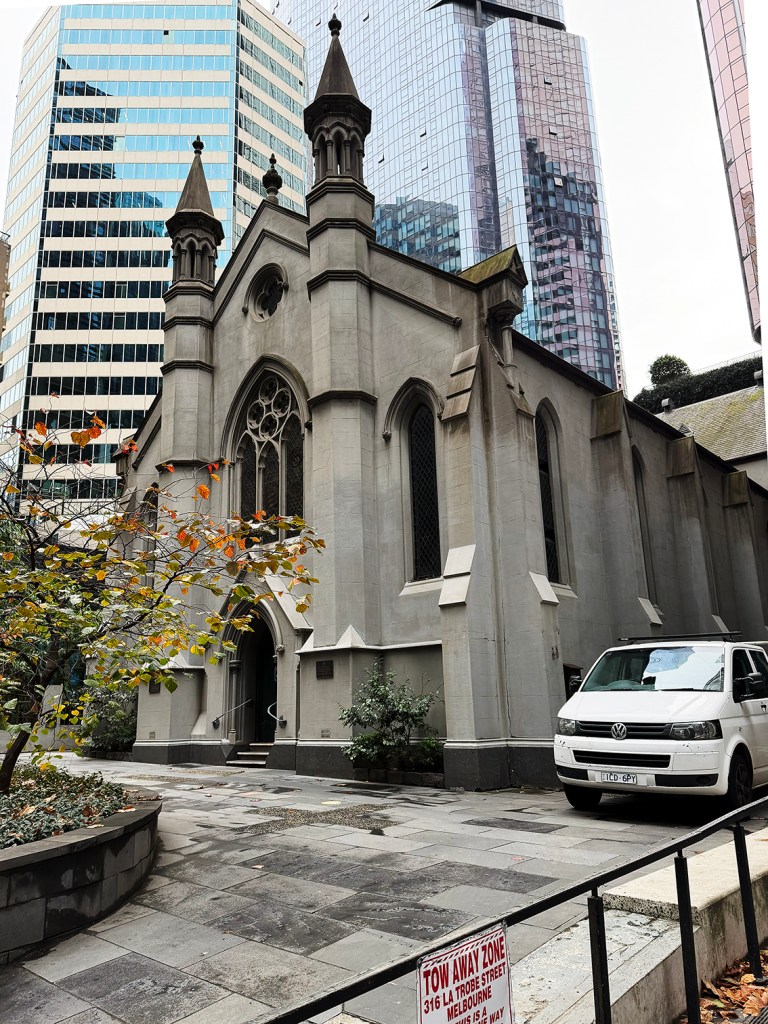
Pressed into service, Google Map promptly located the State Library Victoria ten minutes away on foot from Wills Street. We were happy to mark the iconic institution as our first destination. We set off along streets lined with polished residential towers, modern high-rises clad in reflective glass, and older buildings that wore their years with grace. The streets were lined with trees, their canopy stretching beyond footpaths and filtering the soft autumn light. Fallen leaves gathered along kerbs, scattering shades of brown and gold across the grey pavement. A small Gothic church stood quietly among taller neighbours. From time to time, laneways branched off into the distance, beckoning us to lose ourselves within them.
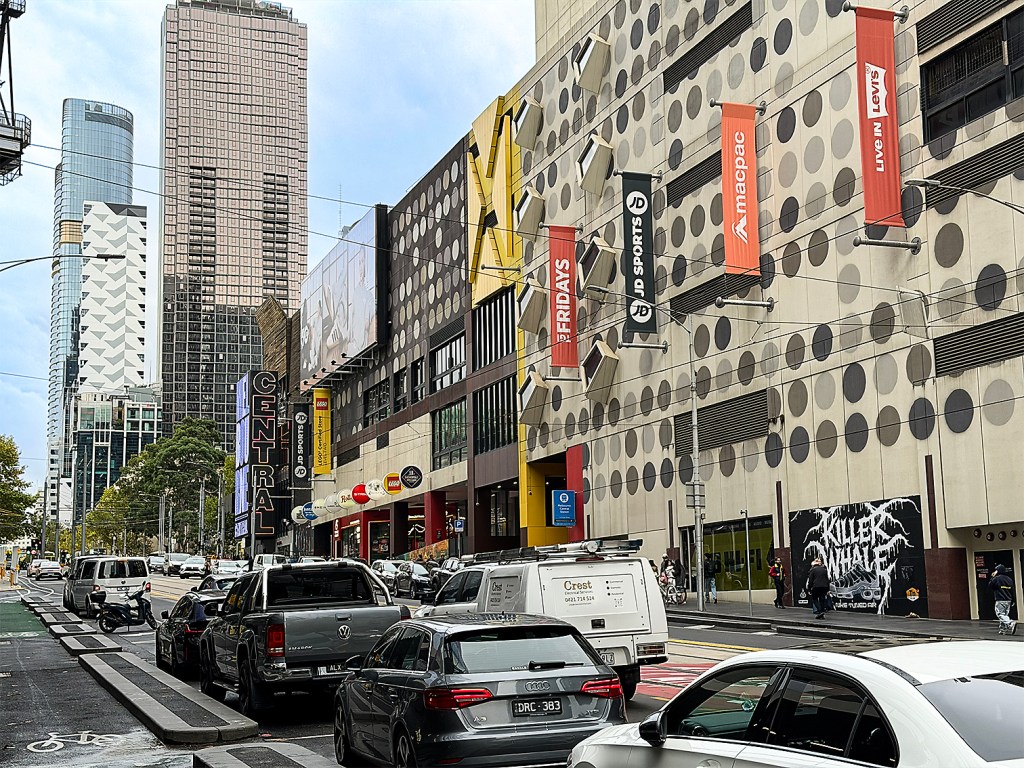
As we closed in on Melbourne Central, the rhythms of the city grew more pronounced. Shops, signs and traffic grew denser, yet the city somehow remained graceful and restrained. Even the commercial signage seemed governed by an unwritten code of civility. Shop signs projected modestly from façades, often circular or mounted perpendicular to the buildings, their dimensions carefully controlled and their placement so harmonious that entire streets appeared composed rather than assembled.
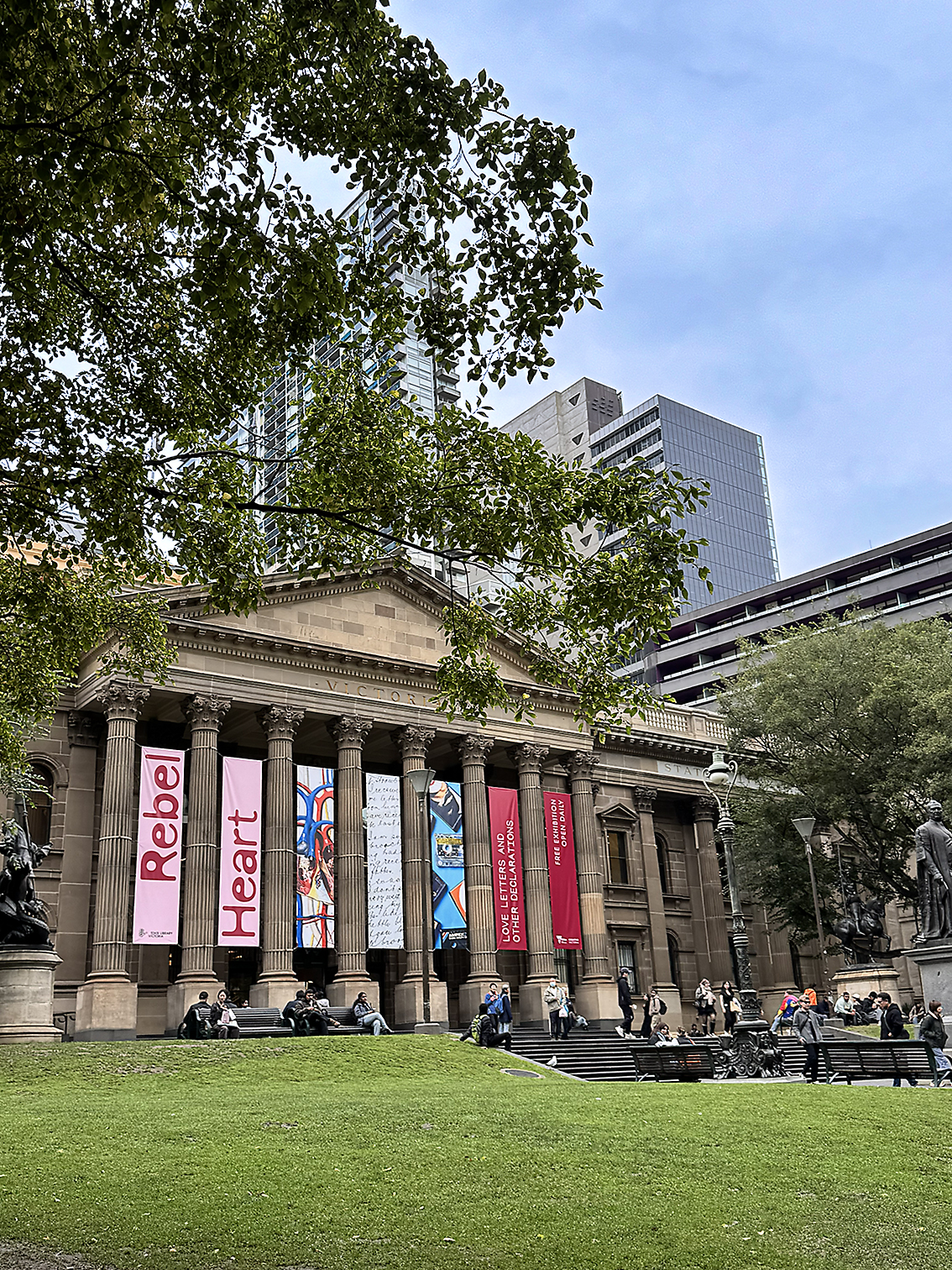
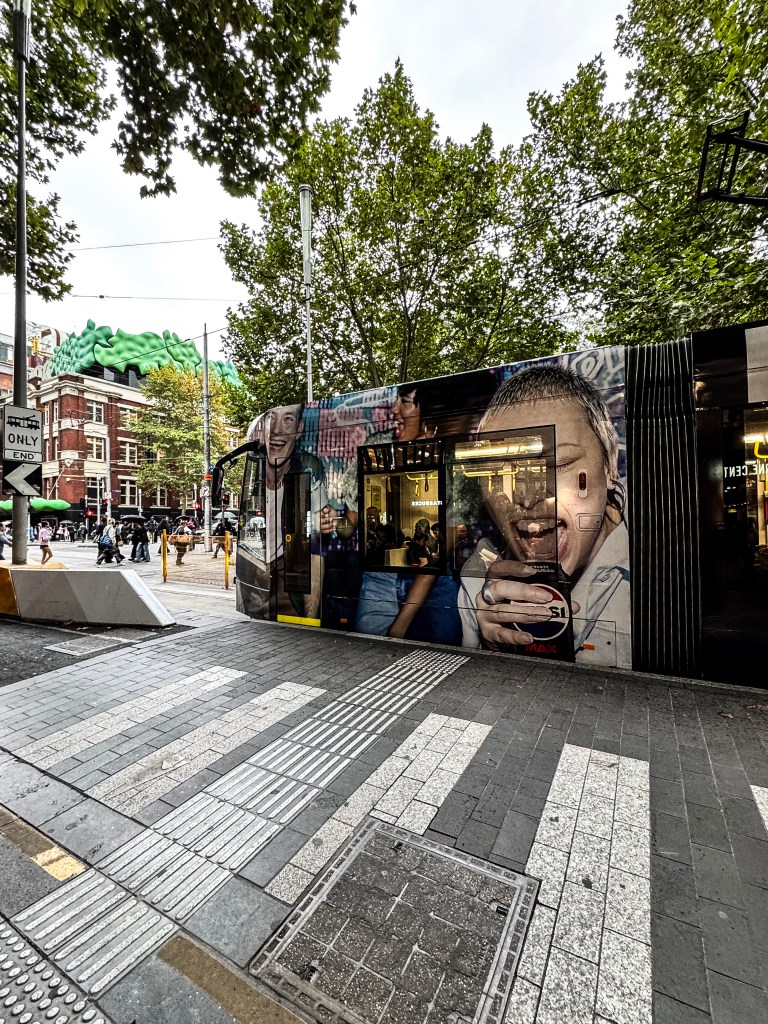
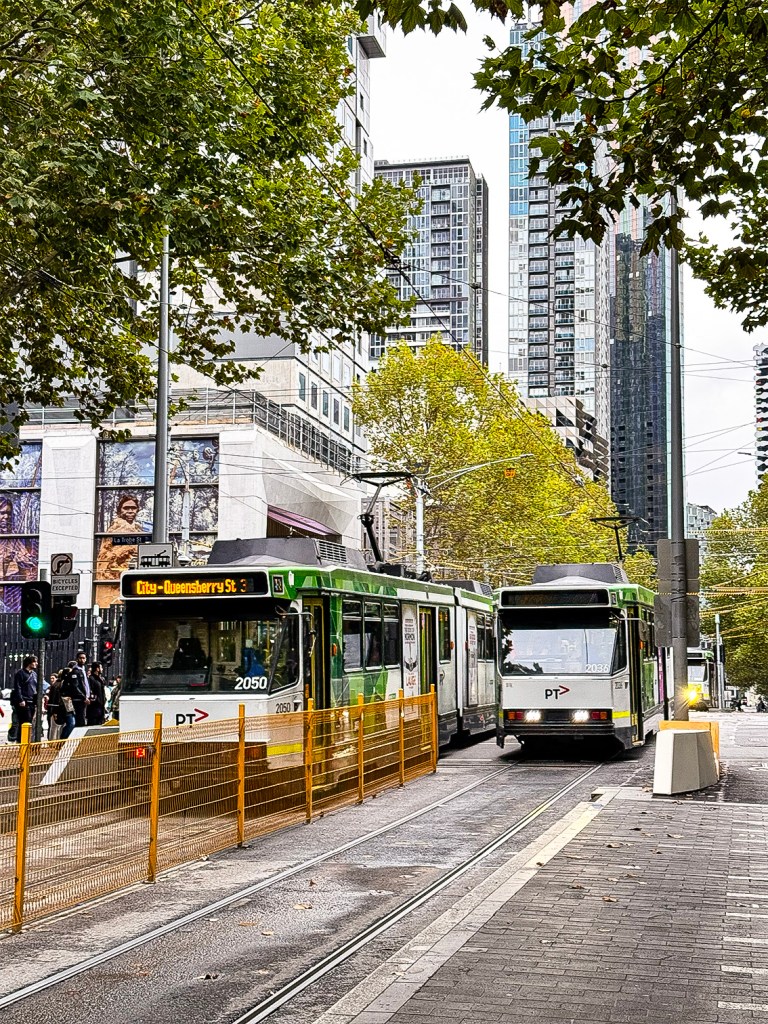
Gleaming trams glided through the ordinary traffic as if they had always belonged there. Even in the heart of the business district, trees softened the hard lines of glass and concrete. Slowly but surely, State Library Victoria came into view, its broad lawns and classical columns offering a welcome release from the city’s tightening geometry.
A brief shower came and went, sweeping across the steps and darkening the stone. The rain vanished almost as soon as we raised our umbrellas in defence. Small groups stood chatting on the forecourt. Commuters waited patiently for trams, indifferent to the persistent wind.
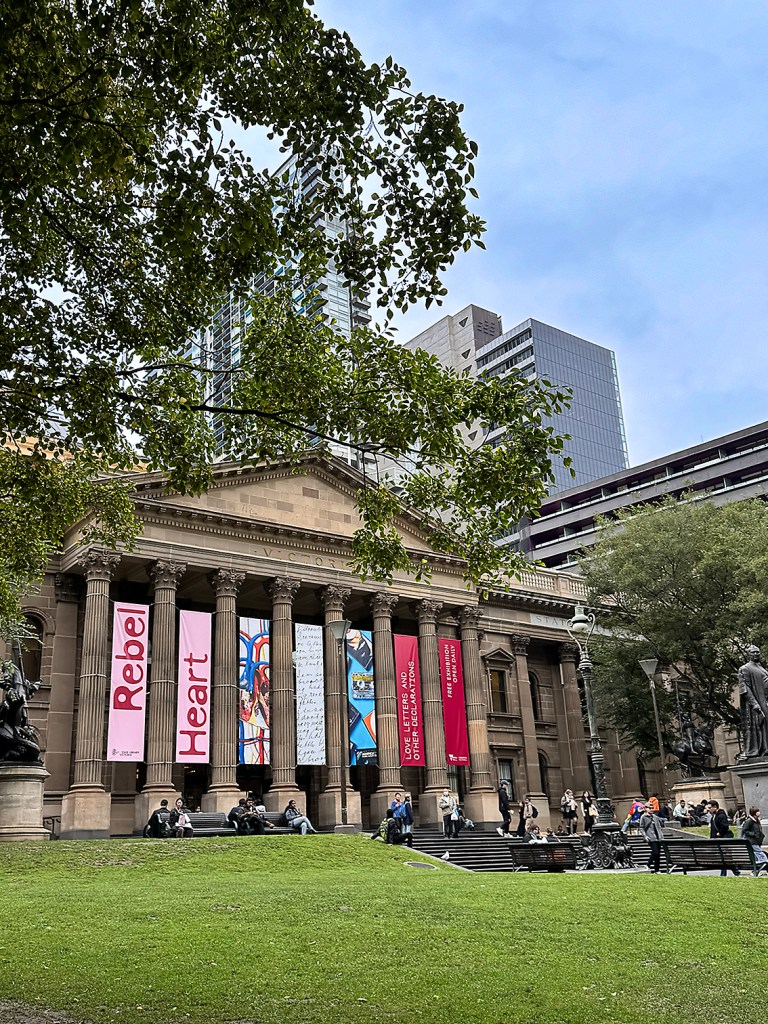
We lingered there for several minutes, as if under a mild enchantment, taking in a rinsed, wind-brushed Melbourne glistening quietly beneath a pale autumn sky.
For more than a century and a half, State Library Victoria has watched Melbourne grow around it and remains one of the city’s enduring landmarks. Stepping into its La Trobe Reading Room brought us to a momentary halt. A vast domed ceiling rose above the room, pierced by large skylights that filled the space with soft daylight. At the centre of the dome, the glass panels spread out like the spokes of a wheel. Several levels of white galleries circled the room, their railings lined with rows of old books. On the floor, long timber reading desks stretched beneath green-shaded lamps, casting pools of warm light over books and laptops.
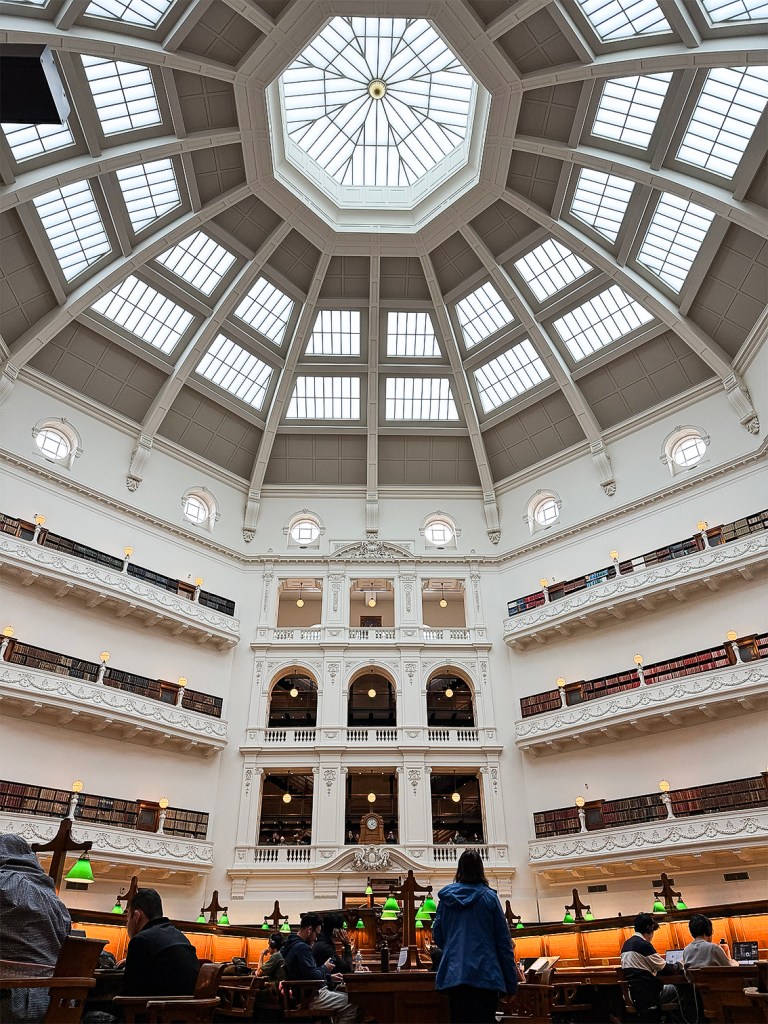
Beyond the Reading Room, the library became quieter and more contemplative. Polished timber floors, spacious galleries and carefully displayed artworks encouraged lingering rather than movement. The arrangement felt elegant without becoming imposing.
The State Library reminded us that a city can make room for reflection without withdrawing from modernity. What lingers in memory is the atmosphere, not any single painting, sculpture or shelf of books. Outside, trams rattle through streets lined with trees and towers; inside, beneath the great dome, minutes lose their usual importance. It is a place where the city slows its pace and lowers its voice.
But at that point of time in the beautiful city in the southern hemisphere, minutes were the scarcest commodity available to a group of travellers that were us.
One by one, I retrieved the twin bibliophiles—one from the gallery and the other from the La Trobe Reading Room. A consensus soon emerged that Flinders Street Station should be our next destination.
AI was promptly pressed into service for advice on tram routes and ticketing arrangements. Its guidance was precise and reassuring. As it happened, R subscribed to the view that information, however convincing, should occasionally be confirmed by a human being.
V accordingly intercepted a gentleman waiting for a tram on Swanston Street. His response was immediate: take Route 67. Unfortunately, he attached a rider.
“I too am a tourist.”
This revelation somewhat diminished the evidentiary value of his testimony. We thanked him nevertheless and withdrew for consultation. The family court assembled briefly on Swanston Street. AI remained confident. The tourist remained confident. We, however, remained unconvinced.
R argued that transport decisions ought not to rely exclusively upon either Artificial Intelligence or Accidental Intelligence. A second opinion was therefore deemed essential.
R had to rule that the matter remained unresolved.
How difficult is it to identify someone as a local in Melbourne?
Apparently, not very. A Melburnian obliged almost immediately.
How helpful is a Melburnian once identified?
Exceptionally helpful, as it turned out. The young woman selected for a second opinion not only confirmed the route but also volunteered the delightful information that public transport throughout Victoria was free until the end of May.
The verdict was now unanimous. The tourist received partial credit, the Melburnian full. R conceded that civilisation had not yet collapsed.
We advanced towards the tram stop with the confidence of explorers who had successfully solved a major navigational challenge, despite having travelled no more than a few hundred metres from where they had started.
This latest intelligence filled T with such enthusiasm, she developed a desire to board the first tram that appeared. Providence, always eager to encourage impulsive decisions, obliged with a Route 67 tram glistening in several shades of green. A casual onlooker could easily have mistaken T for a Melburnian. She boarded the tram with admirable indifference, casually rearranging her designer purse and the now customary tote bag, which by then had accompanied us through so many adventures that it seemed to possess its own travel itinerary. The rest of us followed and dispersed ourselves across the carriage. The tram was modern, comfortable and remarkably civil. As it glided away from Queensberry Street, I found myself admiring Australia’s determination not merely to preserve the trams, but to perfect them.
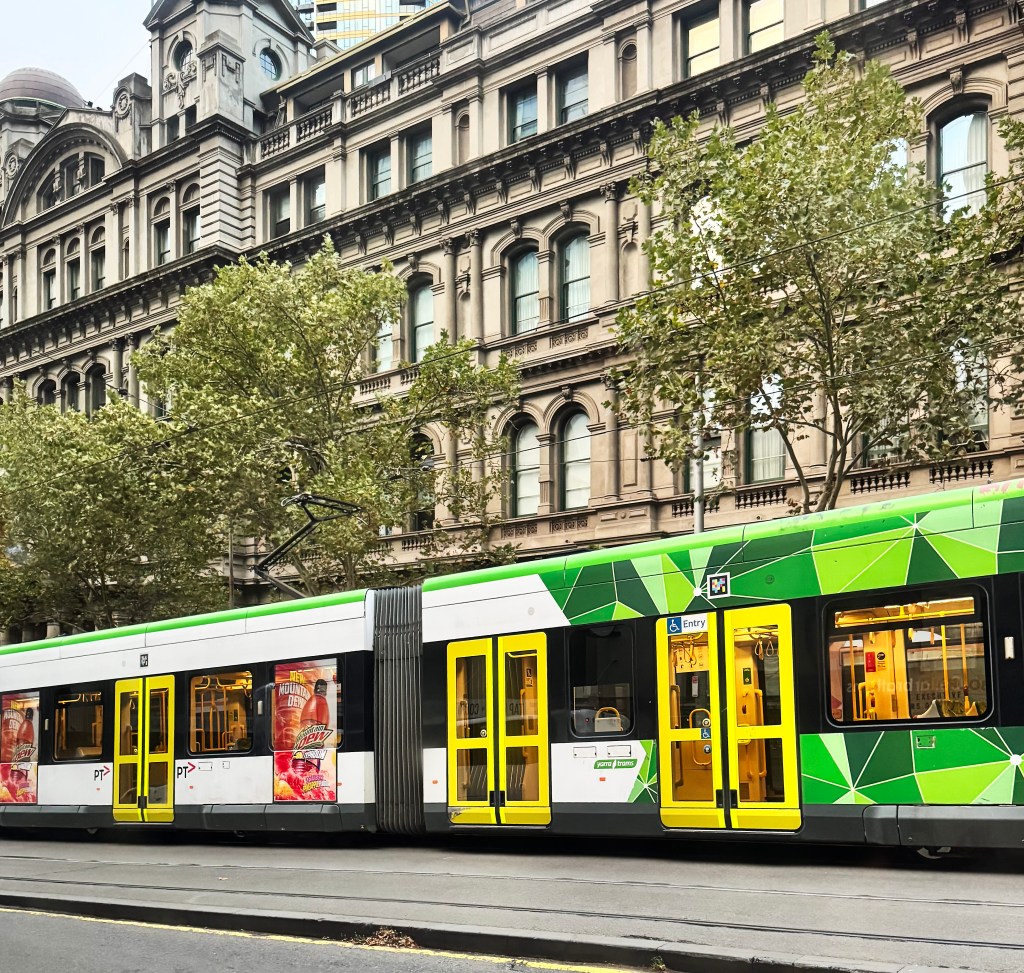
A short while later, Lincoln Square appeared as the next stop. Perhaps it had been announced as well. Either way, a disturbing realisation arrived at roughly the same time. Melbourne Central was not appearing. Bourke Street was not appearing. Flinders Street was certainly not appearing.
We were travelling confidently, comfortably, and entirely in the wrong direction.
There was no point delaying the inevitable. We disembarked at Lincoln Square, a pleasant green space populated largely by students and winter jackets. The breeze carried a chill edge, together with the occasional fleck of moisture. While we assessed our navigational achievements, the drizzle gathered confidence and began to mature into actual rain. Our collective gaze turned towards the girl with umbrellas. The girl was there but her tote bag was not.
The loss of the tote bag was lamented by all of us. It had accompanied the family for eight years, ever since its adoption from the souvenir shop at Jurong Bird Park in Singapore. Few objects survive long enough to become travelling companions. This one had achieved the distinction. Regrettable though its fate was, Melbourne offered little time for prolonged mourning. More urgent matters demanded our attention, including the exploration of a celebrated railway junction.
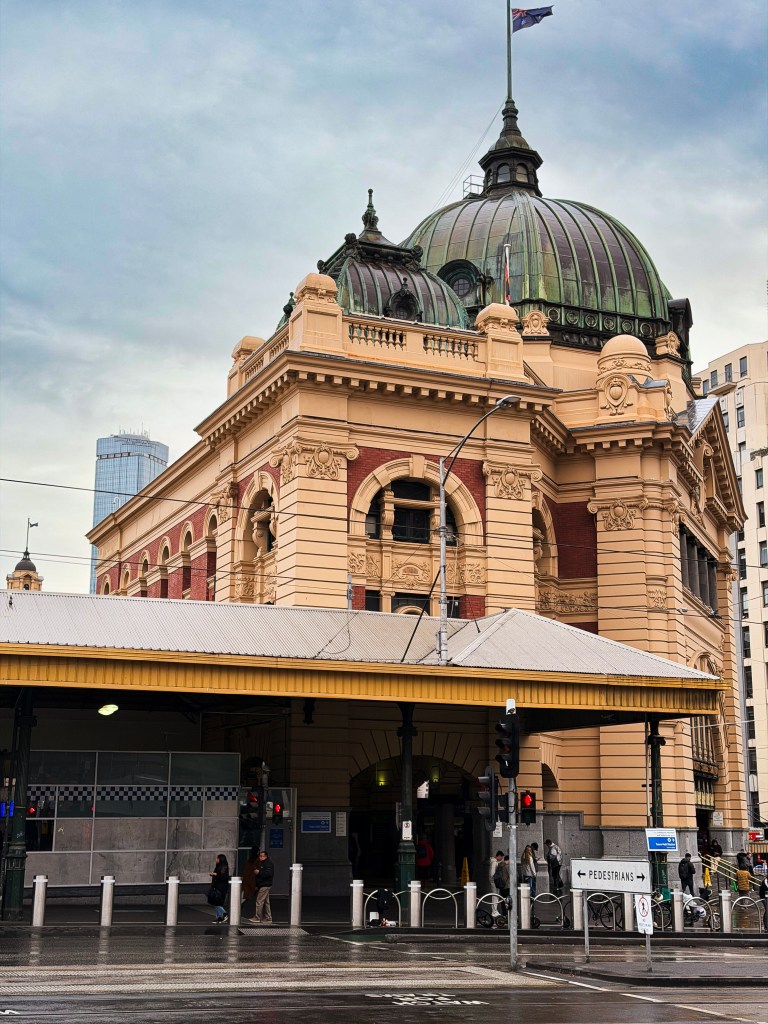
Flinders Street Station is not among the world’s largest railway stations, but few carry themselves with greater confidence. Above the entrance hung the station’s celebrated row of clocks. Along with the ochre dome and long Edwardian façade, they lent the station the reassuring permanence of a place that had watched generations come and go. Across the road, Federation Square responded in an entirely different architectural language, its restless geometry providing a counterpoint to the station’s old-world composure.
Flinders Street turned out to be more than a vital transport hub; it was also something of an unofficial town square. Beneath its clocks, people arrived, departed, reunited, lingered, and arranged their lives in miniature. Trams rattled past, pedestrians converged from every direction, and the city flowed through the intersection. Here, the trains were merely part of the moving scenery in Melbourne’s great theatre of human life.
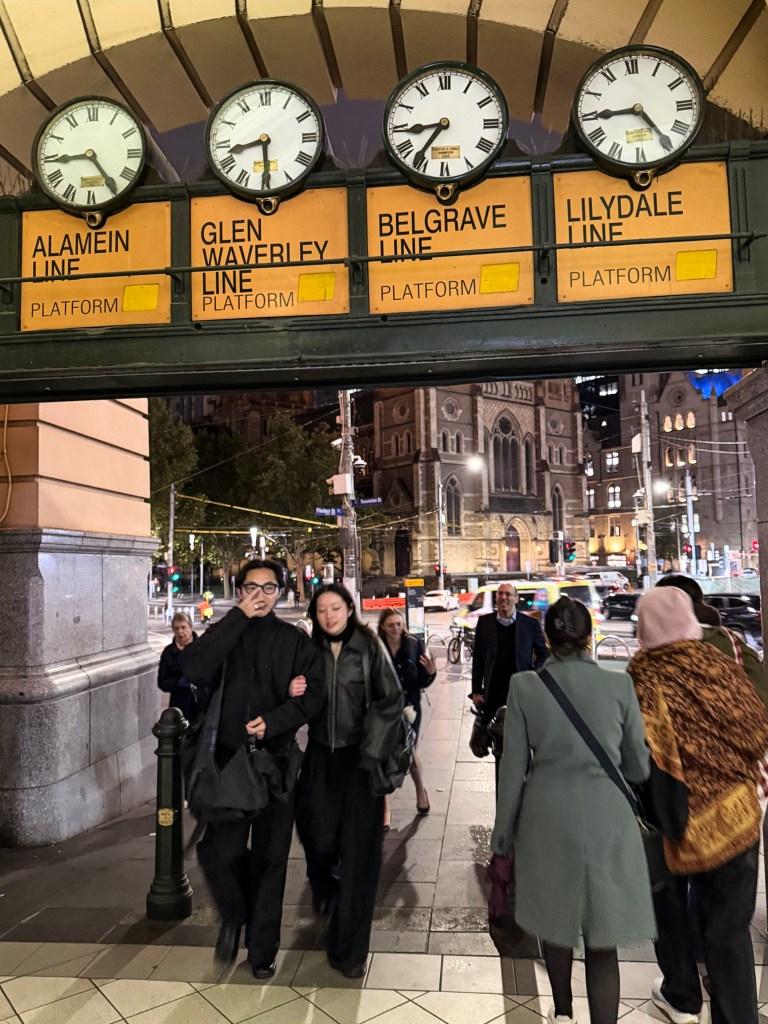
Public transport being free, we exercised our newly acquired rights with commendable enthusiasm. We wandered onto a platform of the Flinders Street Station without the slightest intention of boarding a train. Around us, the station wore its history lightly. The dark-green iron trusses and warm ochre brickwork had long witnessed the daily rituals of commuters, as well as stray travellers like us. Left to my own devices, I might well have boarded the next suburban train, travelled a few stations into Melbourne’s outer reaches, alighted for a suitably reflective interval, and then returned on the first service heading back to the city. Such diversions, however, belonged to a parallel universe in which time was abundant.
Federation Square and Australian Centre for the Moving Image still awaited inspection. More importantly, an Ultimate Experience at Melbourne Skydeck had already been booked and paid for, a circumstance that significantly reduced my freedom to disappear into the suburban rail network.
Crossing the road from Flinders Street, we stepped into Federation Square. It is arguably Melbourne’s principal public space and, quite possibly, a declaration of war against the straight line. If Flinders Street Station belongs to the age of clocks, domes, and punctual railway ambitions, Federation Square appears to have been designed by a committee of highly gifted triangles.
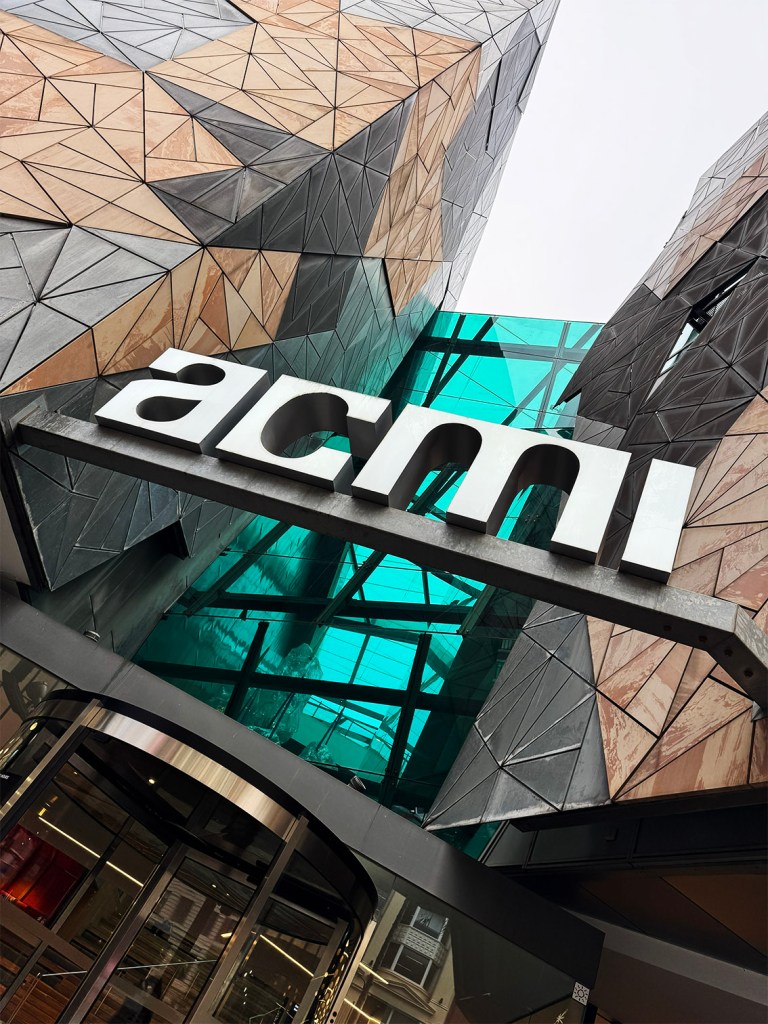
In this Square, almost nothing was straight or predictable. Buildings met at odd angles, their façades broken into restless patterns of glass, metal and stone. From almost every viewpoint, the place rearranged itself into a different picture. For all this visual restlessness, the square felt remarkably easy-going. People sat on the broad, rain-damp steps, talked, watched the passing crowds or simply rested awhile. Strings of lights crossed the open space overhead, while Melbourne’s uncertain sky hovered between rain and sunshine—enough to keep an umbrella close, but not quite enough to open it.
Within the Square, our finer destination was the Australian Centre for the Moving Image. Unfortunately, the centre had already decided that enough images had moved for one day and had closed before we arrived. Undeterred, we turned our attention to the building itself.
And what a building it was.
ACMI looked as though an architect had challenged a mathematician to design a building and then left him unsupervised. Triangles of glass, zinc and sandstone-coloured cladding marched across the façade in patterns that appeared different from every angle.
Dusk had descended and deepened. Somewhere beyond Federation Square and the gathering lights of the city, the Yarra was waiting.


I wandered around Melbourne without spending a dime! Such is the immersive quality of your travelogue. You have translated your visual memory into a delectable literary treat.
Looking at the photograph of ‘Operator 25’, what struck me was that ‘25’ written the way it is, resembles a telephone instrument from the bygone era. Then came the confirmation that the premises earlier housed Melbourne’s first telephone exchange.
Going in the wrong direction can definitely be a value addition to your travel experience, provided it does not derail any of your ‘paid’ excursions planned, further down the itinerary.
It appears that the twins, T and V (or is it V and T?), have quietly assumed command of the expedition. I look forward to accompanying you on many more literary excursions in the days to come.
I will be delighted to be in such esteemed company!
Your observation about the historical character of the font on the sign of Operator 25 is astute. It only testifies to their attention to detail.
After decades of serving as the planning head of the unit, I am glad to have passed the baton to T and V. It is not only a relief for my ageing brain, which now heats up faster than it once did, but also a refreshing arrangement that often yields satisfying results.
Till we meet again!
WOW! You should drop everything Uma and do nothing but write travel logs. It is fascinating, thrilling, unputdownable, and composed with such style as to make the rest of us look like plebs. I’ve never been to Australia – except to change planes – but I’m starting to feel that now I have!
Amazing travel experiences leave behind fascinating memories, though capturing them all can get tricky.
Thank you for the reverberating pat on the back. You may have unwittingly encouraged me to write even more travelogues. Just wait till I board a plane to New Zealand on another cheating airline!
Thank you so much, Bruce
New Zealand is a couple of corner stores and a few sheep!
I shall sit down at the corner stores and watch the sheep.
Wow. I’ve lived in and about Melbourne all my life. Congratulations – you have found so many things I would have wanted to show you. And you saw it with fresh eyes. I await tomorrows episode eagerly.
Approval from a discerning Melburnian is perhaps the finest endorsement I could have hoped for. I would love to know what features on your curated list for our next visit. Thank you so much.
The next episodes will follow, albeit at a slower pace. It’s an old processor here!
I’m so glad you found the Library. But you didn’t find the Supreme Court Library which is smaller but just as impressive.
I must admit that the Supreme Court Library was not on our radar, though finding time for everything we wanted to see proved quite impossible.
I’ve been here quite while and there is still a lot on my bucket list.
I am wearing a black dress in mourning for that lost tote bag.
I think your followers should all chip in to allow you and your family to tavel to may places, so we can be enthralled with your descriptive writing ✍.
I am torn between wanting the next episode right now, and not wanting the adventure to end.
Your grief for the tote bag is not misplaced. It was indeed a very dear companion. Thank you for your delicious compliment.
Fear not, the old phlegmatic processor here takes its own sweet time converting journeys into prose.
I laughed out loud at the Route 67 tram carrying you confidently in entirely the wrong direction — every family trip has that moment! But the lost tote bag from Jurong Bird Park genuinely tugged at me; eight years of travels is a real companion to lose. The La Trobe Reading Room dome and Operator 25 in an old telephone exchange both went straight onto our Melbourne list. Travelling with twins keeps you on your toes, doesn’t it?
You have touched the core of the travelogue. Thank you.
I’d get lonely travelling without the twins and R.
These are places I most likely will never see, and I am enjoying going along for the ride. I used to go to travelogues in a small theatre with a screen up front, and this is as good or better, as you include so many of the family issues that make it personal. The egalitarian way you make decisions as a family is fun to watch also.
I was most engaged with the library and it would have been difficult to leave so soon. I could spend days in there
So true! There are places that we might never visit, no matter how compelling they seem to be. I am so glad you have found a visual hook in my posts — it is a compliment that will encourage me endlessly.
Leaving that library was incredibly difficult. Just as you say, I too could have spent days there.
Another delightful chapter.
What I enjoyed most in this chapter was the family itself. The different personalities, the decision-making process, and the way everyone contributed to the journey made the story especially enjoyable. The travel experiences are memorable, but it is the family interactions that truly bring the narrative to life.
Thank you. We were certainly an interesting family, sharing our joys and quibbles with equal enthusiasm. Travelling together made the experience infinitely richer.
As usual, the cameras were served first. Definitely relatable. Your blogpost is like a piece of art. This one has become like a carefully curated multi course affair. Hence I do not attempt to read when busy. Loved every bit of the narration. Most of the lines have a poetic beauty. Another line that I loved : Beneath the clocks, people arrived, departed, reunited, lingered and arranged their lives in miniature.
Thank you for the heap of compliments, my friend.